









NEET-Related FAQs on Pisces: Classification, Examples, and Adaptations
Pisces, commonly known as fishes, is a fundamental topic in NEET Biology that every aspirant must understand thoroughly. This concept introduces students to a key group of chordates, explaining their features, classification, and biological significance. Mastery of Pisces lays the foundation for more advanced topics in animal kingdom and comparative anatomy which frequently appear in NEET questions. Building a clear conceptual understanding of Pisces will give you a strong edge in solving both direct and application-based questions in the exam.
What is Pisces? Definition and Meaning
Pisces is a major taxonomic group of aquatic, cold-blooded, vertebrate animals commonly known as fishes. They live exclusively in water, breathe through gills, move using fins, and have streamlined bodies ideal for swimming. Pisces are broadly classified under the phylum Chordata due to the presence of a notochord at some stage in their life cycle, and they represent the most primitive group of vertebrates. Understanding the features of Pisces helps students differentiate them from other animal groups, and forms the basis for studying higher chordates.
Core Ideas and Fundamentals of Pisces
General Characteristics of Pisces
Pisces exhibit certain key characteristics that set them apart from other vertebrates:
- They are exclusively aquatic animals, found in both freshwater and marine environments.
- Body is typically streamlined, which reduces resistance during swimming.
- Fishes respire mainly through gills rather than lungs.
- They are poikilothermic (cold-blooded), meaning their body temperature varies with the environment.
- Most have fins for locomotion and control while swimming.
- The body is generally covered by scales, which can differ in structure across different groups.
Economic and Biological Importance
Fishes are not just important from a biological viewpoint, but also have great ecological, nutritional, and economic value. They play critical roles in aquatic ecosystems and are a major source of protein for humans worldwide.
Key Sub-concepts Related to Pisces
Classification of Pisces
Pisces are primarily divided into two classes based on the type of skeleton and other structural differences:
- Chondrichthyes (Cartilaginous fishes): Their endoskeleton is made up of cartilage. Examples include sharks, rays, and skates.
- Osteichthyes (Bony fishes): Their endoskeleton is mainly bony. Examples include rohu, catla, tilapia, and seahorse.
Types of Scales in Fishes
The type of scales covering the body is a distinctive feature used to classify and identify fishes:
- Placoid Scales: Small, tooth-like structures found mostly in cartilaginous fishes (e.g., shark and rays).
- Ctenoid, Cycloid, and Ganoid Scales: Varieties found in bony fishes, each having unique structures and purposes.
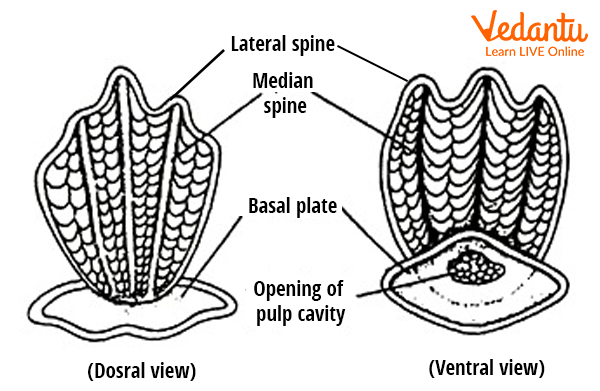
The diagram above shows the structure of placoid scales, which resemble tiny teeth and provide a rough texture to the skin of cartilaginous fishes.
Respiratory and Circulatory Systems
Pisces have a highly specialized respiratory system featuring gills. Their circulatory system is typically single-circuit, with a two-chambered heart (one atrium and one ventricle), which is a fundamental difference from higher vertebrates.
Principles, Rules, and Relationships in Pisces
While there are no direct mathematical formulas for Pisces, understanding certain biological rules and relationships is crucial:
- Pisces exhibit single circulation of blood - blood passes through the heart only once for each complete circuit of the body.
- The counter-current exchange mechanism in gills maximizes oxygen absorption by letting water and blood flow in opposite directions through the gill lamellae.
These principles explain why fishes are so efficient at extracting oxygen from water, a key survival adaptation.
Essential Features and Characteristics of Pisces
- Mostly oviparous (egg-laying), though some show ovoviviparity or viviparity.
- Fertilization is usually external, especially in bony fishes; internal in many cartilaginous fishes.
- Lateral line organs help detect vibrations in water - an adaptation for aquatic life.
- Body shows clear segmentation of head, trunk, and tail.
- Swim bladder in many bony fishes helps in buoyancy regulation; absent in cartilaginous fishes.
Why is Pisces Important for NEET?
Pisces is a highly tested topic in NEET Biology. It acts as the base for understanding animal kingdom, vertebrate evolution, comparative anatomy, and physiology. NEET often features questions on distinguishing traits, classification, examples, adaptations, and unique features of Pisces. Mastery over this topic also sharpens your ability to compare chordates and recognize patterns among animal groups, which is a core skill for higher-level Biology questions. Knowing Pisces thoroughly helps prevent confusion with amphibians and other aquatic vertebrates, reducing errors in MCQs.
How to Study Pisces Effectively for NEET
- Start with understanding general features and classification before going into details of each class.
- Use diagrams (like placoid scales) to visualize structures and differences.
- Compare Chondrichthyes and Osteichthyes side-by-side to remember their key differences.
- Relate adaptations (like swim bladder, lateral line, gill structure) to the aquatic habitat.
- Practice NCERT and NEET-level MCQs on characteristics, examples, and adaptations.
- Revise frequently using self-made charts, tables, and diagrams.
- Clear misconceptions about scales, respiration, or reproduction through teacher/expert explanation if needed.
Common Mistakes Students Make in Pisces
- Confusing the features of Chondrichthyes and Osteichthyes.
- Mixing up the types of scales and their corresponding fish classes.
- Incorrectly identifying respiratory and circulatory adaptations unique to fishes.
- Forgetting key examples or misclassifying fishes in MCQs.
- Neglecting the evolutionary significance of certain features like lateral line or swim bladder.
Quick Revision Points: Pisces
- Pisces are aquatic, cold-blooded vertebrates with gills and fins.
- Chondrichthyes have cartilaginous skeletons and placoid scales; Osteichthyes have bony skeletons with other scale types.
- Fertilization is external in most bony fishes, internal in cartilaginous fishes.
- Single circulation; heart has two chambers.
- Swim bladder (for buoyancy) is present in most bony fishes but absent in cartilaginous fishes.
- Placoid scales are unique to cartilaginous fishes.
- Remember key examples from both classes for MCQs.
FAQs on Pisces in NEET Biology: Classification, Features, and Importance
1. What are Pisces in biology?
Pisces are a major class of aquatic vertebrates commonly known as fishes in biology.
Key features of Pisces include:
- Cold-blooded, aquatic animals
- Bodies covered with scales
- Respirores using gills
- Presence of fins for movement
- Distinct streamlined body shape
2. What are the main characteristics of Pisces?
Pisces possess several unique characteristics that help to classify them as fishes.
- Aquatic habitat: Live in both freshwater and marine environments
- Streamlined body: Designed for efficient swimming
- Covering of scales
- Cold-blooded (poikilothermic)
- Breathe through gills
- True fins for movement
3. How are Pisces classified in the animal kingdom?
Pisces are classified as a superclass under the phylum Chordata.
- Placed under Kingdom Animalia
- Phylum Chordata
- Superclass Pisces
- Two major classes:
- Chondrichthyes (cartilaginous fishes)
- Osteichthyes (bony fishes)
4. What is the difference between Chondrichthyes and Osteichthyes?
The main difference between Chondrichthyes and Osteichthyes is the type of skeleton.
- Chondrichthyes: Have a cartilaginous skeleton (e.g. Sharks, Rays)
- Osteichthyes: Have a bony skeleton (e.g. Rohu, Tuna)
- Other differences include types of scales, gill slits, and reproductive features
5. Which organisms belong to Pisces? Provide examples.
Organisms classified as Pisces include a wide range of fishes.
- Shark (Chondrichthyes)
- Ray (Chondrichthyes)
- Rohu (Osteichthyes)
- Tuna (Osteichthyes)
- Eel (Osteichthyes)
6. How do Pisces breathe underwater?
Pisces breathe underwater using specialized gills that extract oxygen from water.
- Water enters through the mouth
- Passes over gill filaments
- Oxygen is absorbed; carbon dioxide is expelled
7. What is the importance of Pisces in the ecosystem?
Pisces play an essential ecological role in maintaining aquatic food chains and ecosystems.
- Control population of smaller organisms
- Act as prey for larger aquatic and terrestrial predators
- Help in nutrient recycling in water bodies
- Important for commercial fishing and human food supply
8. What are the adaptations of Pisces for an aquatic life?
Pisces show several adaptations allowing them to thrive in aquatic environments.
- Streamlined body to reduce water resistance
- Fins for swimming and balancing
- Gills for underwater respiration
- Swim bladder (in many bony fishes) for buoyancy
- Mucus-covered scales to reduce friction
9. What is the role of swim bladder in Pisces?
The swim bladder helps many bony fishes (Pisces) maintain buoyancy in water.
- Acts as a gas-filled sac
- Allows fish to float at desired depths without sinking
- Helps conserve energy
10. State two economic importance of Pisces.
Pisces have significant economic importance, especially in fisheries and medical research.
- Fisheries industry: Major source of food (protein), employment, and export revenue
- Medical research: Source of compounds for drugs and vaccines
11. Explain why Pisces are considered cold-blooded animals.
Pisces are called cold-blooded because their body temperature matches their surroundings.
- They cannot regulate internal temperature
- Body temperature varies with water temperature
12. What is meant by lateral line system in Pisces?
The lateral line system in Pisces is a sensory organ used to detect vibrations and movement in water.
- Runs along the side of the fish's body
- Helps detect predators, prey, and obstacles
