









Human Ear Physiology in NEET: How Sound is Detected and Processed
The human ear is a key sensory organ responsible for hearing and balance. For NEET aspirants, understanding the structure, function, and working mechanism of the ear is fundamental as it connects with many principles of human physiology. This topic is conceptually important for Biology and often forms the basis of exam questions that test both memory and applied understanding. Building a clear conceptual foundation about the human ear helps you answer NEET questions with confidence and avoid common mistakes.
What is the Human Ear?
The human ear is a complex organ that not only enables us to detect sounds but also plays a critical role in maintaining our balance. Structurally, the ear can be divided into three main regions - external ear, middle ear, and inner ear - each with unique functions vital to auditory perception and equilibrium. For NEET, knowing how these sections work together and support human physiology is crucial for both direct and application-based questions.
Core Ideas and Fundamentals of the Human Ear
Basic Structure of the Human Ear
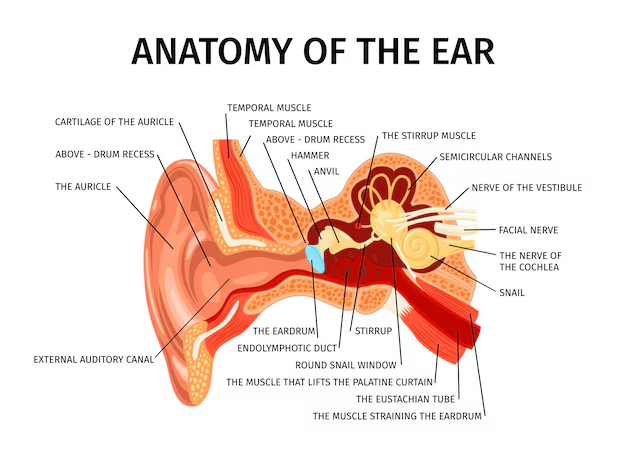
The human ear is anatomically divided into three regions:
- External Ear - collects sound waves and channels them towards the ear drum
- Middle Ear - amplifies and conveys vibrations from the ear drum to the inner ear
- Inner Ear - transforms vibrations into nerve signals and also helps maintain balance
Here is an image showing the detailed structure of the ear for better understanding:
How Sound Travels Through the Ear
Sound waves enter through the external ear and travel along the auditory canal until they hit the tympanic membrane (ear drum), causing it to vibrate. These vibrations are transferred through the middle ear via three tiny bones called ossicles (malleus, incus, stapes). The stapes then passes these vibrations to the inner ear, specifically the cochlea, where they are converted into electrical impulses that the brain interprets as sound.
Role in Balance
The inner ear houses not only the hearing apparatus but also the vestibular system, which is responsible for maintaining body balance and spatial orientation. This is an area frequently asked about in NEET, especially in relation to the function of semicircular canals and otolith organs.
Important Sub-Concepts Related to the Human Ear
External Ear Components
Consists of the pinna (auricle) and external auditory canal. The pinna collects and directs sound waves while the canal channels them toward the tympanic membrane.
Middle Ear Components
Contains the tympanic membrane and ossicles (malleus, incus, stapes). The Eustachian tube connects the middle ear to the throat, equalizing pressure.
Inner Ear Components
Made up of the cochlea (hearing organ), semicircular canals, utricle, and saccule (all involved in balance). The cochlea transforms sound vibrations into nerve signals for the brain to process.
Pathway of Hearing (Auditory Pathway)
The hearing pathway involves sequential transmission from the external ear, through the middle ear ossicles, into the cochlea, and finally via the auditory nerve to the brain (temporal lobe cortex).
Key Relationships and Principles in the Human Ear
While the ear does not involve major mathematical formulas, it is essential to understand key principles:
- Impedance Matching: The ossicles in the middle ear amplify sound vibrations, enabling effective transfer from air (external/middle ear) to fluid (inner ear).
- Tonotopic Organization: Specific areas of the cochlea are sensitive to different pitches (high or low frequency sounds).
- Hair Cells Function: Specialized receptor cells in the cochlea and vestibular system convert mechanical vibrations or motion into electrical signals.
- Balance Principle: The semicircular canals detect angular movements, while the otolith organs detect linear acceleration and head position.
Functions and Features of the Human Ear
- Detects and transmits sound signals to the brain for hearing.
- Protects inner structures from physical damage and infection.
- Maintains body balance and orientation (vestibular function).
- Equalizes air pressure between external environment and middle ear via the Eustachian tube.
Why is the Human Ear Important for NEET?
The human ear is a frequent focus in NEET Biology questions, as it combines anatomy, physiology, and neurobiology. Understanding its structure and function is required for direct questions on hearing and balance, as well as application-based MCQs connecting ear disorders, sensory transduction, and neural pathways. Mastery of this topic enables better performance in human physiology, neural control, and special senses chapters. Since the ear also illustrates many principles of signal processing and coordination, it ties together concepts across organ systems, making it essential for both conceptual clarity and high NEET scores.
How to Study the Human Ear Effectively for NEET
- Review labelled diagrams of the human ear to memorize components and their sequence.
- Understand the stepwise process of hearing and how sound vibrations are converted into nerve impulses.
- Relate the roles of different parts (e.g., ossicles, cochlea, semicircular canals) to their function in hearing and balance.
- Revise sub-concepts like auditory nerve, Eustachian tube, and hair cells using flow diagrams or concept maps.
- Practice NEET-level MCQs on human sensory organs, especially those involving structure-function relationships in the ear.
- Use mnemonics to remember order (malleus-incus-stapes) and function of ossicles.
- Clear conceptual doubts through NCERT diagrams and video explanations if needed.
- Attempt previous year NEET questions and time yourself for better retention and exam practice.
Common Mistakes Students Make in This Concept
- Confusing the order or names of the ossicles (malleus, incus, stapes).
- Mixing up the roles of cochlea (hearing) and semicircular canals (balance).
- Incorrectly labelling ear diagrams or forgetting important components.
- Neglecting the function of the Eustachian tube in pressure equalization.
- Ignoring application-based questions on hearing loss or balance disorders.
Quick Revision Points for the NEET Human Ear Concept
- Ear is divided into external, middle, and inner parts; each has specific functions.
- Ossicles (malleus, incus, stapes) are key for amplification of sound vibrations.
- Cochlea is responsible for converting vibrations to nerve impulses for hearing.
- Semicircular canals, utricle, and saccule are essential for body balance.
- Eustachian tube maintains equal air pressure on both sides of the ear drum.
- Correct labelling of ear diagrams is important in NEET exams.
- Understanding the auditory pathway helps in solving application-based questions.
FAQs on Human Ear NEET Biology: Understanding Structure and Functions
1. What is the structure and function of the human ear in NEET syllabus?
The human ear consists of three main parts—external, middle, and inner ear—that work together to help us hear and maintain balance, which is crucial across NEET Biology questions.
Key details include:
- External ear: Comprised of the pinna and auditory canal, it collects sound waves.
- Middle ear: Contains the tympanic membrane and ear ossicles (malleus, incus, stapes), transmitting vibrations to the inner ear.
- Inner ear: Includes the cochlea for hearing and the vestibular apparatus for balance.
2. How does the human ear help in maintaining balance?
The human ear maintains balance using its vestibular apparatus, an important NEET Biology topic.
The main points are:
- Vestibule and semicircular canals detect head movement and position.
- Contains fluids (endolymph) and sensory hair cells that sense motion.
- Nerve impulses from the inner ear travel to the brain to regulate balance.
3. What is the function of the cochlea in the human ear?
The cochlea is the spiral-shaped part of the inner ear responsible for converting sound vibrations into nerve impulses required for hearing.
Key features for NEET:
- Sound vibrations cause movement in cochlear fluids.
- Hair cells in the Organ of Corti detect these vibrations and produce nerve signals.
- The signals travel via the auditory nerve to the brain for sound interpretation.
4. Name the parts of the human ear and their respective functions for NEET.
The human ear is divided into three parts, each with specific features and functions relevant to NEET:
- External ear: Pinna (collects sound), auditory canal (conducts sound waves).
- Middle ear: Tympanic membrane (vibrates with sound), ossicles (amplify vibrations).
- Inner ear: Cochlea (hearing), vestibular apparatus (balance).
5. Explain the mechanism of hearing in the human ear.
The hearing mechanism in humans involves sound wave collection, vibration transmission, and signal generation.
Steps are:
- Pinna funnels sound into the ear canal.
- Vibrations hit the tympanic membrane (eardrum).
- Ear ossicles (malleus, incus, stapes) amplify these vibrations.
- Cochlea transduces vibrations into nerve impulses.
- The auditory nerve transmits signals to the brain.
6. What are ear ossicles and what is their role?
Ear ossicles are three tiny bones in the middle ear (malleus, incus, stapes) that transmit and amplify sound vibrations from the eardrum to the inner ear.
Main points for NEET learners:
- Malleus (hammer)
- Incus (anvil)
- Stapes (stirrup)
7. How is sound transmitted from the ear to the brain?
Sound transmission to the brain occurs through a series of steps involving physical and neural processes, key for NEET aspirants:
- Sound waves are collected by the pinna.
- Vibrations pass through the tympanic membrane to the ossicles.
- Ossicles transmit vibrations to the cochlea.
- Hair cells in the cochlea convert vibrations to electrical impulses.
- Electrical signals are sent to the brain via the auditory nerve.
8. What happens if the eustachian tube is blocked?
Blockage of the eustachian tube disrupts pressure balance, which can impact hearing and cause discomfort, important for NEET understanding.
Consequences include:
- Impaired sound transmission
- Ear pain or a sensation of fullness
- Increased risk of infection (otitis media)
- Hearing loss (temporary or persistent)
9. What is the difference between the auditory nerve and the vestibular nerve?
The auditory nerve carries impulses related to hearing, while the vestibular nerve carries information about balance.
For NEET Biology, key differences include:
- Auditory nerve: Transmits sound signals from the cochlea to the brain.
- Vestibular nerve: Transmits balance and spatial orientation data from the vestibular apparatus to the brain.
10. What are common ear disorders relevant for NEET?
Common ear disorders include conditions affecting hearing and balance, often asked in NEET exams.
Common disorders are:
- Otitis media (middle ear infection)
- Deafness (partial/complete hearing loss)
- Tinnitus (ringing sensation)
- Meniere's disease (vertigo and hearing loss)
