









Obtuse Angle Definition Degree Range Properties and Examples
Before we answer the question, let’s understand what an angle is. An angle is a fundamental part of geometry that has been used as an important aspect of architecture and engineering for a long time. We use them to measure changes in the path of motion of ships, stars, airplanes, etc.
But, how do they form?
Angles are formed when two rays or lines intersect at a point. There are different types of Angles in geometry. In this article, we will discuss Obtuse Angles.
Obtuse Angle: Definition
A simple definition of an obtuse angle is “an angle which is greater than 90o but less than 180o.” Or, we can also say that “it is the angle formed when a ray rotates between 90o and 180o around a point.”
During the day, we can see a clock forming many obtuse angle degrees between the minute hand and the hour hand. Let us understand more about the obtuse angles and their properties.
Obtuse Angle Pic
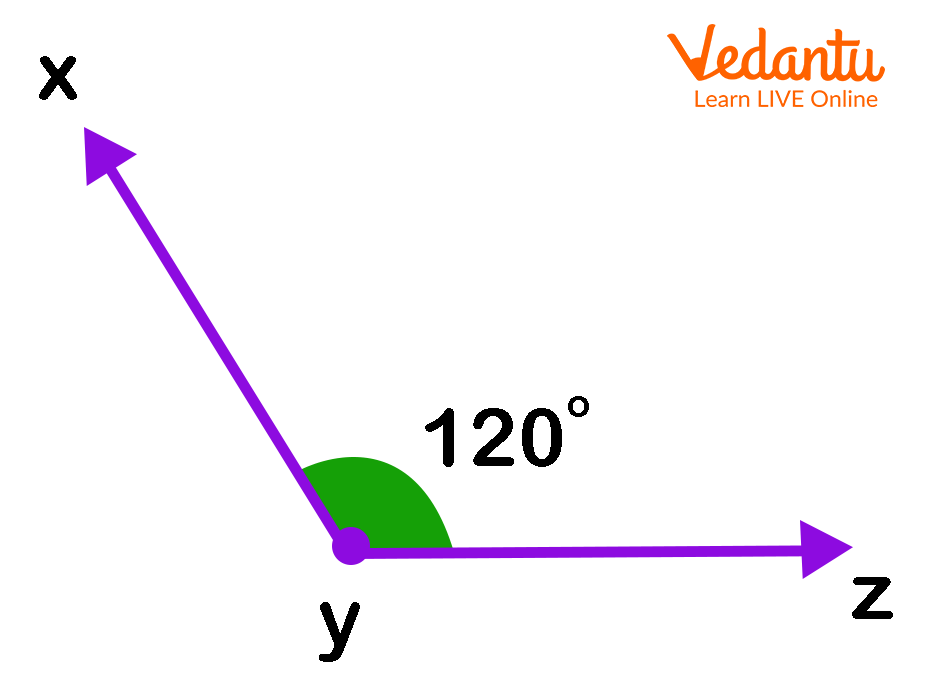
Obtuse angle measuring 120o.
Obtuse Angles in Real Life
Below are some real-life examples of obtuse angles.
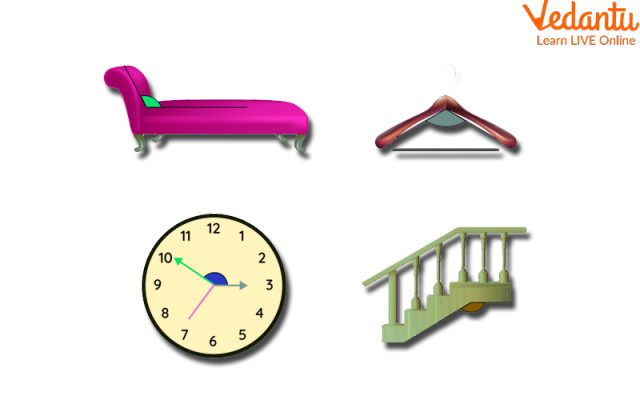
Obtuse Angle Pictorial representation
If we look up the sofa or other objects and the highlighted angles, then we observe that the angle formed is greater than the right angle, i.e., 90o but less than the straight angle, i.e., 180o. So, these objects are examples of obtuse angles.
Properties of an Obtuse Angle
The angles always range from 90o and 180o. It means an obtuse angle is greater than 90 degrees and smaller than a straight angle that is 180 degrees.
This angle will resemble a quarter of the circle but not half of the circle.
If we divide the circle into four pieces, an obtuse angle will occupy between \[\frac{1}{4}\] and \[\frac{1}{2}\] of a circle.
In an obtuse triangle, there will always be an obtuse angle.
Conclusion
An obtuse angle is defined as 'an angle whose measure is larger than 90° but less than 180o'. A protractor can be used to measure or draw an obtuse angle. This is a helpful tool that students will learn to use in geometry lessons.
To learn more geometrical concepts or any other mathematical concepts, explore our website.
FAQs on What Is an Obtuse Angle in Geometry
1. What is an obtuse angle?
An obtuse angle is an angle that measures more than 90° and less than 180°. It is wider than a right angle but smaller than a straight angle. In geometry, obtuse angles are commonly found in triangles, polygons, and real-life shapes such as open doors or roof slopes.
2. How many degrees is an obtuse angle?
An obtuse angle measures greater than 90° and less than 180°. This means its degree measure lies between these two values but does not include 90° or 180°.
- Example: 120° is an obtuse angle.
- Example: 150° is an obtuse angle.
- 90° (right angle) and 180° (straight angle) are not obtuse.
3. What is the difference between an acute, right, and obtuse angle?
The difference between acute, right, and obtuse angles is based on their degree measures.
- Acute angle: less than 90°
- Right angle: exactly 90°
- Obtuse angle: more than 90° but less than 180°
4. How do you identify an obtuse angle?
You identify an obtuse angle by checking if its measure is greater than 90° and less than 180°. To determine this:
- Measure the angle using a protractor.
- If the reading is above 90° but below 180°, it is obtuse.
- Visually, it appears wider than a right angle.
5. Can a triangle have an obtuse angle?
Yes, a triangle can have one obtuse angle, and such a triangle is called an obtuse triangle. In an obtuse triangle:
- One angle is greater than 90°.
- The other two angles are acute.
- The sum of all interior angles is always 180°.
6. What is an example of an obtuse angle?
An example of an obtuse angle is an angle measuring 120°. Since 120° is greater than 90° and less than 180°, it satisfies the definition of an obtuse angle. Other examples include 100°, 135°, and 170°.
7. Is 180 degrees an obtuse angle?
No, 180° is not an obtuse angle; it is a straight angle. An obtuse angle must be strictly less than 180° but greater than 90°. Therefore, 179° is obtuse, but 180° is not.
8. What is the formula for an obtuse angle?
There is no special formula for an obtuse angle, but its defining condition is 90° < θ < 180°. In geometry problems, you may find an obtuse angle using angle sum properties.
- In a triangle: Angle 1 + Angle 2 + Angle 3 = 180°.
- If one angle is more than 90°, it is obtuse.
9. Can an obtuse angle be a reflex angle?
No, an obtuse angle cannot be a reflex angle because their degree ranges are different. An obtuse angle measures between 90° and 180°, while a reflex angle measures greater than 180° and less than 360°. Since these ranges do not overlap, an angle cannot be both.
10. Where are obtuse angles used in real life?
Obtuse angles are commonly seen in real life in structures and everyday objects where the angle is wider than 90° but less than 180°.
- An open door wider than a right angle.
- Roof designs and architectural shapes.
- Hands of a clock at certain times (e.g., 4:00).
