









Why tan 180 Degrees Equals 0 Using Unit Circle Proof
Sine, cosine, tangent, cosecant, secant, and cotangent are the six trigonometric functions. There are numerous identities involving these six trigonometric functions that are used to solve many mathematical problems, and they are all related to one another in some way.
Sine, cosine, and tangent are the three fundamental among them because we can derive the other three using these fundamental functions. Secant is the reciprocal of cosine, cotangent is the reciprocal of a tangent, and cosecant is the reciprocal of sine. While tangent and cotangent have a periodicity of $\pi$, sine, cosine, secant, and cosecant have a periodicity of $2\pi$.
What is the Value of tan 180?
In Trigonometry, the measurement of tan 180 degrees equals 0. The \[\tan{180}^{\circ}\] can also be represented by 3.14159, which is the spherical geometry equivalent to the specific angle of 180 degrees.
How to Calculate Tan Value at 180 Degrees?
In this section, we will learn methods to find the value \[\tan{180}^{\circ}\].
The method for determining $\tan 180$ degree is as follows:
Making Use of Trigonometric Functions
Using Unit Circle
Value of Tan 180 Degrees Using Unit Circle
The \[\tan{180}^{\circ}\] can be expressed as $\tan \pi$ in a circular notation.
We already know that the tan can be written as \[\dfrac{\text{sin}}{\text{cos}}\]. The tan 180 value can be obtained from the unit circle using this relationship.
We can calculate the tangent values for each degree for a unit circle with a radius of 1. We can determine all the trigonometric ratios and values by using a unit circle drawn on the XY plane.
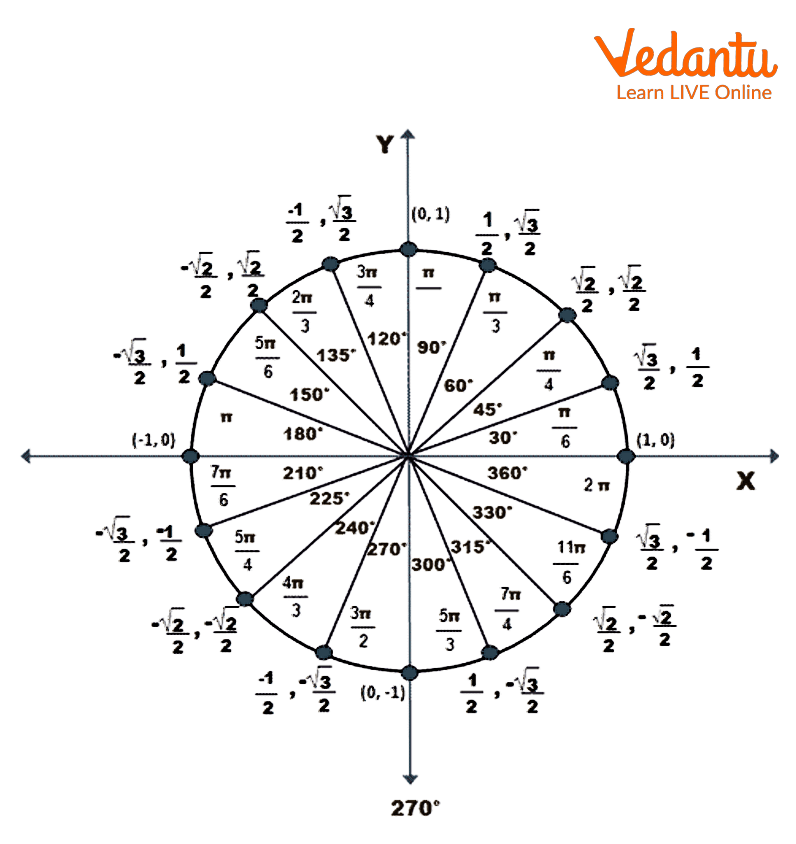
Value of Tan 180 Degrees on the Unit Circle
We know,
\[\sin 180^0=0\] and \[\cos 180^0 = -1\]
Therefore, \[\tan 180^0 = \dfrac{\sin 180^0}{\cos 180^0}\]
$=\dfrac{0}{-1}=0$
Value of Tan 180 Degrees Using Trigonometric Functions
In trigonometric ratios of angles \[(180\cos 180^{\circ}- \theta)\], we will find the relation between all six trigonometric ratios.
We know that
\[\sin (90^0 + \theta) = \cos \theta\]
\[\cos (90^0 + \theta) = - \sin \theta\]
\[\tan (90^0 + \theta) = - \cot \theta\]
\[\csc (90^0 + \theta) = \sec \theta\]
\[\sec ( 90^0 + \theta) = - \csc \theta\]
\[\cot ( 90^0 + \theta) = - \tan \theta\]
and
\[\sin (90^0 - \theta) = \cos \theta\]
\[\cos (90^0 - \theta) = \sin \theta\]
\[\tan (90^0 - \theta) = \cot \theta\]
\[\csc (90^0 - \theta) = \sec \theta\]
\[\sec (90^0 - \theta) = \csc \theta\]
\[\cot (90^0 - \theta) = \tan \theta\]
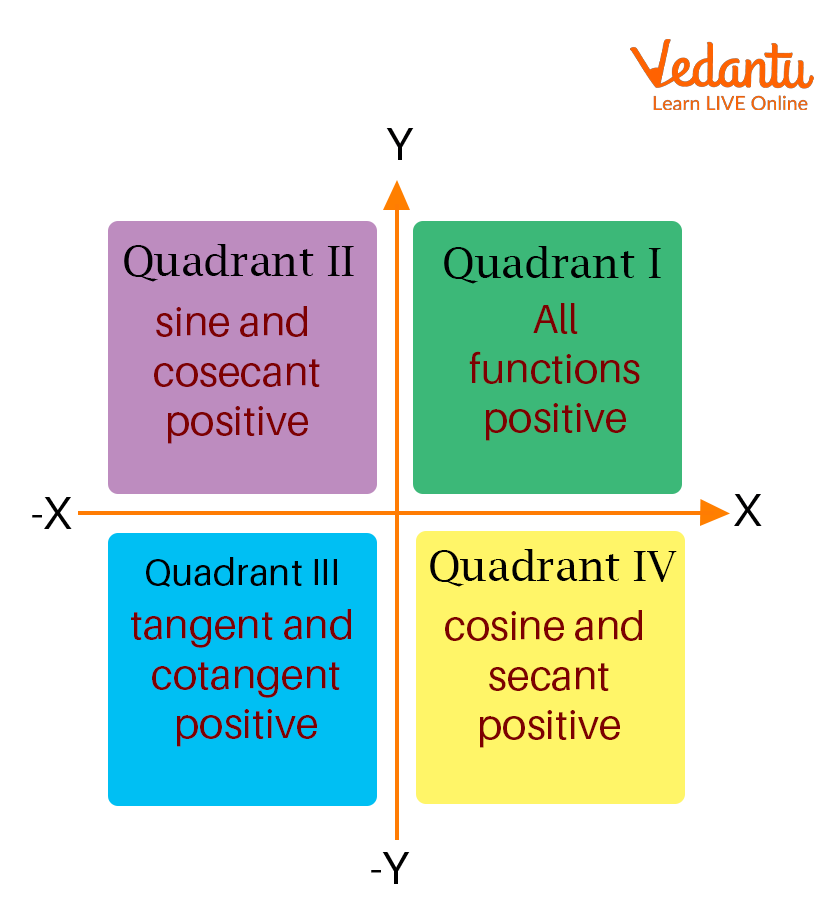
Trigonometric Ratios in Quadrants
Now, \[180^0\] can be mathematically defined as \[tan(90^0 + 90^0)\].
According to the above image, \[tan(90^0 + A)\] is located in the second quadrant, so the tan is positive.
\[= – \cot 90^0\]
\[= –\dfrac{(\cos 90^0)} { \sin 90^0)}\]
\[= – \dfrac{0}{1}\]
\[= 0\]
Consequently, \[\tan 180^0 = 0\]
Alternately, \[\tan 180^0\] can be calculated as:
\[\tan 180^0 = \tan(180^0 – 0) = – \tan 0^0 = 0\]
Solved Examples
Example 1: Find the value of tan 1200.
Solution: \[\tan 120^0 = \tan(180^0 – 60^0)\]
\[= –\ tan 60^0\]
$= – \sqrt{3}$
So, the value of $\tan 120^0$ is $-\sqrt{3}$
Example 2: Evaluate 2tan1800 - tan1500.
Solution: \[2 \tan180^0 - \tan150^0\]
\[= 2\ tan 180^0 - \tan(180^0 -30^0\]
\[= 2(0) - (-\tan 30^0)\]
\[= 0 + \tan 30^0\]
\[= \dfrac{1}{\sqrt{3}}\]
So, the value of $2\tan180^0 – \tan150^0$ is $= \dfrac{1}{\sqrt{3}}$
Example 3: Find tan1800 + cot 450.
Solution: The value of \[\tan 180^0 = 0\] and \[\cot 45^0 = 1\].
Therefore,
\[\tan 180^0 + \cot 45^0\]
$= 0 + 1 = 1$
So, the value of $\tan 180^0 + \cot 45^0$ is 1.
Example 4: Find the value of tan2400.
Solution: \[\tan 240^0= tan (180 + 60)^0\]
\[= tan 60^0\]
We know \[\tan (180^{\circ} + \theta) = tan \theta\]
$ = \sqrt{3}$
So, the value of $\tan 240^0$ is $ = \sqrt{3}$
Practice Problem
Q 1. Find sec 1500.
Q 2. Find tan 1200 + cot 450.
Answer
$\dfrac{-2}{\sqrt{3}}$
$1-\sqrt{3}$
Conclusion
To summarise, the measurement of tan 180 degrees equals 0. $\tan 180 °$ can also be represented by 3.14159, which is the spherical geometry equivalent to the specific angle of 180 degrees. The cot of an angle is the reciprocal of a tan. We hope this article helped you understand how to find the value of $\tan 180$ degrees. Take out a pencil and piece of paper and try to practise the questions given above in this article by yourself.
FAQs on What Is the Value of Tan 180 Degrees
1. What is the value of tan 180°?
The value of tan 180° is 0.
This is because:
- tan θ = sin θ / cos θ
- sin 180° = 0
- cos 180° = −1
2. Why is tan 180° equal to 0?
Tan 180° equals 0 because the sine of 180° is zero.
Using the identity:
- tan θ = sin θ / cos θ
- sin 180° = 0
- cos 180° = −1
3. What is the value of tan 180 in radians?
The value of tan π radians is 0.
This is because:
- 180° = π radians
- tan π = sin π / cos π
- sin π = 0 and cos π = −1
4. How do you find the value of tan 180° using the unit circle?
Using the unit circle, tan 180° is 0 because the y-coordinate is zero at that angle.
On the unit circle:
- The point at 180° is (−1, 0)
- tan θ = y/x
5. Is tan 180° positive or negative?
Tan 180° is neither positive nor negative; it is 0.
Since:
- sin 180° = 0
- cos 180° = −1
6. What is the exact value of tan 180°?
The exact value of tan 180° is 0.
This is an exact trigonometric value, not a decimal approximation. It follows directly from the identity:
- tan θ = sin θ / cos θ
7. How is tan 180° related to tan 0°?
Tan 180° and tan 0° are equal because both values are 0.
This happens because:
- sin 0° = 0 and sin 180° = 0
- cos 0° = 1 and cos 180° = −1
8. What is the formula used to calculate tan 180°?
The formula used to calculate tan 180° is tan θ = sin θ / cos θ.
Applying it:
- sin 180° = 0
- cos 180° = −1
9. What quadrant does 180° lie in and how does it affect tan 180°?
The angle 180° lies on the negative x-axis, between Quadrant II and III, and its tangent value is 0.
At 180°:
- The coordinate is (−1, 0)
- tan θ = y/x = 0/(−1)
10. Is tan 180° undefined?
No, tan 180° is not undefined; it equals 0.
Tangent is undefined only when cos θ = 0 (such as 90° or 270°). Since:
- cos 180° = −1 (not zero)
