








Key Math Skills Every 6 Year Old Should Learn
The moment kids start exploring the world, they also start learning about Maths from that very moment. From recognising shapes to counting large numbers to identifying patterns, kids develop all these skills by engaging in activities that involve practical problem solving.
In our increasingly technological world, the demand for a strong skill set in Maths is expected to increase as technological innovations continue to progress. So, as a parent, it is your responsibility to help your kids learn the skills that are needed for success and involve them in their learning as early as possible.
Here, we have listed some of the simple things and activities that you can do at home to support your child to progress in Maths.
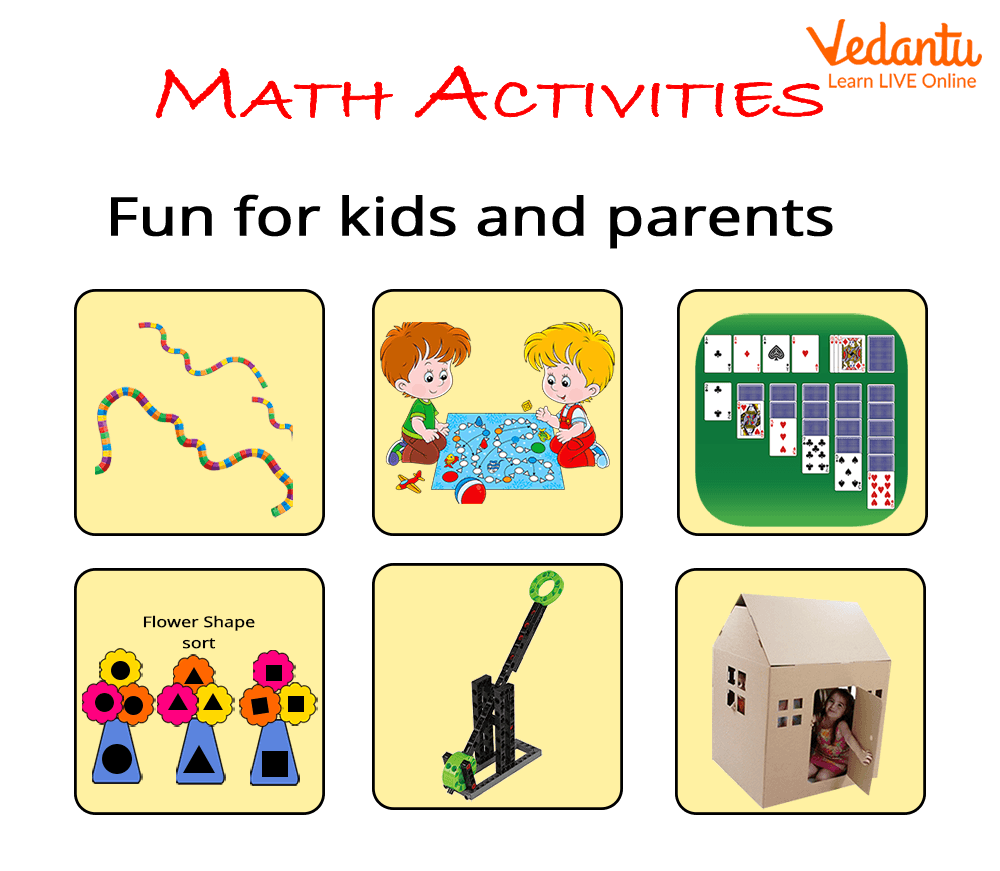
Fun activities for kids
But before that, you must know what are the concepts that your 6-year-old kids should learn at this age.
Maths Concepts to Learn for 6 Year-olds Kids
At age 6, your child will continue to develop their counting and calculation skills. Below are some of the important concepts that your kids should learn at this age.
Number and Place Value
At age 6, your child will be able to understand the position of a digit in a number and can tell you the place value of that digit (for example, 34 has 3 tens and 4 ones). They should be able to compare and order numbers and should be able to use this to solve problems. They will also learn to use symbols like more than (>), less than (<), and equals (=) to compare numbers.
Addition and Subtraction
At age 6, children will learn to solve addition and subtraction problems using objects, pictures, and drawings and also solve these problems mentally.
Multiplication and Division
At age 6, children will learn 1, 2, 3, 4, and 5 times tables and will learn how to identify odd and even numbers up to 100. They will also learn a variety of methods to solve multiplication and division problems.
Fraction
At age 6, children will learn how to write fractions in simple calculations and how to find 1/4 2/4 ⅓ 3/4 of quantities and shapes.
Geometry
At age 6, children will learn to compare and sort common 2D and 3D shapes and everyday objects and continue patterns of shapes. These involve 2D shapes including the number of sides and lines of symmetry, 3D shapes including the number of faces, edges, and vertices.
Measurement
At age 6, children will learn to use standard units to calculate length, mass (weight), capacity, and temperature and compare intervals of time and solve problems related to money.
How to Teach Maths to Your Kids at Home?
You will be amazed to know what a 6-year-old kid is capable of! Kids of this age are becoming readers, writers, and mathematicians. With proper guidance and support from caring adults, they will not only improve their Maths skills but also improve in other areas as well. So, We have explained here some easy ways to encourage your child to progress in Maths when they’re not in the classroom and all from the comfort of your own home.
1. Let Them Help You in Cooking and Baking
A simple way to improve your kid’s Mathematics skills is by encouraging them to help you with baking and cooking. Get them used to with reading the instructions, following recipes, and measuring and weighing the ingredients. This will help them to become familiar with the quantities, fractions, temperatures, and cooking units.
2. Involve in Food Shopping
If you involve your kids in food shopping, it will not only turn out to be a fun activity for you kids but also they can practise Maths through this activity. Encouraging the kids to read food labels, compare the brands and prices, and find the best deals available will help your child to understand the value of money and learn to understand the numbers and prices concept in a better way.
3. Try to Play Maths Games at Home
If you are trying to improve Maths skills and knowledge for your kids, making Maths interesting and fun is the only key. There are plenty of enjoyable games that you can play with your kids such as dominoes, chess, cards, and memory games. These games will test your kids’ Maths skills without them even realising it.
If your kids are using technology on a daily basis, then find some Maths learning apps. Check out some articles that feature all the best learning apps for kids here.
4. Read Books that Consist of Maths
Encouraging the kids to read books that consist of Maths or logic is a better way to improve Maths at home. You will find many fantastic Maths books ranging from addition, subtraction, multiplication, division, fractions, and shapes to probability if you search on the internet.
5. Encourage Your Kids to Do Some Maths Every Day
To encourage your kid to do a little bit of Maths every day is very important, even though it’s only for 10-15 minutes. It will gradually improve your kids’ skills if they practise Maths regularly.
Here are some Maths problems that will really give your kid’s Maths skills a workout!
In the car, you can ask your child how long it will take to reach your destination based on your speed.
If you are at your child’s favourite shop, ask him to calculate the price of a discounted item he wants to buy and how long it will take to save his pocket money to buy it.
Alternatively, books on Sudoku puzzles and Maths puzzles will be a challenging and fun activity to practise Maths during the weekends and holidays.
6. You Need to Familiarise Yourself with What Your Child Is Currently Learning
What area of Maths your child is currently learning is very important for you to understand. Checking your kid’s homework diaries and chatting with his teachers is the only key. Once you know what your child is currently learning, it will be easier for you to adapt Maths activities at home.
So, these are all the activities that can help you to improve your children's Math as well as problem-solving skills. Visit our website to get hold of articles and worksheets on Maths topics curated for kids of 6 years age.
FAQs on Essential Maths Skills for 6 Year Old Kids
1. What maths skills should a 6 year old have?
A 6 year old should understand basic counting, simple addition and subtraction, number recognition up to 100, and basic shapes. Key maths skills to develop include:
- Counting forward and backward up to 100
- Adding and subtracting numbers within 20
- Understanding place value (tens and ones)
- Recognising 2D shapes like circles, squares, and triangles
- Solving simple word problems
These foundational maths skills prepare children for more advanced primary school mathematics.
2. How can I improve my 6 year old’s addition and subtraction skills?
You can improve addition and subtraction skills by practising hands-on activities and simple daily exercises. Effective methods include:
- Using objects like toys or coins to show 5 + 3 = 8
- Practising number bonds up to 10 and 20
- Playing maths games and flashcards
- Solving short word problems such as “If you have 7 apples and eat 2, how many are left?”
Regular short practice sessions help build confidence and speed in mental maths.
3. Why is place value important for 6 year olds?
Place value is important because it helps children understand that the position of a digit determines its value, such as in 34 = 3 tens + 4 ones. This concept:
- Builds strong number sense
- Helps with addition and subtraction of larger numbers
- Prepares children for regrouping (carrying and borrowing)
Understanding tens and ones is a key step in early primary maths development.
4. How do you teach counting to 100 for a 6 year old?
Counting to 100 is taught by practising number sequences, skip counting, and number patterns. Follow these steps:
- Count aloud from 1 to 100 daily
- Use a hundred chart to spot patterns
- Practise skip counting by 2s, 5s, and 10s
- Fill in missing numbers (e.g., 45, 46, __, 48)
This strengthens sequencing skills and builds a strong maths foundation.
5. What problem-solving skills should a 6 year old develop in maths?
A 6 year old should develop the ability to read, understand, and solve simple one-step word problems. Important problem-solving skills include:
- Identifying key numbers in a question
- Deciding whether to add or subtract
- Checking if the answer makes sense
For example, “Tom has 9 balloons and gets 1 more” means calculate 9 + 1 = 10. These skills improve logical thinking and reasoning.
6. How can maths games help boost skills in 6 year olds?
Maths games boost skills by making practice fun while reinforcing number recognition, counting, and basic operations. Helpful games include:
- Board games using dice to practise counting
- Card games comparing greater and smaller numbers
- Online interactive addition and subtraction quizzes
Game-based learning increases engagement and improves mental maths fluency.
7. What shapes should a 6 year old know in maths?
A 6 year old should recognise and describe basic 2D and simple 3D shapes. These include:
- Circle, square, rectangle, triangle
- Cube, sphere, cone, cylinder
Children should also identify basic properties, such as a square having 4 equal sides and a triangle having 3 sides.
8. How do you teach number bonds to a 6 year old?
Number bonds are pairs of numbers that add up to a given total, such as 7 + 3 = 10. To teach number bonds:
- Use visual aids like ten frames
- Practise bonds to 10 and 20
- Play matching pair games
Strong knowledge of number bonds improves speed and accuracy in addition and subtraction.
9. What are common maths mistakes 6 year olds make?
Common maths mistakes include reversing numbers, miscounting, and misunderstanding place value. Typical errors are:
- Writing 14 instead of 41
- Skipping numbers while counting
- Confusing addition and subtraction signs
Regular guided practice and visual models help correct these early maths mistakes.
10. How can parents support maths learning at home for a 6 year old?
Parents can support maths learning by including daily real-life maths practice at home. Practical ideas include:
- Counting money while shopping
- Measuring ingredients while cooking
- Asking quick mental maths questions like 6 + 4
- Using calendars to discuss dates and number patterns
Consistent short practice builds confidence, accuracy, and strong foundational maths skills.
