









What is a Side in Geometry Definition Properties and Examples
The concept of side in Maths is something very fundamental, and this concept should be picked up almost spontaneously by kids as they play around with toys or are curious about objects. The knowledge of side in Mathematics or in general is very basic and should be absorbed and retained for life. Let us learn more about side definitions in Maths in this article.
Meaning of Side in Maths
In any two-dimensional figure, the line segment that joins two vertices is known as a side of the figure. In the case of a three-dimensional figure, the side that we are talking about will be called an edge. Different shapes have different numbers of sides and side lengths. Let us see a few examples.
Examples of Sides of a Few Two-Dimensional Figures
The minimum number of sides required to form a two-dimensional shape is 3, which gives us a triangle. The next number would be 4, giving us a quadrilateral, and so on. Let us go through a few examples to understand better.
Triangle: A triangle is a two-dimensional figure that has 3 sides. In the case of an equilateral triangle, the side lengths are equal, while they vary in isosceles or scalene triangles.
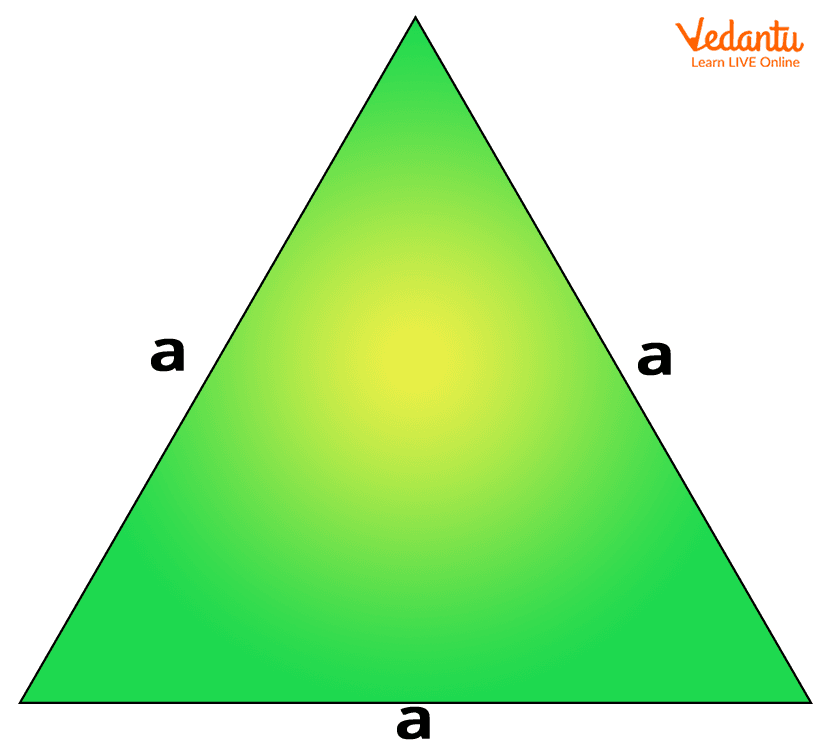
Sides of an equilateral triangle
Quadrilateral: A quadrilateral is a two-dimensional figure that has 4 sides. A rectangle is a regular quadrilateral with opposite sides equal, a square is a regular quadrilateral with all sides equal while a trapezium is a quadrilateral where the side lengths are unequal.
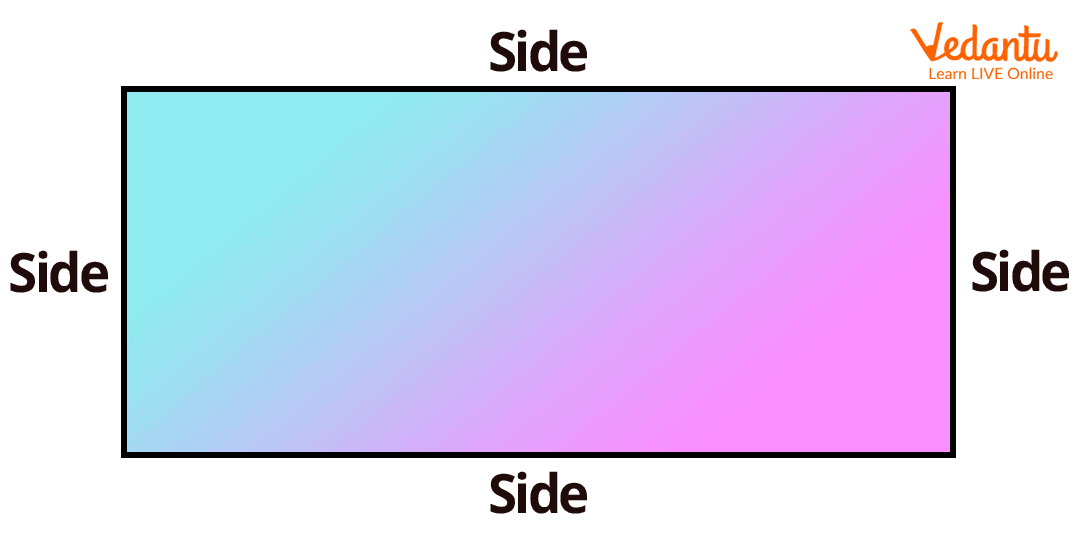
Sides of a rectangle
Pentagon: A regular pentagon has 5 sides of equal length while an irregular pentagon has 5 sides of unequal lengths.
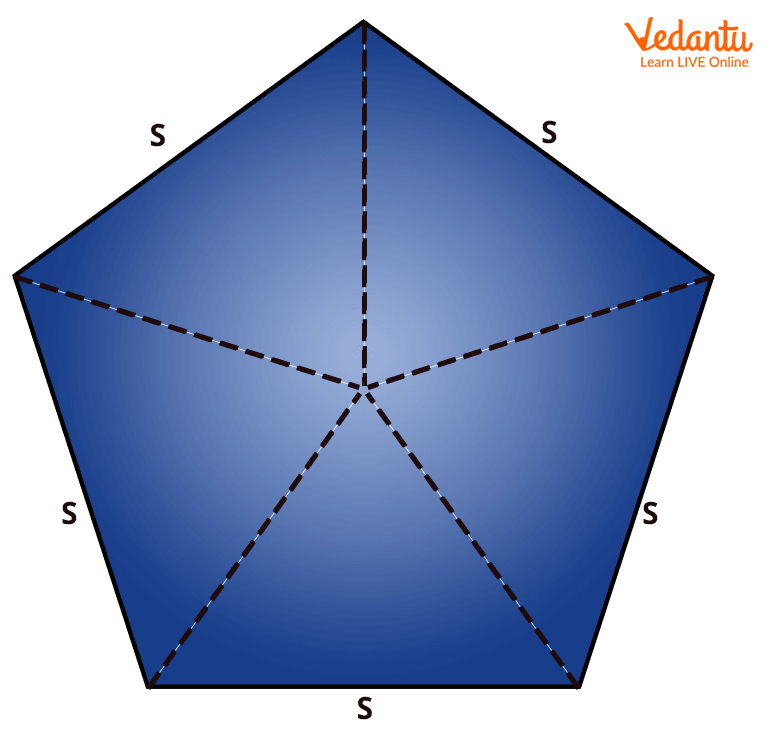
Side of a regular pentagon
Point to Note
Figures like circles, which have curved boundaries, do not have sides. A circle is bounded by a curved line called the circumference.
Conclusion
Sides are the line segments that join the vertices in any two-dimensional figure. They form the boundaries of the figure and are used to formulate measures like area, perimeter, and so on. It is a basic concept that should remain clear in the minds of children throughout their academic years and even further.
FAQs on Side in Maths Explained with Meaning and Examples
1. What is the definition of a side in Maths?
A side in Maths is a straight line segment that forms part of the boundary of a geometric shape. In polygons, sides connect two adjacent vertices and together enclose a region. For example, a triangle has 3 sides, and a square has 4 sides. The length of a side helps determine the shape’s perimeter and area.
2. What is a side in a polygon?
A side in a polygon is any one of the straight line segments that connect consecutive vertices to form a closed figure. Key points include:
- A polygon must have at least 3 sides.
- Each side meets exactly two other sides at endpoints.
- The number of sides equals the number of angles and vertices.
3. How many sides does a triangle have?
A triangle has 3 sides. These three sides join at three vertices to form three interior angles. The sum of the interior angles of a triangle is 180°, and the lengths of its sides determine whether it is equilateral, isosceles, or scalene.
4. What is the difference between a side and an edge in geometry?
A side refers to a line segment in a 2D shape, while an edge refers to a line segment where two faces meet in a 3D shape. For example:
- A square (2D) has 4 sides.
- A cube (3D) has 12 edges.
5. What is a side length in Maths?
A side length is the measurement of a line segment forming part of a shape’s boundary. It is usually measured in units such as cm, m, or inches. Side length is used to calculate:
- Perimeter (sum of all sides)
- Area (using formulas specific to the shape)
6. How do you find the missing side of a right triangle?
You can find the missing side of a right triangle using the Pythagorean Theorem: a² + b² = c². Steps:
- Identify the legs (a and b) and hypotenuse (c).
- Substitute known values into the formula.
- Solve for the unknown side.
7. What is the formula for the perimeter using sides?
The perimeter of a shape is the sum of all its side lengths. General formula:
- Perimeter = sum of all sides
- Square: P = 4a
- Rectangle: P = 2(l + w)
- Triangle: P = a + b + c
8. What are equal sides in geometry?
Equal sides are sides of a shape that have the same length. Shapes with equal sides include:
- Equilateral triangle – all 3 sides equal
- Square – all 4 sides equal
- Isosceles triangle – 2 sides equal
9. Can a circle have sides?
A circle has no sides because it is not made of straight line segments. Unlike polygons, a circle is formed by a continuous curved boundary. Since sides are defined as straight line segments, a circle does not meet the definition of having sides.
10. What is the relationship between sides and angles in a triangle?
In a triangle, the length of a side is directly related to the size of its opposite angle. The key rule is: the longest side is opposite the largest angle, and the shortest side is opposite the smallest angle. In an equilateral triangle, all sides and angles are equal, with each angle measuring 60°.
