









Multiplication Table Chart for Kids 1 to 20 with Tricks Patterns and Practice Methods
A multiplication table chart shows tables clearly in one grid. It's a handy reference to memorise multiplication facts. A multiplication chart is a table that shows the product of two numbers. Usually, one set of numbers is written on the left column and another on the topmost row. A multiplication chart saves a lot of time and energy in doing calculations.
The first use of a maths table is unknown, but they have been used since at least the 19th century. Maths tables are essential for understanding mathematics. The students are advised to learn Maths tables else it would be difficult to understand the other aspects of mathematics. Let's start with the multiplication table chart for kids.
Multiplication Tables Chart
A multiplication table chart is a list of multiples of a number. We can get the multiplication table by multiplying the given number with whole numbers. Multiplication is one of the basic mathematical operations which is taught to students at an early age. A simple way to teach students the concept of multiplication is through a multiplication table chart.
Times tables can be very helpful in doing basic mathematical calculations. These work as building blocks for higher maths like fractions, decimals, factors and many more. Table charts for kids are provided to help you learn times tables by heart.
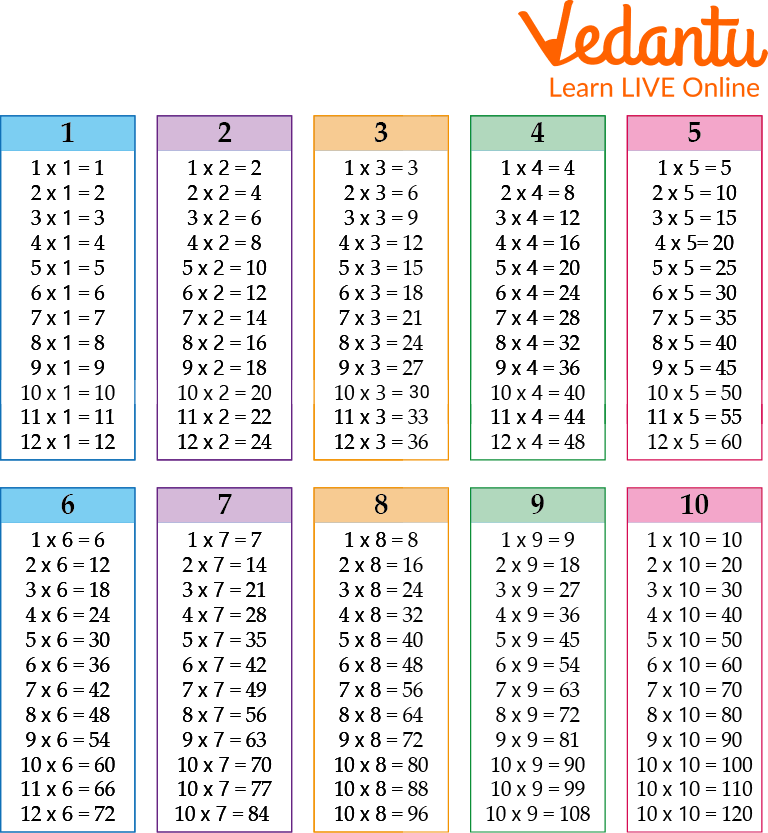
Times Tables Chart
Importance of Tables in Mathematics
The following are the importance of tables:
Learning times tables make our work easier. We can make fast calculations.
It helps us in everyday life. It makes maths more interesting.
Maths tables are very useful and will help students learn further chapters of algebra.
They are very helpful in exams and calculations as they work as a time saver. Long calculations can be solved in seconds.
The importance of tables is not only in Mathematics but also in everyday life. They build good communication skills and improve mental maths. This is how tables play an important role in Mathematics.
How to Make Kids Learn Tables?
Most experts think that kids begin learning tables around the age of 6. This is when they become more aware of their numbers and understand how to work with them. The method of teaching tables to children varies with the understanding and grasping capabilities of the child. Here are some points which will help you to understand how to make kids learn tables faster:
The Waldorf multiplication flower.
A times table sheet in the classroom.
Explaining addition facts is an effective way to teach multiplication tables.
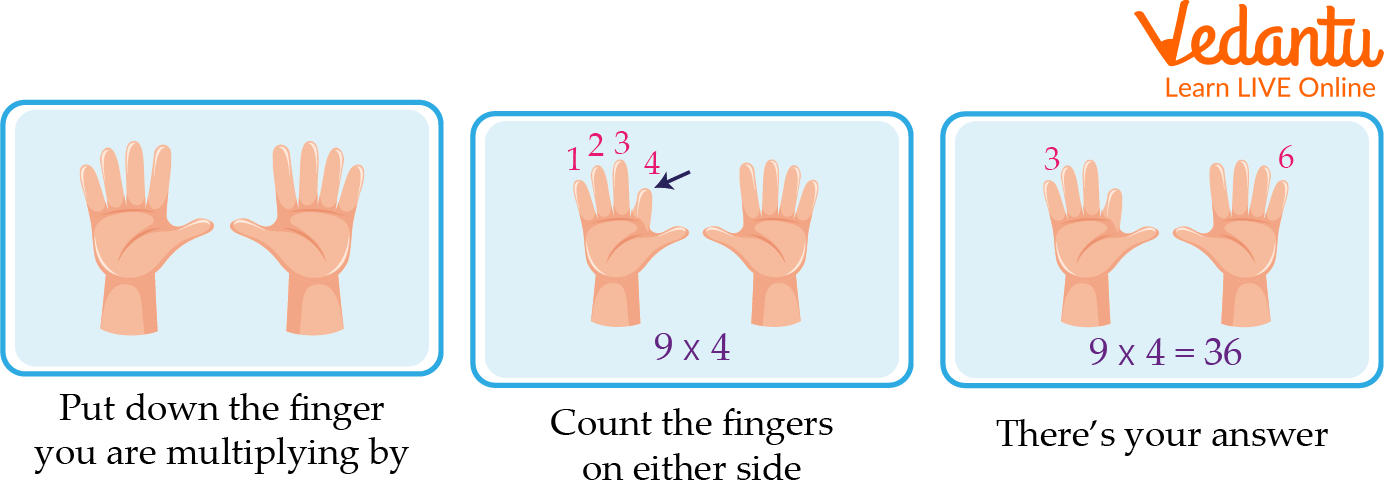
How to Make Kids Learn Tables?
What is the Objective of Learning Tables?
One of the objectives of learning tables is to develop an understanding of multiplication and division. This can be achieved by learning the table facts and also by using tables to help solve problems. Tables can also help understand other concepts such as fractions, decimals, multiples, and factors.
Solved Examples
Q 1. A bicycle costs Rs.200. How much will be paid for 8 such bicycles?
Ans: The cost of one bicycle = 200 Rs
Number of bicycles = 8
The cost of 8 bicycles = 200 × 8
= 1600 Rs
Thus 8 bicycles cost 1600 Rs.
Q 2. Multiply 3014 by 2.
Ans:
Step 1: Start with the digit in ones place. (2 × 4 = 8)
Step 2: Multiply 2 with the digit in the tens place. (2 × 1 = 2)
Step 3: Now, multiply 2 with the digit in the hundreds place. (2 × 0 = 0)
Step 4: Now multiply 2 with the digit in the thousands place. (2 × 3 = 6)
Step 5: 3014 × 2 = 6028.
Q 3 Sam works for 5 hours a day and is paid $8 per hour. How much does Sam earn in a day?
Ans: Sam works for 5 hours and is paid $8 per hour. Therefore, by using multiplication tables, the total amount he earns is 5 times 8.
Therefore, Sam earns $40.
Practice Questions
Q 1 Ram has 6 chocolates. He shares them equally with his 3 friends. How many chocolates does each friend get?
Ans: Each friend gets 2 chocolates.
Q 2 What is 784 times 44?
Ans: 784 times 44 is 34496.
Summary
A great way to learn your timetables. They help you to understand how multiplication works and can be a fun way to learn your tables. There are many different ways to learn your timetables, but a Maths times table is a great way to start. We have discussed how to make kids learn tables on their tips by using tricks in the chapter. Table charts for kids make our calculations easier and faster. So learning multiplication table charts is helpful in great ways.
FAQs on Multiplication Table Chart for Kids with Easy 1 to 20 Tables
1. What is a multiplication table chart for kids?
A multiplication table chart is a grid that shows the products of numbers when they are multiplied together. It helps children quickly learn and memorize multiplication facts from 1 to 10, 12, or higher.
- Rows and columns represent numbers.
- Each box shows the product of two numbers.
- Example: In a 10×10 chart, 4 × 6 = 24.
2. How do you read a multiplication table chart?
To read a multiplication table chart, find one number on the top row and the other on the left column, then look at where they meet.
- Step 1: Choose the first number (e.g., 7) from the top row.
- Step 2: Choose the second number (e.g., 8) from the side column.
- Step 3: The intersection gives the product: 7 × 8 = 56.
3. Why is a multiplication table important for kids?
A multiplication table is important because it builds speed, accuracy, and confidence in basic math calculations.
- Improves mental math skills.
- Helps in solving division, fractions, and word problems.
- Forms the foundation for algebra and higher mathematics.
4. What is the pattern in a multiplication table chart?
A multiplication chart follows clear number patterns that help in easy learning.
- Each row increases by the same number (e.g., 5, 10, 15, 20 in the 5 times table).
- The chart is symmetrical because 4 × 6 = 6 × 4 = 24 (commutative property).
- Multiples of 10 always end in 0.
5. How do you teach multiplication tables to beginners?
To teach multiplication tables to beginners, start with simple tables and use repetition and patterns.
- Begin with 1, 2, 5, and 10 tables.
- Use skip counting (e.g., 3, 6, 9, 12 for the 3 table).
- Practice with a multiplication chart daily.
- Use real-life examples like 4 groups of 3 apples = 12.
6. What is the easiest way to memorize multiplication tables?
The easiest way to memorize multiplication tables is through pattern recognition, repetition, and practice.
- Learn tables in small groups (1–5 first).
- Notice repeated digits (e.g., 9 × 9 = 81).
- Use flashcards and timed quizzes.
- Practice daily using a multiplication table chart.
7. What is the difference between a multiplication table and a multiplication chart?
A multiplication table lists multiples of one number, while a multiplication chart shows products of many numbers in a grid format.
- Example of table: 6, 12, 18, 24 (6 times table).
- Example of chart: A full 1–10 grid showing all products.
8. Can you give an example of using a multiplication table chart?
Yes, you can use a multiplication chart to quickly find the product of two numbers.
- Find 9 on the top row.
- Find 4 on the left column.
- The intersection shows 9 × 4 = 36.
9. Up to what number should kids learn multiplication tables?
Kids are usually encouraged to learn multiplication tables from 1 to 10 or 1 to 12.
- Tables up to 10 are common in primary school.
- Some curricula extend learning to 12 for advanced skills.
- Knowing up to 12 × 12 = 144 helps in division and fractions.
10. What are common mistakes when learning multiplication tables?
Common mistakes when learning multiplication tables include reversing numbers and skipping multiples.
- Confusing facts like 6 × 7 and 7 × 6 (both equal 42).
- Skipping numbers while skip counting.
- Relying only on counting instead of memorizing.
