








How to Find the Number of Ways to Make an Amount Using Different Coins
Money is what we give for buying food, toys, candy, going to the movies, shopping, paying taxes, and renting a house. We give money in return for buying these things or anything. There is a simple trade going on here. Just like a barter system. We want something; we take it. But as a trade/replacement, we give away money for it. A fixed price (value of money) is given to everything we try to trade (or buy). This is known as an advanced form of barter system. So in this article, we will learn about what money is. , money conversion, and making money in different ways. There will be some fun activities for kids, and there will be money worksheets for grade 1.

Kids Learning About Money
What is Money?
What exactly is the concept of money? Let's put it this way: We needed money to buy anything, right? What, then, is money? To pay for goods and services, we can state that money can be used as a means of exchange, such as coins, notes, etc. We swap money for anything that can be sold or purchased, including chocolates, cakes, fruits, meals, footballs, bats, rackets, houses, and other items.
So money can be almost anything as long as everyone agrees on its value. It's a medium of exchange; it's acceptable in exchange for any goods or services.
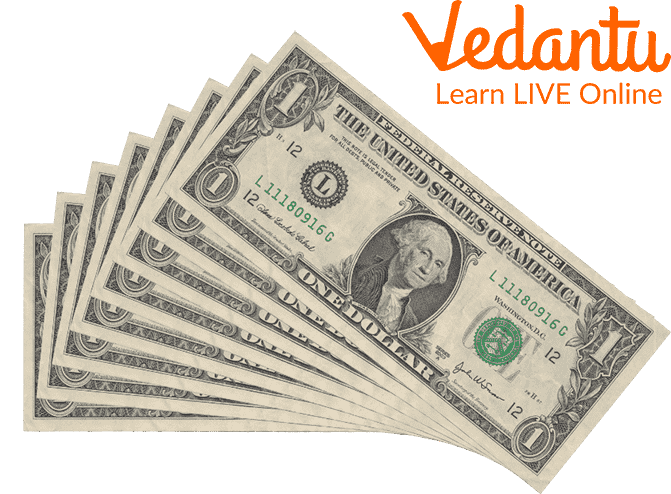
Money
What is Currency?
A currency is the system of money used in a country, or a currency is a system of money in common use, especially for people in a nation. Money can be used in any form as a medium of exchange, especially circulating banknotes and coins. Each country has its currency value because different currencies are used in different countries. U.S. dollars (US$), Euros (€), Japanese Yen (¥), and Pounds Sterling (£) are examples of currencies.
Money Conversion
Let's say your family is travelling to another nation, or you are ordering something from an overseas site, so the prices will be listed in a different currency than the one you are used to. Let's check an example: If you wish to purchase a football from any German online store. A game of football costs €25. What is the football's price in dollars? You must now know the Euro to Dollar exchange rate to calculate the football cost in dollars. The following table compares several currency values to the US dollar (USD).
Importance of Money
It's important to fulfil our basic needs like food, shelter, and clothes. With the help of money, we can fulfil it.
We can buy quality goods and services with the help of money.
Money frees us from working to survive.
It reduces our financial stress.
It provides security to us.
It can allow us to live our life to the fullest.
It's important for health also because if we have money, we can take good health care facilities.
Making Money in Different Ways
As we were kids, we always wanted something, and if our parents said no to it, we wanted to buy it on our own. Still, at that time, it was not possible for us. Because of technology, kids have many options for making money.
And if your child wants to earn money of their own, then you should encourage their spirit of doing it because it not only creates self-confidence in them but also they will learn to do hard work and understand the importance of money on their own.
So now, let's see how you can help them make money differently.
Pet sitting and dog walking: Now, pets are treated as family members, so taking care of them is the priority.
Small kids use this as an opportunity, like when the owner is taking a vacation, or if the owner has a busy schedule making it difficult to take care of their pet, they're willing to pay someone for help. It's a very enjoyable way for kids to earn money.

Pet sitting
Start a youtube channel: We can't say what's going viral nowadays. So if your kid has any wonderful ideas, help them give it a shot by helping them create their video.

Youtube
Tips for Parents
Make them use their own money- Teach your child to save money and help them to understand that saving money will help them in the future so they can buy something of their own.
Have a conversation about money with your kids. We know that no one is perfect and has made a few financial mistakes. So be truthful with your kids and encourage them not to make your mistakes.
Get your kid to do a few odd jobs. Through this, they will learn about the importance of money and how to mind and spend it.

Kids Learning About Money
Money Worksheet for Grade 1
Children can grasp the concept of money at an early age, so why don't we clear their concept more clearly with the help of worksheets?
Q1. Draw a line to match the coin with its name
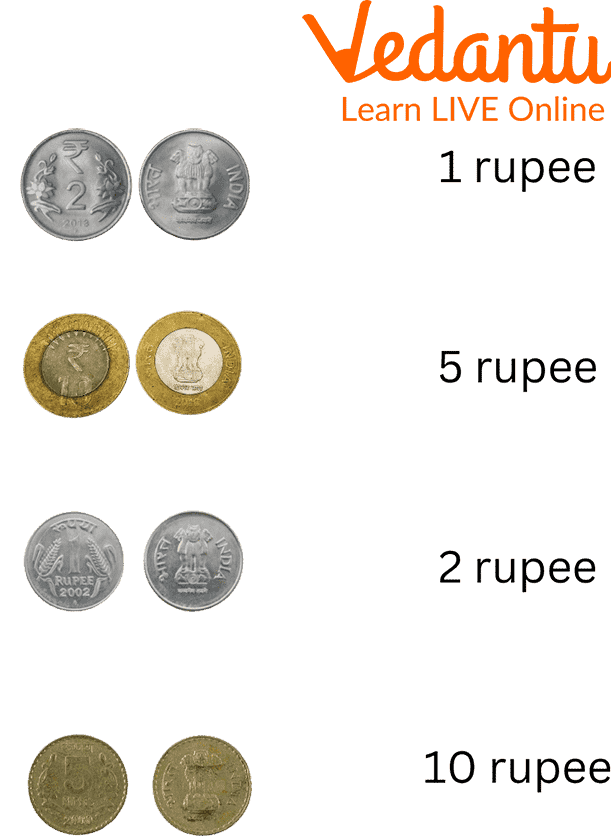
Worksheet 1
Ans:
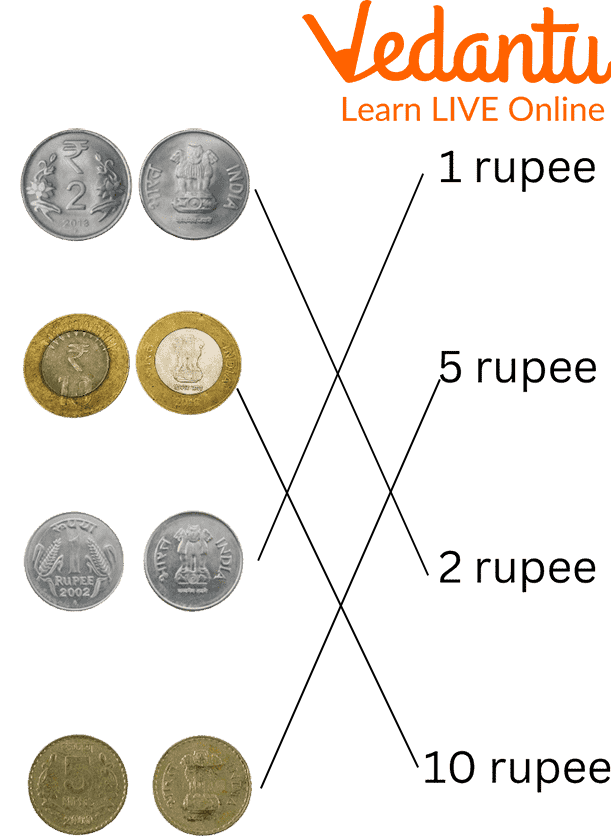
Worksheet 1
Q 2. Express the currency value in words.
(For example: $4.62 is four dollars sixty-two cents)
(a) $7.84 = _____________________________
(b) $25.04 = _____________________________
(c) $0.60 = _____________________________
Ans:
(a) $7.84 = Seven dollars eighty-four cents
(b) $25.04 = Twenty-five dollars four cents
(c) $0.60 = Zero dollars sixty cents
Q 3. Write the amount in numbers, using the dollar sign.
(For example: $5.42 is five dollars forty-two cents)
(a) Three dollars seven cents = _____
(b) Seventy-two dollars thirty cents = _____
(c) Zero dollars sixty-four cents =_____
Ans: (a) $3.07
(b) $72.30
(c) $0.64
Practice Questions
Q 1. Match the following with the correct currency:
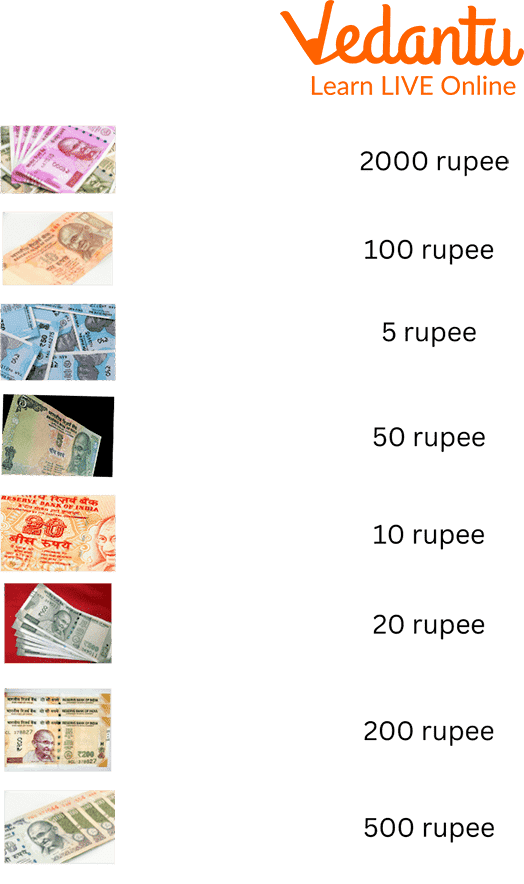
Practice Sheet
Q 2. Write the value in dollars.
(a) 2 dollars + 2 nickels = $_____
(b) 5 dollars + 1 quarter = $_____
Ans: (a) $2.10
(b) $5.25
Summary
So, in this article, we learned about money. We had learnt what money is, the importance of money and how the evolution of money has taken place, how kids can earn money and the simple and early financial decisions that small kids can make. Also, we have seen some money conversion, and different currencies have been converted. In this article, we also learned how parents could guide their children on how many chocolates or chips they can buy or if they want to save them for their favourite toy. In the end, some solved examples and practice problems are added to get more hands-on money conversion.
FAQs on Making Amounts in Different Ways with Coins and Notes
1. What does making amounts in different ways mean in maths?
Making amounts in different ways means showing the same total using different combinations of numbers, coins, or notes. It is a key concept in number partitioning and money maths.
- For example, the amount 10 can be made as 5 + 5, 6 + 4, 7 + 3, or 8 + 2.
- With money, £1 can be made using two 50p coins or five 20p coins.
- This helps learners understand place value, addition, and flexible thinking with numbers.
2. How do you make an amount in different ways?
To make an amount in different ways, you break the total into different combinations that still add up to the same number. Follow these steps:
- Step 1: Choose the total amount (for example, 12).
- Step 2: List pairs or groups of numbers that add to 12.
- Step 3: Check each combination by adding to confirm the total.
3. How can you make the same amount using different coins?
You can make the same amount using different coins by combining coin values that add up to the required total. For example, to make 50p:
- 1 × 50p coin
- 2 × 20p + 1 × 10p
- 5 × 10p coins
- 10 × 5p coins
4. What is partitioning in making amounts?
Partitioning is splitting a number into smaller parts that add up to the original number. It is commonly used in making amounts in different ways and understanding place value.
- For example, 34 can be partitioned into 30 + 4.
- It can also be split as 20 + 14 or 25 + 9.
- All parts must add back to 34.
5. How many ways can you make a number?
The number of ways to make a number depends on the rules you are using, such as which numbers or coins are allowed. For example, making 5 using positive whole numbers:
- 5
- 4 + 1
- 3 + 2
- 3 + 1 + 1
- 2 + 2 + 1
- 2 + 1 + 1 + 1
- 1 + 1 + 1 + 1 + 1
6. Why is making amounts in different ways important?
Making amounts in different ways is important because it builds strong understanding of addition, subtraction, and place value. It helps learners:
- Develop flexible thinking with numbers.
- Improve mental maths strategies.
- Understand money calculations and change.
- Prepare for algebra and number bonds.
7. Can you give an example of making 20 in different ways?
Yes, 20 can be made in many different ways using addition combinations. Examples include:
- 10 + 10
- 15 + 5
- 12 + 8
- 18 + 2
- 5 + 5 + 5 + 5
8. What are number bonds and how do they relate to making amounts?
Number bonds are pairs of numbers that add up to a specific total. They are directly used in making amounts in different ways.
- For example, number bonds to 10 include 7 + 3, 6 + 4, and 5 + 5.
- Each pair makes the same total.
9. How do you make amounts using place value?
You make amounts using place value by breaking numbers into tens and ones. For example:
- The number 47 is made of 40 + 7.
- It can also be written as 30 + 17.
- Or 20 + 27.
10. What mistakes should you avoid when making amounts in different ways?
The most common mistake when making amounts in different ways is choosing combinations that do not add up to the correct total. To avoid errors:
- Always add carefully to check the final sum.
- Do not repeat the same combination in a different order unless order matters.
- Make sure all coin or number values are counted correctly.
