









Multiplication Vocabulary Words with Definitions and Examples
There are four basic operations of Mathematics; these are addition, subtraction, multiplication, and division. So, multiplication is one of the elementary operations of computation in Mathematics. There are a lot of terminologies that are used in multiplication which come under multiplication vocabulary. The multiplication of two numbers (e.g. 2 2) is equivalent to adding as many copies of one of them. We are required to know the meaning of these terminologies. In this article, we will learn about the words of multiplication vocabulary and their meaning as well.
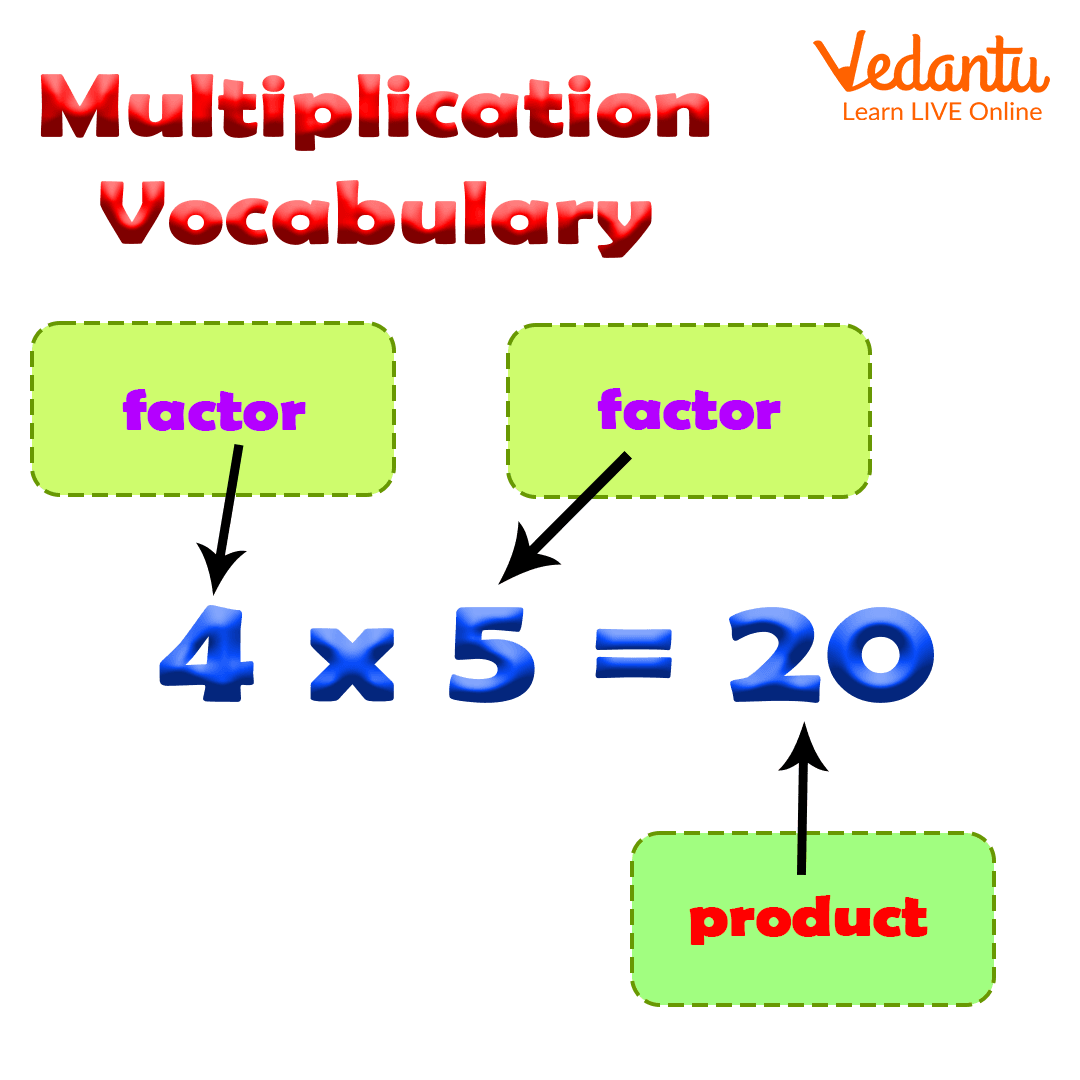
Basic terminology of multiplication
The List of Multiplication Vocabulary words
The list of multiplication vocabulary words is given below with their meanings.
Properties of Multiplication
There are some important properties that are related to multiplication which are discussed below.
Commutative property of multiplication
According to the commutative property of multiplication, when the order of multiplier and multiplicand are changed, the product does not change.
For example, 8 × 6 = 48 or 6 × 8 = 48
So, 8 × 6 = 6 × 8.
Associative property of multiplication
According to the associative property of multiplication, the product of three or more numbers does not change if we change the grouping of the numbers.
For example: (3 × 8) × 5 = 24 × 5 = 120
or, (3 × 5) × 8 = 15 × 8 = 120
or, (8 × 5) × 3 = 40 × 3 = 120
One property of multiplication
According to one property of multiplication, the product of a number and 1 is the number itself.
For example:
4 × 1 = 4
5 × 1 = 5
23 × 1 = 23
21× 1 = 21
Zero property of multiplication
According to the zero property of multiplication, the result of multiplication of any number and zero is zero.
For example:
6 × 0 = 0
0 × 34 = 0
8 × 0 = 0
80 × 0 = 0
Distributive property of multiplication
According to the distributive property of multiplication, the product of a number and the sum of two numbers is always the same as the sum of the product of the numbers.
For example:
6 × (3 + 8) = 6 × 11 = 66
6 × 3 + 6 × 8 = 66
So, 6 × (3 + 8) = 6 × 3 + 6 × 8 = 66
In the same way, the product of a number and the difference of two numbers is also always the same as the difference of the product of the numbers.
For example:
3 × (6 − 5) = 3
3 × 6 − 3 × 5 = 18 − 15 = 3
So, 3 × (6 − 5) = 3 × 6 − 3 × 5 = 3
Conclusion
In the above article, all the words related to multiplication are described and the properties of multiplication are explained with examples. This article will help students to develop a strong concept of multiplication.
FAQs on List of Multiplication Vocabulary for Students and Teachers
1. What is multiplication vocabulary in maths?
Multiplication vocabulary refers to the key terms and words used to describe multiplication concepts and operations in maths.
- Common terms include factor, product, multiple, and times.
- It also includes phrases like groups of, lots of, and multiplied by.
- Understanding multiplication vocabulary helps students solve word problems and interpret equations correctly.
2. What are the key terms used in multiplication?
The key terms in multiplication are factor, product, and multiple.
- Factor: Numbers being multiplied (e.g., 4 and 5 in 4 × 5).
- Product: The result of multiplication (4 × 5 = 20).
- Multiple: A number obtained by multiplying (e.g., 20 is a multiple of 4 and 5).
3. What does the word “product” mean in multiplication?
The product is the answer you get when two or more numbers are multiplied together.
- Example: 6 × 3 = 18.
- Here, 6 and 3 are factors, and 18 is the product.
- The word “product” always refers to the final result of multiplication.
4. What is a factor in multiplication?
A factor is a number that is multiplied by another number to produce a product.
- In 7 × 8 = 56, both 7 and 8 are factors.
- Factors divide the product exactly without a remainder.
- 56 has factors such as 1, 2, 4, 7, 8, and 14.
5. What does “times” mean in multiplication?
The word “times” means to multiply one number by another.
- Example: 5 times 4 means 5 × 4.
- This can also mean 5 groups of 4.
- 5 × 4 = 20.
6. What is a multiple in multiplication?
A multiple is a number you get when you multiply a number by an integer.
- Multiples of 3 include 3, 6, 9, 12, and 15.
- These are found by 3 × 1, 3 × 2, 3 × 3, and so on.
- Multiples help in understanding patterns and times tables.
7. What does “groups of” mean in multiplication?
The phrase “groups of” represents repeated addition in multiplication.
- Example: 4 groups of 3 means 4 × 3.
- This equals 3 + 3 + 3 + 3 = 12.
- It shows how multiplication combines equal groups.
8. What is the difference between a factor and a multiple?
A factor divides a number exactly, while a multiple is the result of multiplying a number.
- Example: In 5 × 6 = 30, 5 and 6 are factors of 30.
- 30 is a multiple of 5 and 6.
- Factors go into a number; multiples come from a number.
9. What symbols are used in multiplication?
The main symbols used in multiplication are ×, ·, and sometimes *.
- Example: 8 × 2 = 16.
- The dot symbol is common in algebra: 8 · 2 = 16.
- In calculators or coding, the asterisk (*) represents multiplication.
10. Can you give an example of multiplication vocabulary in a word problem?
A multiplication word problem uses terms like times, groups of, and product to describe repeated addition.
- Example: There are 6 bags with 4 apples in each bag.
- This means 6 groups of 4 → 6 × 4.
- The product is 24 apples.
