









How To Convert Units Of Speed With Formula And Examples
Hello champs, you must have seen moving vehicles on the road, but, have you noticed different vehicles run at different speeds? Do you know how their speed is measured?
In this article, you will find all these answers and will be learning things that will help you to find accurate measurements of speed and time. The speed of the vehicle is measured in kilometers per hour. Conversion is important because suppose we are given a car which has a speed of 60 km/h and a bike with the speed of 220 m/s, so we need a uniform unit to compare them both.

Police Charging Fine for Crossing the Speed Limit
Converting Kilometer Per Hour to Meter Per Second
To convert a kilometer per hour measurement to a meter per second measurement, multiply the speed by the transformation ratio.
Since, one kilometer per hour = \[\dfrac{\text{1 km}}{1\,\text{hr}}=1\times \dfrac{\text{1000 m}}{60\times 60\,\sec }\]
$=\dfrac{1000}{3600}\text{m}\,\text{/}\,\text{s}$
$\text{=}\dfrac{5}{18}m/s$
So, we can say that to convert km/hr into m/sec, we multiply by $\dfrac{5}{18}$.
meters per second, you can use this simple equation to convert:
meters per second = $\mathrm{Kilometers per hour} \times \dfrac{5}{18}m/s$.
The speed in meters per second is equivalent to the kilometers per hour multiplied by $\dfrac{5}{18}$.
The meter per second is a SI unit of speed in the metric standard for measuring. Kilometers per hour can be abbreviated as km/h, and also some of the time abbreviated as kph. Also, 1 kilometer per hour can be written as 1 km/h or 1 kph.
How to Convert Sec to hr?
We know 1 second is equal to $\dfrac{1}{3600}$ hour
Hence, the Seconds to Hours Conversion Formula is given as
Hours = Seconds ÷ 3,600
As discussed above, similarly, we can convert hr to sec by the following formula-
Seconds = Hours × 3,600.
What is the Unit of Speed?
Meters per second is a SI unit of speed in the metric standard for measuring. It is the measurement of speed expressing the distance traveled in meters in a second.
Meters per second can be abbreviated as m/s, and are also abbreviated as m/sec. For example, 1 meter per second can also be written as 1 m/s or 1 m/sec.
Similarly, a kilometer per hour is also a unit of speed.
It can be abbreviated as km/h, and some of the time abbreviated as kph.
For example, 1 kilometer per hour can also be written as 1 km/h or 1 kph.
Kilometers per hour are a measurement of speed expressing the distance traveled in kilometers in an hour.
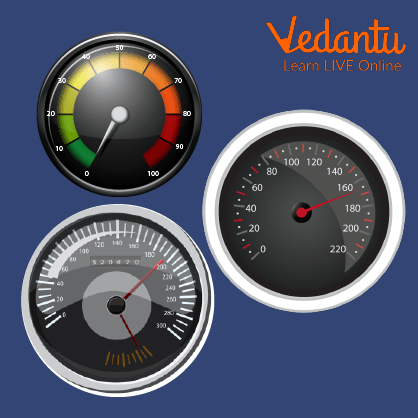
Speedometer (Used to Measure the Speed of a Vehicle in km/hr)
How to Convert km to m?
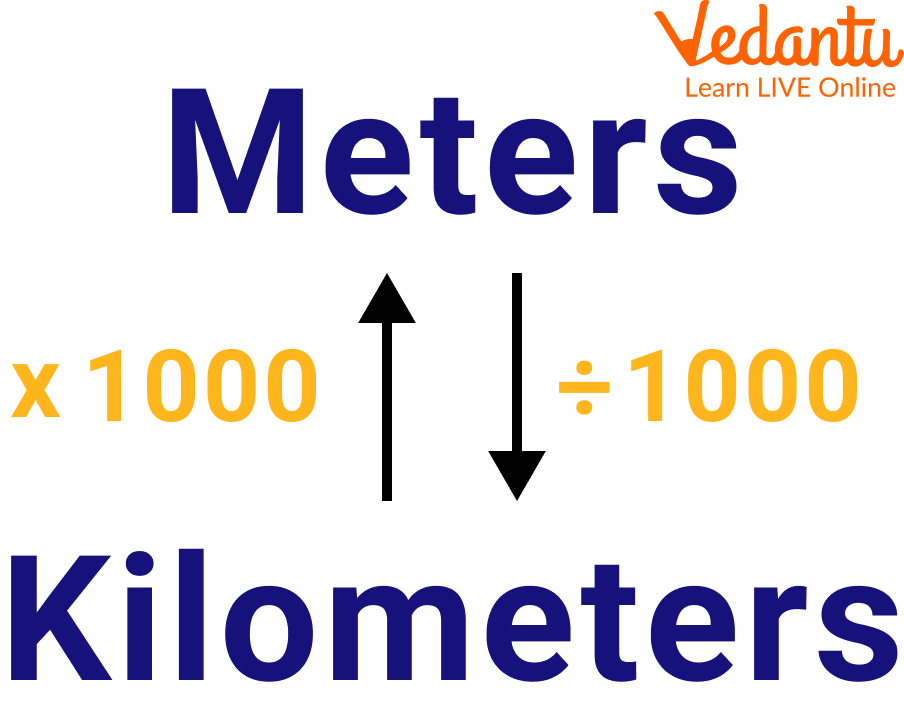
Conversion
To convert a kilometer measurement to a meter measurement, multiply the length by the transformation ratio.
Since one kilometer is equivalent to 1,000 meters, you can use this basic formula to convert:
meters = kilometers × 1,000
The length in meters is equivalent to the kilometers multiplied by 1,000.
For example, this is the way to convert 8 kilometers to meters using the formula above.
8 km = (8 × 1,000) = 8,000 m
Steps to Convert m Into Km
Step 1: For example, take 2,000 meters.
Step 2: Since one kilometer is equal to 1,000 meters, Divide it by 1,000.
Step 3: By doing so, 2,000 m = (2,000 ÷ 1,000) = 2 Km
Solved Examples
Q 1. Convert 54 km/hr to m/sec
Ans: We have 54 km/hr
= $54\mathrm{km/hr} \times \dfrac{5}{18}m/s$
= 15 m/sec
Q 2. The speed of the bicycle is 36 km/hr, what is its speed in m/sec?
Ans: Speed of bicycle = 36 km/hr
We know that to convert the speed into m/sec, we multiply by $\dfrac{5}{18}$
Therefore, speed of bicycle = $36\mathrm{km/hr} \times \dfrac{5}{18}m/s$
= 10m/s
Practice Questions
Q 1. Convert 36 km/s into m/s.
Ans: 10m/s
Q 2. Convert 54 km/s into m/s.
Ans: 15m/s
Q 3. Convert 10 km into m.
Ans: 10,000 m
Q 4. Convert 10,000 m into km.
Ans: 10 Km
Q 5. Convert 40,000 m into km.
Ans: 40 Km
Summary
In this article, we discussed the kilometer per hour, which is a SI unit of speed. To convert a kilometer per hour measurement to a meter per second measurement, multiply the speed by the conversion ratio. We multiply km/hr by $\dfrac{5}{18}$ to get data in m/sec. Km per hr is an example of the speed we measure while running a vehicle. At the end of the article, we added some practice questions, so after going through the article, give it a try to the practice questions.
FAQs on Conversion Of Units Of Speed In Maths
1. What is conversion of units of speed?
The conversion of units of speed is the process of changing a speed value from one unit (like km/h) to another unit (like m/s) without changing its actual magnitude. Speed is defined as distance ÷ time, so converting speed means converting both distance and time units correctly. For example, converting 36 km/h to m/s changes only the unit, not the actual speed.
2. How do you convert km/h to m/s?
To convert km/h to m/s, multiply the value by 5/18. This is because 1 km = 1000 m and 1 hour = 3600 seconds. Formula:
Speed (m/s) = Speed (km/h) × 5/18
Example:
36 km/h × 5/18 = 10 m/s.
3. How do you convert m/s to km/h?
To convert m/s to km/h, multiply the value by 18/5. This reverses the km/h to m/s conversion factor. Formula:
Speed (km/h) = Speed (m/s) × 18/5
Example:
20 m/s × 18/5 = 72 km/h.
4. Why do we multiply by 5/18 to convert km/h to m/s?
We multiply by 5/18 because 1 km = 1000 m and 1 hour = 3600 seconds, so 1000/3600 simplifies to 5/18. Derivation:
- 1 km/h = 1000 m / 3600 s
- 1000/3600 = 5/18
5. What is the formula for converting speed units?
The general formula for converting units of speed is New Speed = Given Speed × (Conversion factor). For common cases:
- km/h to m/s: × 5/18
- m/s to km/h: × 18/5
6. How do you convert km/min to m/s?
To convert km/min to m/s, multiply by 1000/60 or simplify to 50/3. Steps:
- 1 km = 1000 m
- 1 min = 60 s
Speed (m/s) = Speed (km/min) × 1000/60
Example:
2 km/min × 1000/60 = 2000/60 = 33.33 m/s (approx).
7. What is the difference between km/h and m/s?
The difference between km/h and m/s is that km/h measures speed in kilometres per hour, while m/s measures speed in metres per second. Key differences:
- km/h is commonly used for vehicles.
- m/s is the SI unit of speed.
- 1 km/h = 5/18 m/s.
8. Can you give an example of converting units of speed?
Yes, for example, to convert 90 km/h to m/s, multiply by 5/18. Calculation:
- 90 × 5/18 = 25
9. What are the common speed units used in Maths problems?
The most common speed units in Maths problems are m/s, km/h, and sometimes km/min or cm/s. These units are used depending on the context:
- m/s – SI unit (scientific calculations)
- km/h – transport and daily life
- cm/s – small-scale motion problems
10. What mistakes should be avoided while converting units of speed?
The most common mistake in conversion of units of speed is converting only distance or only time instead of both. Avoid these errors:
- Using 18/5 instead of 5/18 in km/h to m/s conversion.
- Forgetting that 1 hour = 3600 seconds.
- Not simplifying fractions properly.
