









How to Find LCM of 3 Numbers Using Prime Factorization and Division Method
The least common multiple (LCM) is the smallest positive integer that is divided by both a and b. Its official name is Least Common Multiple.
The LCM method is used to determine the least multiple of two or more numbers. Both of the numbers will divide the LCM. When performing any arithmetic operations involving fractions, such as addition and subtraction, LCM is utilized to make the denominators common. This method facilitates the simplification process.
What is LCM?
When the denominators of two fractions are different, LCM can also be used to add or subtract the fractions. The smallest positive integer that is divided by both a and b is known as the least common multiple (LCM) .A number that is a multiple of two or more other numbers is said to be a common multiple.
LCM with 3 Numbers:
LCM is represented as LCM for three integers a, b, and c. For instance, the smallest number that can be divided by all three integers is 60, which is the LCM of 12, 15, and 10. \[{\rm{LCM}}\left[ {12,15,10} \right]\] thus equals 60.
How to Calculate LCM of Three Numbers:
To find 3 Numbers LCM with Listing Multiples:
This is a very interesting process to How to Take the LCM of 3 Numbers:
List every multiple of three numbers until at least one of them appears on every list.
Find the number that appears on all of the lists and is the least.
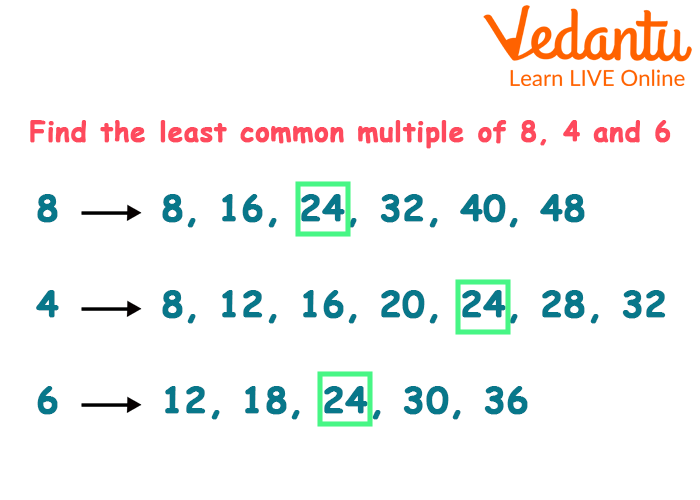
LCM of 3 Numbers Formula(for 8, 4, 6)
Utilizing Prime Factorization, get the LCM of Three Numbers:
Make a list of each of the provided numbers' prime factors.
List all the prime numbers you've discovered, in order of how frequently they appear in the given numbers.
To find the Least Common Multiple, multiply the list of prime numbers.
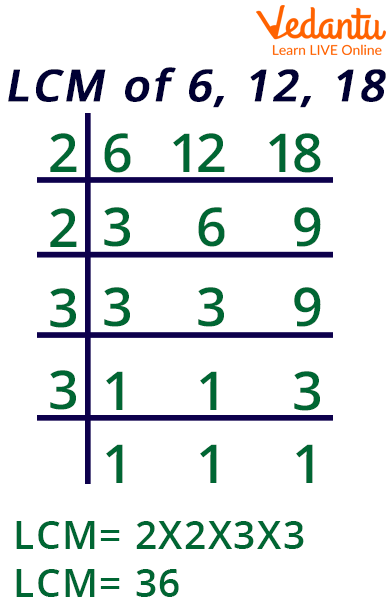
LCM of 6,12,18
Find LCM of Numbers Using Cake/ Ladder Method:
Put the three numbers in a row or cake pattern.
Bring the result into the following layer after dividing the integers in the layer by the given number that is equally divisible by all those numbers present.
Simply bring any non-divisible number down if it is present in the layer or row.
Divide the rows by prime numbers once more.
You are finished when there are no more numbers.
Then, multiply all the numbers together and you will get the LCM of required numbers.
Properties of LCM:
PROPERTY 1 : LCM obeys Associative Property
\[{\rm{LCM}}\left[ {c,d} \right] = {\rm{LCM}}\left[ {d,c} \right]\]
PROPERTY 2 : LCM obeys Commutative Property
\[{\rm{LCM}}\left[ {a,b,c} \right] = {\rm{LCM}}\left[ {{\rm{LCM}}\left[ {a,b} \right],c} \right] = {\rm{LCM}}\left[ {a,{\rm{LCM}}\left[ {b,c} \right]} \right]\]
PROPERTY 3 : LCM obeys Distributive Property
\[{\rm{LCM}}\left[ {da,db,dc} \right] = d \times {\rm{LCM}}\left[ {a,b,c} \right]\]
Conclusion
LCM can be used to add or subtract two fractions when their respective denominators are different. The least common multiple (LCM) is the smallest positive integer that is divided by both a and b. (LCM).
Solved Example :
Example 1 : Find \[{\rm{LCM}}\left[ {6,7,21} \right]\] by listing Multiples.
Solution : Given digits 6, 7, and 21
There are six multiples: 6, 12, 18, 24, 30, 36, 42, 48, 54, and 60
7 is a multiple of 14, 21, 28, 35, 42, 49, and 56.
21 is a multiple of 21, 42, and 63.
According to the definition, the least common multiple [LCM] of all three integers is the smallest number.
Thus, the LCM of 6, 7, and 21 is 42.
Example 2 : Find LCM of 12, 24, 30 using Prime Factorization Method?
Solution : 12's prime factorization is \[2 \times 2 \times 3\]
24's prime factorization is \[2 \times 2 \times 2 \times 2 \times 3\]
prime factorization of 30 will be \[2 \times 3 \times 5\]
Make a note of the often occurring prime numbers for the provided numbers, then multiply them.
\[ = 2 \times 2 \times 2 \times 3 \times 5\]
\[ = 120\]
Thus, its LCM of given numbers is 120.
Example 3 : Find the LCM(10, 12, 15) using the Cake/ Ladder Method.
Solution : Numbers given are 10, 12, and 15.
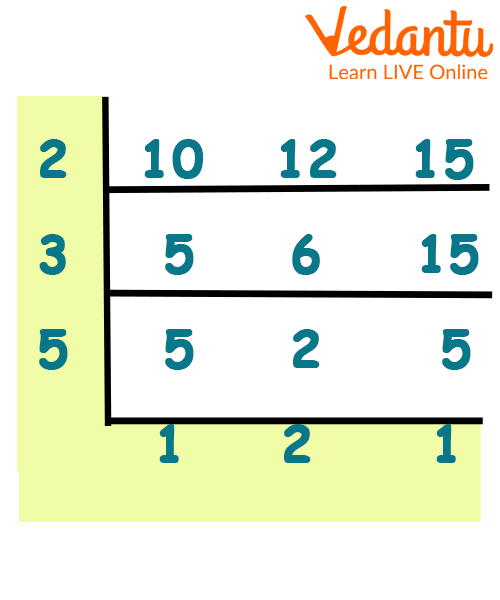
LCM of 10,12,15 by Cake/Ladder Method
Using a Cake and Ladder
To locate LCM From top to bottom, multiply all the prime integers, i.e.
\[2 \times 3 \times 5 \times 1 \times 2 \times 1 = 60\]
LCM(10, 12, 15) is therefore 60.
FAQs on LCM With 3 Numbers Complete Guide With Methods and Examples
1. What is the LCM of 3 numbers?
The LCM (Least Common Multiple) of 3 numbers is the smallest positive number that is exactly divisible by all three numbers. In other words, it is the smallest common multiple shared by them. For example, the LCM of 2, 3, and 4 is 12 because 12 is the smallest number divisible by 2, 3, and 4 without leaving a remainder.
2. How do you find the LCM of 3 numbers step by step?
You can find the LCM of 3 numbers using the prime factorization method. Follow these steps:
- Step 1: Write the prime factors of each number.
- Step 2: Take the highest power of each prime factor.
- Step 3: Multiply those highest powers.
Example: Find LCM of 6, 8, and 12.
- 6 = 2 × 3
- 8 = 2³
- 12 = 2² × 3
- Highest powers: 2³ and 3
- LCM = 2³ × 3 = 24
3. What is the formula to find the LCM of 3 numbers?
The formula to find the LCM of three numbers using HCF is LCM(a, b, c) = (a × b × c × HCF(a, b, c)) ÷ (HCF(a, b) × HCF(b, c) × HCF(c, a)). However, in most cases, the prime factorization method is simpler and more commonly used in exams. This formula is based on the relationship between LCM and HCF and works when HCF values are known.
4. Can you find the LCM of 3 numbers using the division method?
Yes, you can find the LCM of 3 numbers using the division method by dividing them simultaneously by common prime numbers. Follow these steps:
- Write the numbers in a row.
- Divide by a common prime factor.
- Continue dividing until no common factor remains.
- Multiply all the divisors and remaining numbers.
Example: For 4, 6, and 8, the LCM is 24.
5. What is the LCM of 3 and 4 and 5?
The LCM of 3, 4, and 5 is 60. Prime factorization gives:
- 3 = 3
- 4 = 2²
- 5 = 5
- Highest powers: 2², 3, and 5
Multiplying them: 2² × 3 × 5 = 4 × 3 × 5 = 60.
6. Is the LCM of 3 numbers always greater than the numbers?
Yes, the LCM of 3 numbers is always greater than or equal to the largest number among them. It equals the largest number only when that number is a multiple of the other two. For example, LCM of 2, 4, and 8 is 8 because 8 is already divisible by 2 and 4.
7. What is the difference between HCF and LCM of 3 numbers?
The HCF (Highest Common Factor) of 3 numbers is the greatest number that divides all of them, while the LCM (Least Common Multiple) is the smallest number divisible by all of them. For example, for 6, 9, and 12:
- HCF = 3
- LCM = 36
HCF deals with common factors, whereas LCM deals with common multiples.
8. How do you find the LCM of 3 numbers using listing method?
You find the LCM of 3 numbers using the listing method by writing multiples of each number and identifying the smallest common one. For example, for 2, 3, and 4:
- Multiples of 2: 2, 4, 6, 8, 10, 12…
- Multiples of 3: 3, 6, 9, 12…
- Multiples of 4: 4, 8, 12…
The smallest common multiple is 12, so LCM = 12.
9. Can the LCM of 3 numbers be equal to one of the numbers?
Yes, the LCM of 3 numbers can be equal to one of the numbers if that number is a multiple of the other two. For example, in 3, 6, and 12, the LCM is 12 because 12 is divisible by both 3 and 6.
10. Why do we use LCM of 3 numbers in real life?
The LCM of 3 numbers is used to find when repeating events occur together or to solve problems involving common denominators. Common applications include:
- Finding when 3 traffic lights change together
- Solving word problems in time intervals
- Adding fractions with different denominators
LCM helps determine the smallest common cycle or shared multiple in real-life and mathematical problems.
