









Metre to Kilometre Conversion Formula and Solved Examples
By providing the definition of metre and kilometre, we also get to know about converting metre into kilometre. Accordingly, in the International System of Units, a kilometre represents one mile (SI). The symbol for it is km. Km is typically used to describe a location's or a piece of land's distance. As 1 km = 1000 m, a metre can measure both length and distance. It is an SI unit with the symbol "m." The unit of measurement for length and distance is the metre. In this article, we will learn how to convert m to km.

Symbols
How to Convert m to km?
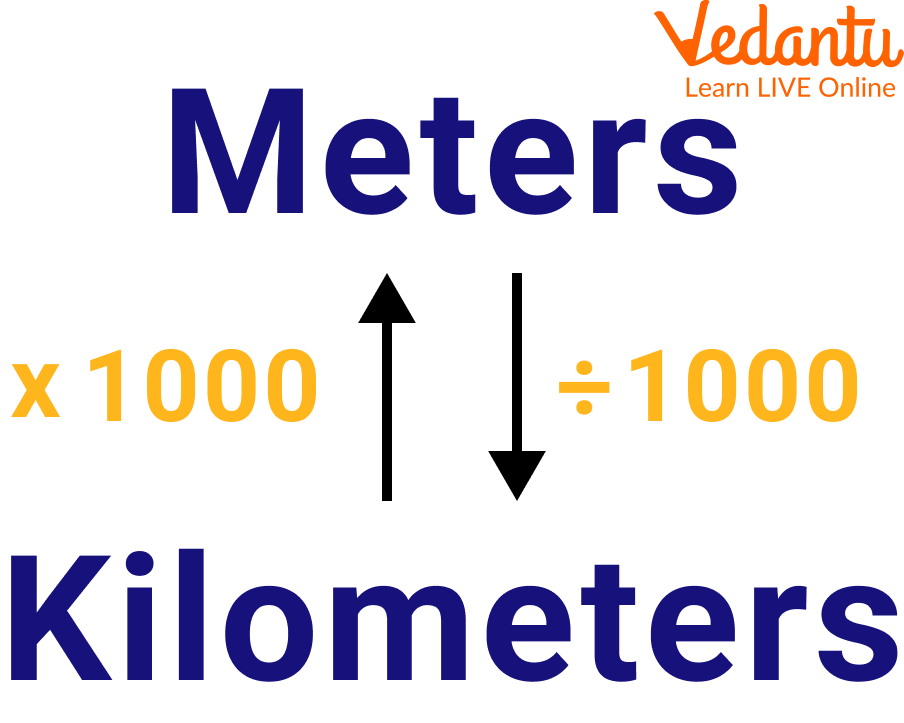
Conversion of m to km
The SI unit of distance is the metre, as we all know. The units of measurement for length and distance are metres and kilometres. The metric system's unit of measurement for distance is the kilometre or 1,000 metres. One metre is, therefore, equal to one-thousandth of a kilometre. The symbol for a metre is m, while the symbol for a kilometre is km.
To convert from m to km, we have to divide by 1000.
To convert from km to m, we have to multiply by 1000.
How Many Metres in a Kilometre?
A kilometre, often known as a km, is one thousand metres, or roughly $0.621$ miles, in length. It is the most popular unit for determining the distance between locations throughout most of the world. The fundamental unit of length in the metric system, upon which all other length units are built, is the metre, or metre. It is equivalent to $100 \mathrm{~cm}$, or roughly $39.37$ inches, or $\dfrac{1}{1000}$ th of a kilometre. Knowing the conversion factor allows us to quickly and easily convert 1000 metres to kilometres by multiplying $0.001$ by the number of metres we have, which is 1000.
$1000 \times 0.001=1 \mathrm{~km}$
As is common knowledge, a kilogramme is equal to 1000.
There are 1000 metres in a kilometre.
This implies that when converting 1000 metres to km, it makes up 1 kilometre.
Consequently, one kilometre is equal to 1000 metres.
Metre to Km Conversion Chart
The metre to km conversion chart is given below:
Solved Examples
Q1. 6000 metres to kilometres
Ans: 1000m = 1km
So, 6000 is divided by 1000
Quotient = 6
Remainder = 0
Thus, answer = 6km
Q2. 10000 metres to kilometres
Ans: 10000m = 1km
So, 10000 is divided by 1000
Quotient = 10
Remainder = 0
Thus, answer = 10km
Q3. 7856 m to km
Ans: 1000m = 1km
So, 7856 is divided by 1000
Quotient = 7
Remainder = 856
Thus, answer = 7 km 856 m (7000+856) or 7.856 km
Practice Questions
Q1. 9999 m to km
Ans: 9 km 999 m
Q2. 1210 m to km
Ans: 1 km 210 m
Q3. State true or false:
Metre is the standard unit to measure the length.
Ans: True
Summary
The process of converting metres into kilometres is simple and only requires a few steps. First, identify the number of metres you wish to convert. Second, divide that number by 1,000 to find the equivalent number of kilometres. Third, round off the answer to the nearest tenth if necessary. And that's it! You've now successfully converted metres into kilometres. Try doing a few more conversions on your own to practise. Once you have mastered this conversion, you will be able to easily calculate distances in both metric units. So next time someone asks you how far away something is, don't hesitate to give them an answer in either unit of measurement!
FAQs on Converting Metre to Kilometre Explained
1. How do you convert metre into kilometre?
To convert metre into kilometre, divide the number of metres by 1000. Since 1 kilometre = 1000 metres, use this formula:
Kilometres = Metres ÷ 1000
For example:
- 5000 m ÷ 1000 = 5 km
- 250 m ÷ 1000 = 0.25 km
2. What is the formula to convert metres to kilometres?
The formula to convert metres to kilometres is Kilometres = Metres ÷ 1000. This is because 1 km = 1000 m in the metric system.
Steps:
- Write the number of metres.
- Divide by 1000.
- Express the answer in kilometres (km).
3. Why do we divide by 1000 to convert metres into kilometres?
We divide by 1000 because 1 kilometre equals 1000 metres. In the metric system, “kilo” means 1000.
This means:
- 1000 m = 1 km
- 1 m = 0.001 km
4. How many kilometres are there in 1 metre?
There are 0.001 kilometres in 1 metre. Since 1 km = 1000 m, we calculate:
1 m ÷ 1000 = 0.001 km
This shows that a metre is a much smaller unit compared to a kilometre.
5. What is 5000 metres in kilometres?
5000 metres is equal to 5 kilometres. To convert:
5000 ÷ 1000 = 5 km
Since 1000 metres make 1 kilometre, 5000 metres equals 5 kilometres.
6. How do you convert metres to kilometres with decimals?
To convert metres to kilometres with decimals, divide the metres by 1000 and place the decimal correctly. Use the formula:
Kilometres = Metres ÷ 1000
Examples:
- 750 m ÷ 1000 = 0.75 km
- 125 m ÷ 1000 = 0.125 km
7. What is the difference between metre and kilometre?
The main difference is that a kilometre is 1000 times larger than a metre. In the metric system:
- 1 kilometre = 1000 metres
- A metre is used for shorter distances.
- A kilometre is used for longer distances.
8. Can you give an example of converting metre into kilometre?
Yes, to convert 2800 metres into kilometres, divide by 1000 to get 2.8 km.
Step-by-step:
- Given: 2800 m
- Apply formula: 2800 ÷ 1000
- Result: 2.8 km
9. How do you convert kilometres back into metres?
To convert kilometres into metres, multiply the kilometres by 1000. The formula is:
Metres = Kilometres × 1000
Example:
- 4 km × 1000 = 4000 m
- 1.5 km × 1000 = 1500 m
10. What are common mistakes when converting metres to kilometres?
A common mistake when converting metres to kilometres is multiplying instead of dividing by 1000. Remember:
- Metres to kilometres → Divide by 1000
- Kilometres to metres → Multiply by 1000
