









What Are Adjacent Sides of a Quadrilateral With Properties and Examples
A quadrilateral is a simple closed geometric figure with four sides and four angles. In simple words, a quadrilateral has four points lying in the same plane, out of which no three are collinear, and those points are joined by lines that do not intersect each other except at their common endpoints. A quadrilateral has 4 angles, 2 pairs of opposite sides and 4 pairs of adjacent sides each and a pair of diagonals.
Quadrilateral Examples:
Square, Rectangle, Kite, Rhombus, Parallelogram and Trapezium are examples of the quadrilateral.
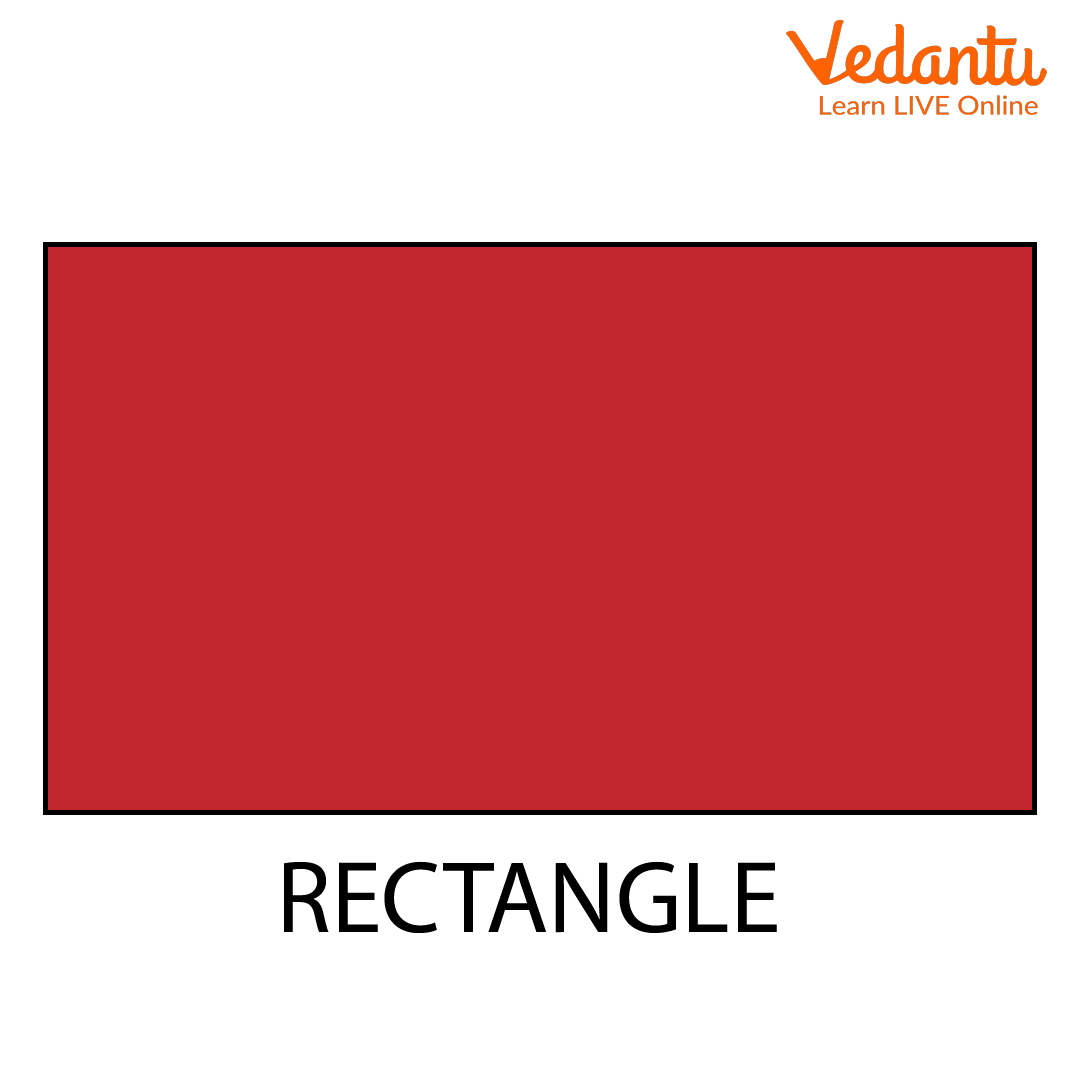
A Rectangle
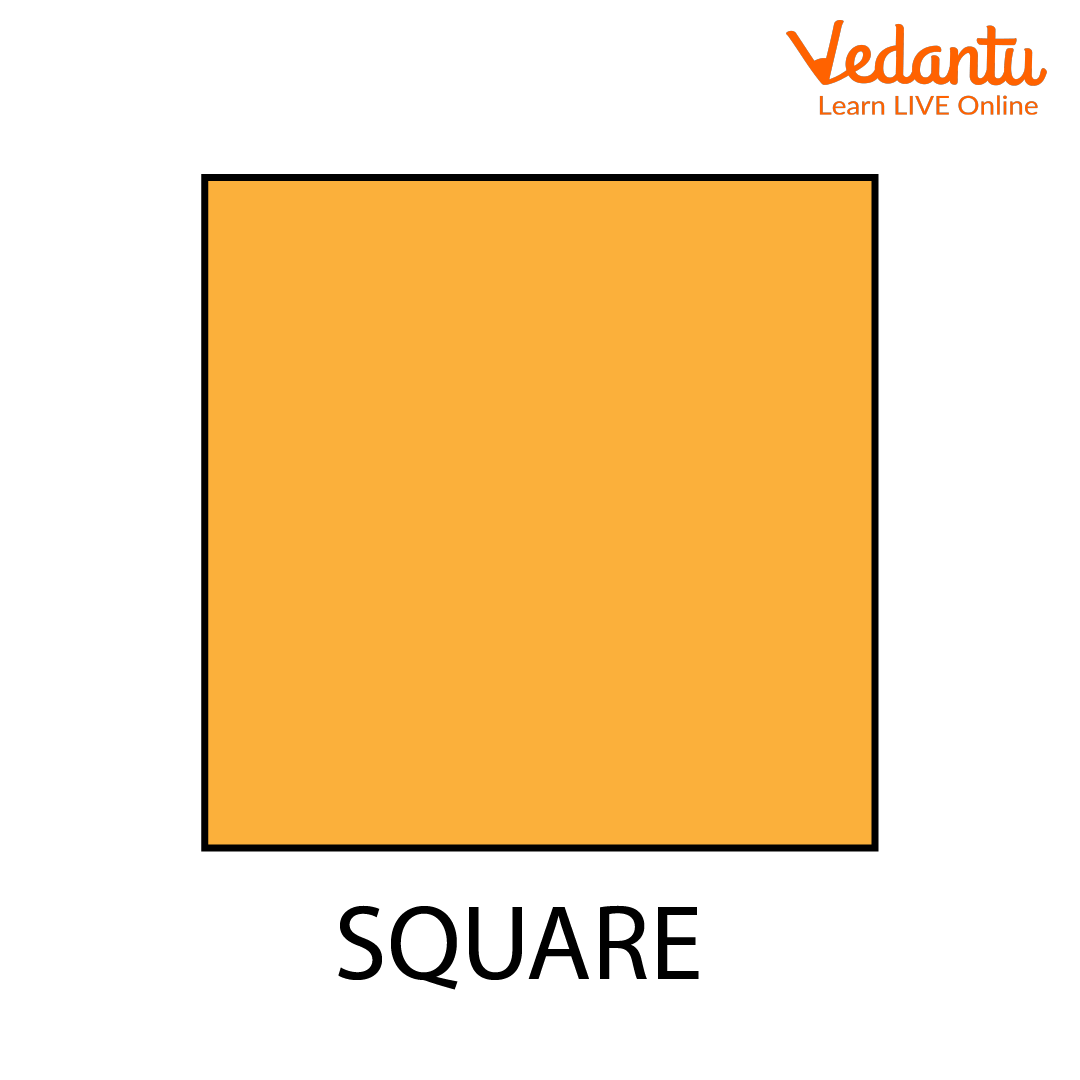
A Square
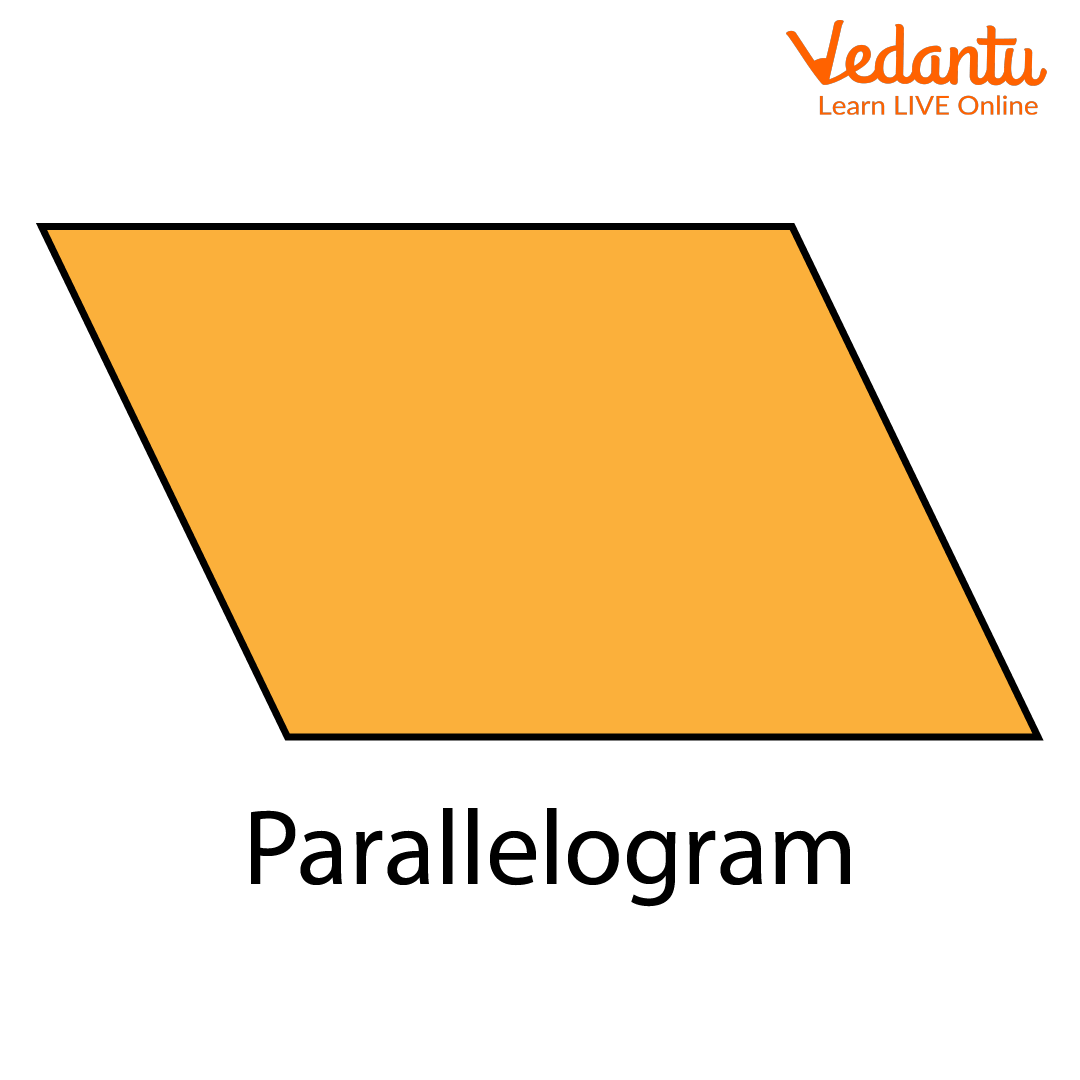
A Parallelogram
What are the Vertices of a Quadrilateral?
The common point joining the sides of a quadrilateral is said to be the vertices of a quadrilateral.
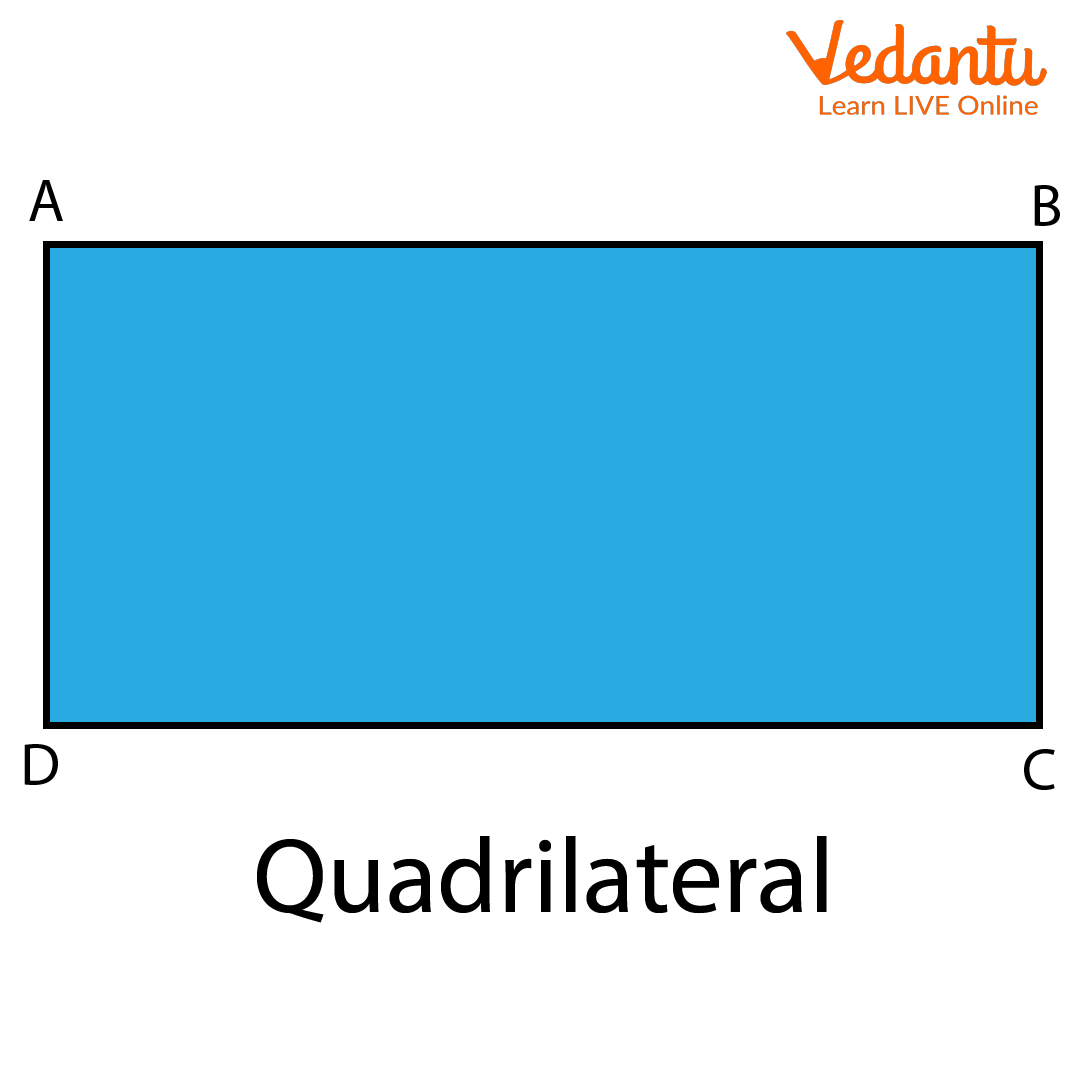
Quadrilateral
In quadrilateral ABCD, shown in the above figure, A, B, C and D are the vertices.
What are the edges of a quadrilateral?
The line segments joining the vertices of the quadrilateral are said to be the edges or sides of that quadrilateral.
In the quadrilateral ABCD shown above, AB, BC, AD and CD are the edges.
How many Diagonals does a Quadrilateral Have?
Let us see how many diagonals does quadrilateral have. The line segments joining the non-adjacent opposite vertices of a quadrilateral are called the diagonals of a quadrilateral. The diagonals of a quadrilateral intersect and bisect each other.
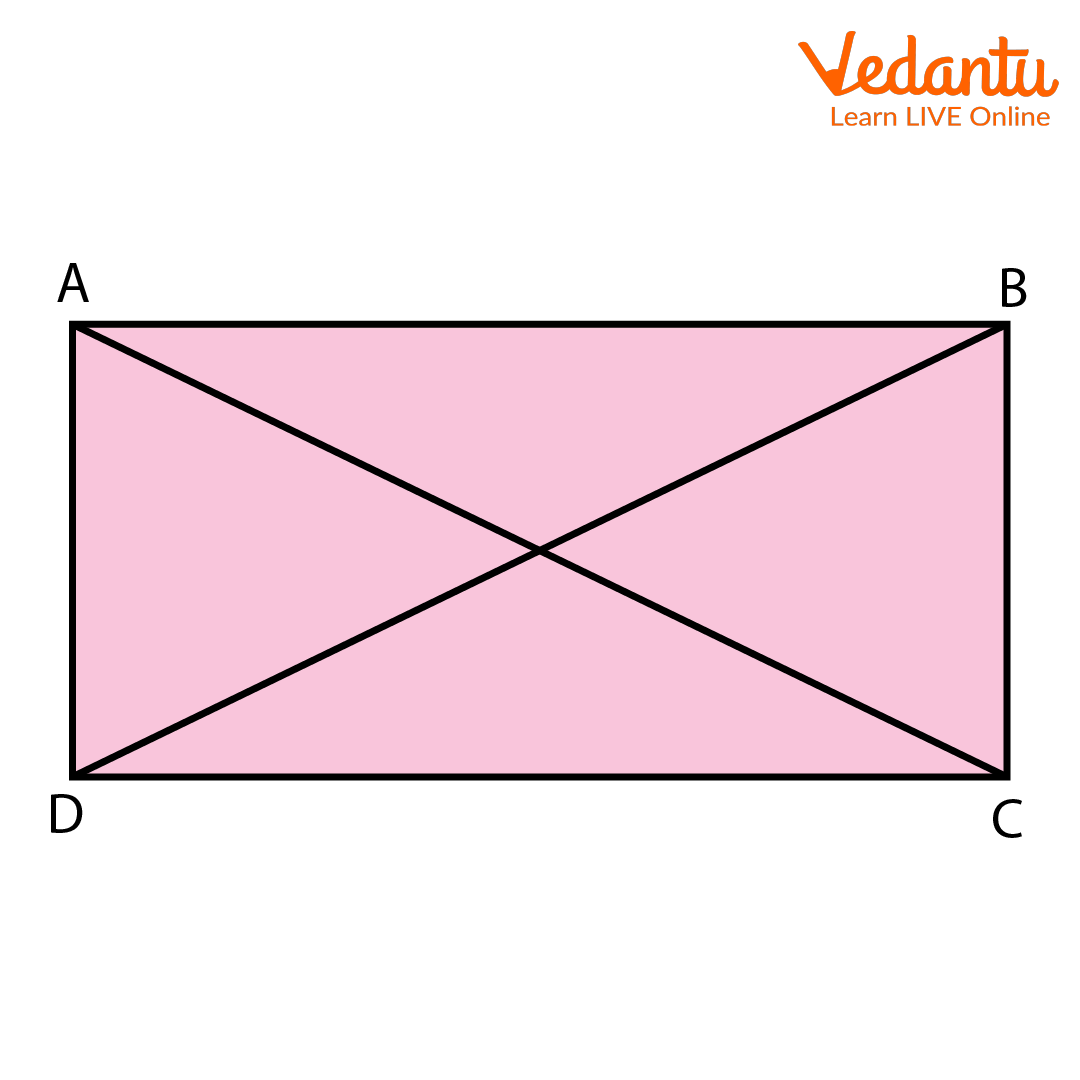
Number of Diagonals in Quadrilateral
In quadrilateral ABCD shown above, AC and BD are the diagonals.
How many Angles are there in a Quadrilateral?
Let us see how many angles does a quadrilateral have? Angles of a quadrilateral refer to the angles formed at each vertex by the adjacent sides of the quadrilateral. A quadrilateral has 4 angles. The sum of a quadrilateral's angles is \[360^\circ \].
In quadrilateral ABCD shown above, \[\angle {\rm{A}}\],\[\angle {\rm{B}}\],\[\angle {\rm{C}}\] and \[\angle {\rm{D}}\] are the angles of the quadrilateral.
Adjacent Sides of a quadrilateral
The sides of a quadrilateral with a common endpoint are called its adjacent sides.
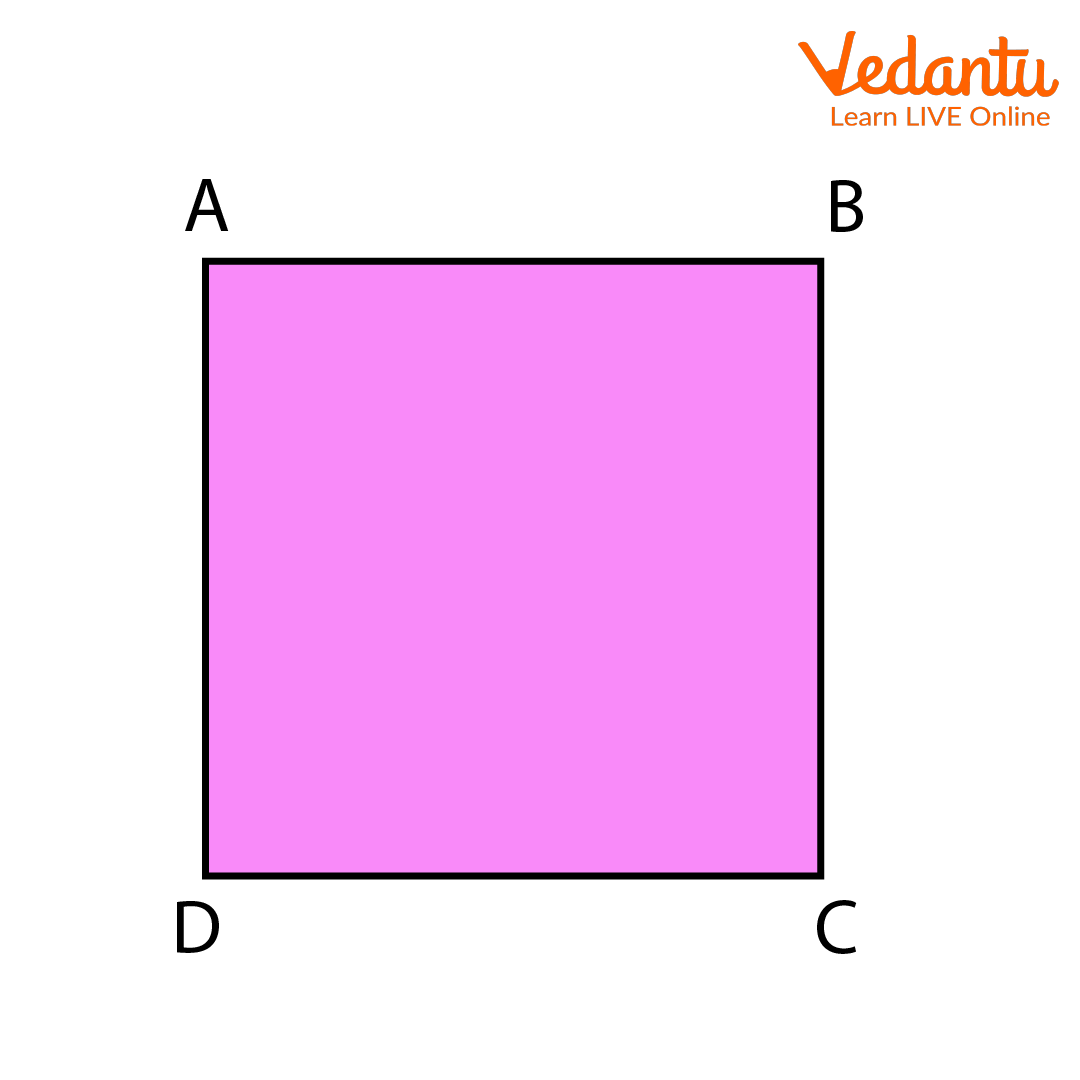
Quadrilateral ABCD
In the given figure, (AB, BC), (BC, CD), (CD, DA) and (DA, AB) are four pairs of adjacent sides of quadrilateral ABCD.
Solved Examples :
Identify the pairs of adjacent sides from the given figure.
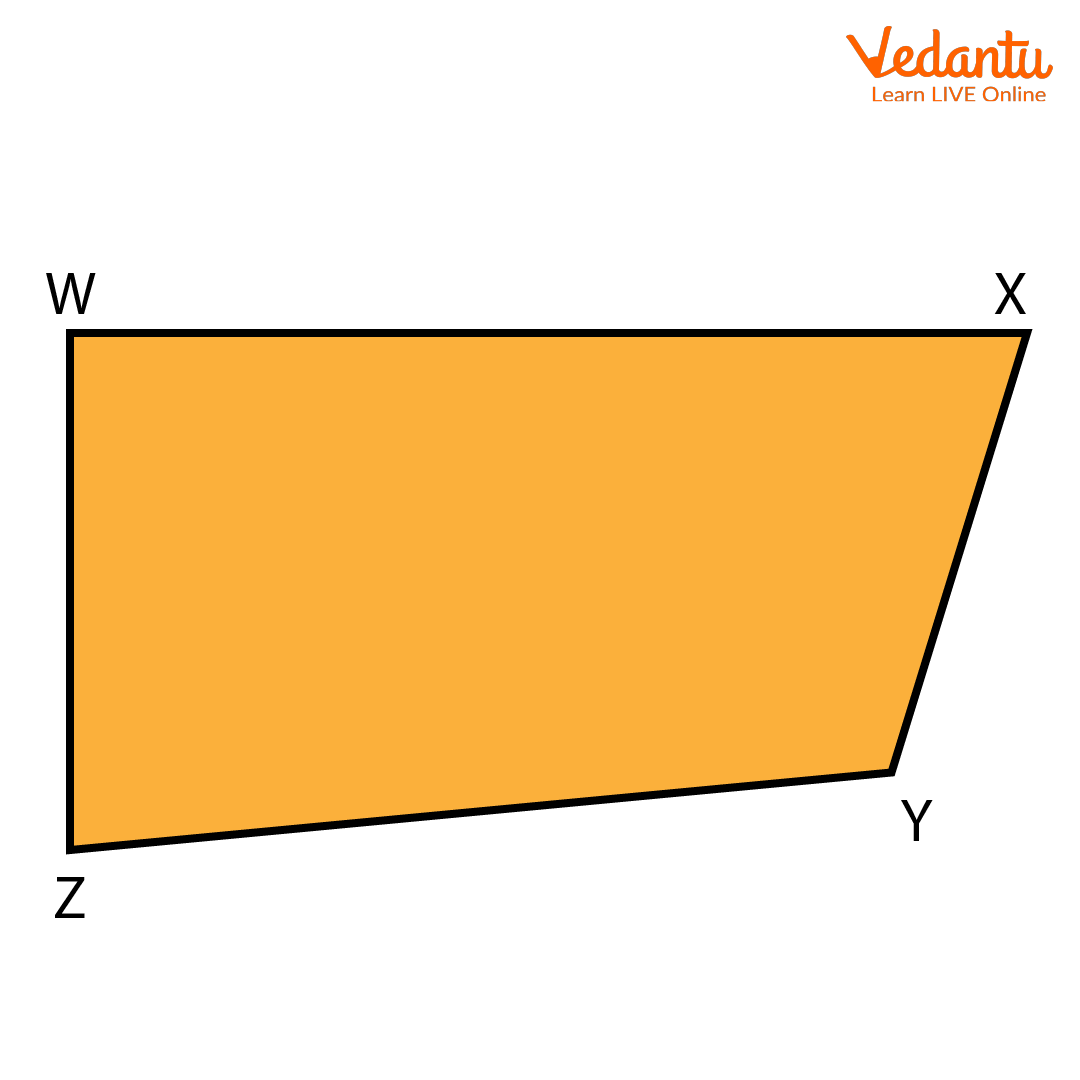
Solution: In the given quadrilateral, WXYZ, (WX, XY), (XY, YZ), (YZ, ZW) and (ZW, WX) are the pairs of adjacent sides.
Identify the pairs of adjacent sides from the given figure.
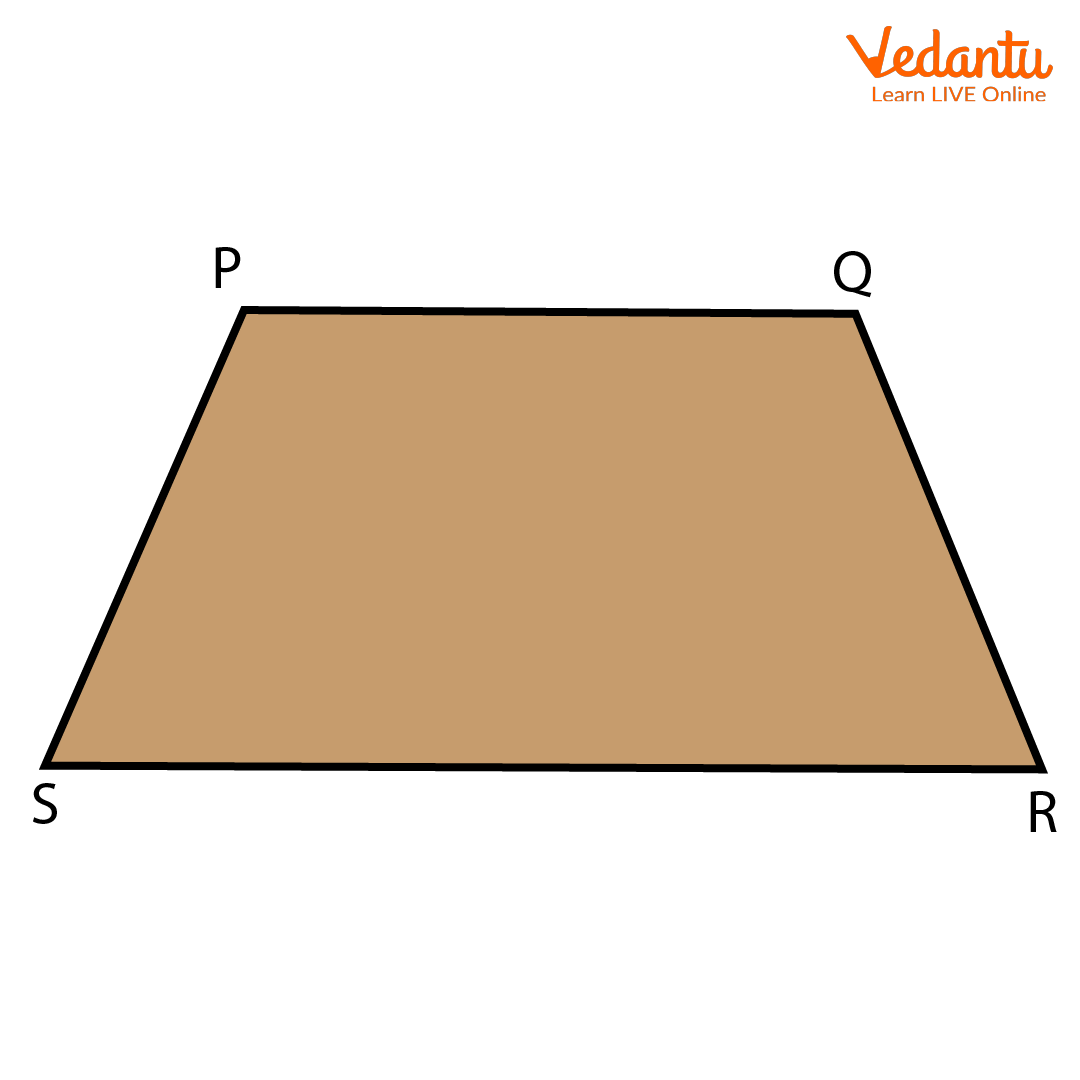
Solution: In the given quadrilateral PQRS, (PQ, QR), (QR, RS), (RS, SP) and (SP, PQ) are the pairs of adjacent sides.
Conclusion:
Thus, a quadrilateral is a closed figure with 4 vertices, 4 sides, 4 angles and 2 diagonals. A quadrilateral has 4 pairs of adjacent sides and 2 pairs of opposite sides. Talking about the angles, it has 2 pairs of opposite angles and 4 pairs of adjacent angles. Examples of quadrilaterals are Square, Rectangle, Rhombus, Parallelogram, Kite and Trapezium.
FAQs on Adjacent Sides in a Quadrilateral Explained Clearly
1. What are adjacent sides of a quadrilateral?
Adjacent sides of a quadrilateral are the two sides that share a common vertex. In any quadrilateral ABCD, sides AB and BC are adjacent because they meet at point B.
- They always touch at one common endpoint.
- They form an interior angle at that vertex.
- Every quadrilateral has four pairs of adjacent sides.
2. How many pairs of adjacent sides does a quadrilateral have?
A quadrilateral has four pairs of adjacent sides. Since a quadrilateral has four sides, each side touches two others at its endpoints.
- AB is adjacent to BC and AD.
- BC is adjacent to AB and CD.
- CD is adjacent to BC and DA.
- DA is adjacent to AB and CD.
3. What is the difference between adjacent sides and opposite sides in a quadrilateral?
Adjacent sides share a common vertex, while opposite sides do not share any endpoints.
- Adjacent sides: Meet at one corner (e.g., AB and BC).
- Opposite sides: Lie across from each other (e.g., AB and CD).
- Opposite sides never intersect in a simple quadrilateral.
4. Can adjacent sides of a quadrilateral be equal?
Yes, adjacent sides of a quadrilateral can be equal in length depending on the type of quadrilateral.
- In a square, all adjacent sides are equal.
- In a rhombus, every pair of adjacent sides is equal.
- In a general quadrilateral, adjacent sides may or may not be equal.
5. Do adjacent sides form an angle in a quadrilateral?
Yes, adjacent sides always form an interior angle at their common vertex. For example, sides AB and BC form ∠ABC.
- Each pair of adjacent sides creates one interior angle.
- A quadrilateral has four interior angles.
- The sum of all interior angles is 360°.
6. How do you identify adjacent sides in a quadrilateral?
You identify adjacent sides by checking which sides share a common endpoint.
- Step 1: Label the vertices in order (e.g., A, B, C, D).
- Step 2: Write the sides (AB, BC, CD, DA).
- Step 3: Look for sides that meet at the same letter.
7. Are adjacent sides always perpendicular in a quadrilateral?
No, adjacent sides are not always perpendicular; they are perpendicular only in special quadrilaterals like squares and rectangles.
- In a square, adjacent sides meet at 90°.
- In a rectangle, all adjacent sides form right angles.
- In a general quadrilateral, angles can have any measure.
8. What is an example of adjacent sides in a quadrilateral?
An example of adjacent sides is AB and BC in quadrilateral ABCD. These sides:
- Meet at point B.
- Form angle ∠ABC.
- Are next to each other in order.
9. How are adjacent sides used in finding the area of a quadrilateral?
Adjacent sides are used in area formulas when the included angle is known, such as in a parallelogram. The formula is Area = ab sinθ, where a and b are adjacent sides and θ is the included angle.
- Example: If a = 5, b = 6, and θ = 30°,
- Area = 5 × 6 × sin30°
- Area = 30 × 0.5 = 15 square units.
10. Do all quadrilaterals have adjacent sides?
Yes, every quadrilateral has adjacent sides because it has four connected line segments forming a closed shape.
- Each side connects to two others.
- These connections create four pairs of adjacent sides.
- This property is true for all types, including squares, rectangles, trapeziums, and irregular quadrilaterals.
