







Understanding Metals: Elements, Alloys, and How They're Formed
Have you ever seen metals? If yes, you must observe something like this:
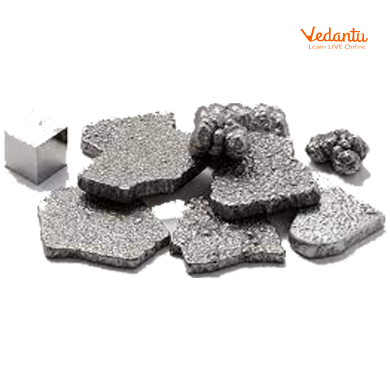
Metal
A metal is a type of solid substance that is usually hard, and shiny which when freshly polished shows lustre. They are minerals like iron or lead that are found underground in the rocks. These are separated from the rocks using heat.
Metals are good conductors of electricity as well as heat which makes them useful for various purposes in utensils and electrical wires. Apart from this, they have a good shine so are used to make jewellery. Metals also have high reflectivity of light.
What Are Metals Made up of?
Metals are made up of atomic materials such as electrons, neutrons, and protons. Atoms of different elements can be distinguished from one another by the number of protons they contain. Metals comprise about 25% of the earth's crust. It was found about 11,000 years ago.
Primary Types of Metals
Metals can be categorised according to their physical as well as chemical properties.
The different types of metals are as follows.
Iron
Iron is a highly abundant and immensely popular type of metal. It is used in making different products such as cookware because its porous surface prevents the food from sticking, and thus the cooking process is completed in a good manner. In heavy machinery also, iron is used to make machines with heavy bases.
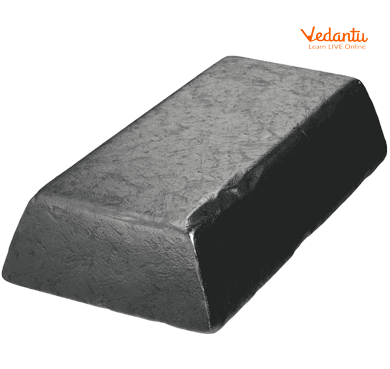
Iron
Aluminium
It is widespread metal on planet Earth and originates from or derived from its ore called bauxite. It has different properties such as being durable, lightweight and is corrosion free, or resistant to corrosion, and a good conductor of electricity.
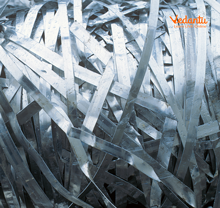
Aluminium
Copper
Copper is an important metal and does not occur in nature in its pure form. It has excellent heat conductivity. Copper reacts with the oxygen present in the air and thus further leads to corrosion. It turns green in colour and stops corroding further. It is reddish in colour in normal form.
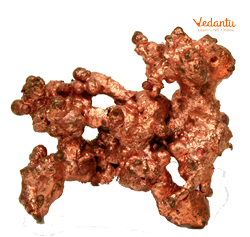
Copper
Potassium
The potassium element is denoted by the symbol K. Iit is a silvery-white soft metal, waxy in nature and it can be cut with a knife easily. It has a low melting boiling point, lower density than water, and active chemical properties. Potassium is present in igneous rocks. Potassium is required by all plants and animals.
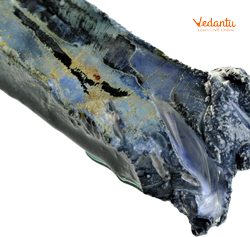
Potassium
Gold
Gold is a metal element that has a symbolic representation of Au and the atomic number is 79. It is a precious metal and is used in making jewellery and is one of the monetary metals. It is solid at room temperature with high density, has a great softness, and is very bright.
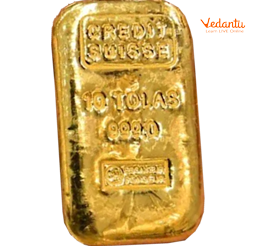
Gold
Things Made up of Metal
In everyday life, we use numerous things made up of metal. These include utensils, pencils, nail cutters, foil paper, wires, jewellery, bolts and nuts, gates, coins, alloy wheels, tools, cutlery, car parts, metal windows, and doors. Also, mercury is used in the thermometer and helps to check the temperature. Sodium and titanium are used in atomic energy in science projects. Lead, which is an important metal, is used in making car batteries.
Interesting Facts about Metals
Metals can be recycled numerous times and they will not lose their properties.
Metals form positively charged ions called cations through the loss of electrons.
The most abundant metal in the universe is Iron followed by magnesium.
Vanadium is the most beautiful metal of all.
Rhodium is the most expensive metal on the planet.
Summary
Metals are good conductors of heat and electricity. They are elastic in nature and are known as metalloids as they have properties of both metals and nonmetals. They can be hammered into sheets or wires. Metals come from the earth's crust and are found in ores, minerals, and rocks.
FAQs on What Is Metal Made Of?
1. What is metal made of?
Metals are natural materials made up of tiny building blocks called atoms. Each type of metal, such as iron, copper, or gold, is made of its own unique kind of atom. These atoms are packed together very tightly and held by strong bonds, which is what gives metals their characteristic strength and hardness.
2. What are the main properties of metals?
Metals are known for several key properties that make them useful in our daily lives. These include:
Lustre: They are typically shiny when polished.
Strength and Hardness: They are tough and can withstand heavy loads without breaking.
Malleability: They can be hammered or pressed into thin sheets, like aluminium foil.
Ductility: They can be drawn into thin wires, such as copper wiring.
Conductivity: They are excellent conductors of both heat and electricity.
3. What are some everyday things made of metal?
You can find metal in many common objects around you. Some examples include:
Kitchen Items: Spoons, forks, knives, and cooking pots are often made from steel or aluminium.
Transportation: Cars, bicycles, trains, and aeroplanes use metals like steel and aluminium for their frames and engines.
Buildings: Structural beams, pipes, gates, and door handles are commonly made from iron or steel.
Jewellery: Precious metals like gold, silver, and platinum are used to make rings, necklaces, and bracelets.
4. How do we get metals? Do they come from rocks?
Yes, most metals are extracted from the Earth's crust where they are found mixed with rock. These special rocks that are rich in metal are called ores. To get the pure metal, the ores are first dug out of the ground through a process called mining. After mining, the ores are processed, often using heat, to separate the valuable metal from the rock and other impurities.
5. Why are cooking pots and pans almost always made of metal?
Cooking pots and pans are made of metal because metals are excellent conductors of heat. This property allows heat from the stove to transfer quickly and evenly to the food, ensuring it cooks properly. Additionally, metals like stainless steel and aluminium are strong, durable, and have high melting points, so they can withstand high cooking temperatures without getting damaged.
6. What is the difference between metals and non-metals like wood or plastic?
The primary difference lies in their physical and chemical properties. Metals are typically shiny, hard, and strong, whereas non-metals are usually dull and brittle. A key distinction is that metals are good conductors of heat and electricity, while non-metals are poor conductors (insulators). For example, a copper wire (metal) conducts electricity, but its plastic coating (non-metal) does not.
7. Are all metals magnetic like iron?
No, not all metals are magnetic. While iron is strongly magnetic, and metals like nickel and cobalt also show magnetic properties, most other common metals are not. For example, aluminium, copper, gold, and silver are not attracted to magnets. Magnetism is a unique property found in only a few specific types of metals.
8. Why are gold and silver considered precious metals for making jewellery?
Gold and silver are highly valued for jewellery for several reasons. Firstly, they have a brilliant, attractive lustre (shine). Secondly, they are highly unreactive, meaning they do not rust or tarnish when exposed to air and moisture, keeping their appearance over time. Lastly, they are very malleable, which allows them to be easily shaped into intricate and beautiful designs without breaking.
