







Why Is Sphalerite Important in Evs? Real-World Uses for Students
Sphalerite is the most important ore of zinc. It is a sulphide mineral with the chemical formula (Zn, Fe)S. It was discovered in 1847 by German geologist Ernst Friedrich Glocker. He named sphalerite based on the Greek word sphaleros meaning 'deceiving' because it is difficult to identify as it is often mistaken for galena, valuable lead ore.

Sphalerite Mineral
Where is Sphalerite Found?
Sphalerite is formed under a wide range of low-to-high temperatures. It is mainly found in the veins and irregular displacement beds in limestone. It is deposited worldwide in hydrothermal veins and contacts metamorphic deposits in igneous rocks.
Sphalerite Properties
Sphalerite occurs in different colours and forms. Impurities, like iron, are often present. Some varieties are pale yellow and red and are translucent due to very little iron. Some varieties are darker and more opaque because they contain more iron. Some varieties are also fluorescent in ultraviolet light. They are non-magnetic.
Given below are some physical properties of sphalerite:
Colour: green, yellow, light to dark brown, red-brown, red, black, and colourless.
Lustre: adamantine, greasy, resinous, nonmetallic, submetallic.
Streak: pale yellow, brownish, white often with an odour of sulphur.
Tenacity: brittle.
The dispersion of three times that of a diamond.
Important Uses of Sphalerite
Sphalerite is the primary ore of zinc and the zinc mined from sphalerite is used to obtain brass, an alloy of copper.
Crystals of suitable size and transparency are fashioned into gemstones, featuring a brilliant cut.

Sphalerite Gemstone
Zinc mined from sphalerite is used as a protective coating to prevent corrosion and rusting.
The zinc extracted from sphalerite is also used as an electrode in batteries. It allows high energy to be stored in smaller areas.
It is also used in making paint and dyeing.
Sphalerite Medical Uses
The zinc mined from sphalerite is also used to produce zinc supplements in the pharmaceutical industry. It is used as a micronutrient for plants, humans, and animals.
Learning by Doing
Choose the Correct Answer.
Sphalerite is also called a blender.
True
False
Where is sphalerite used?
Making paint
Gemstones
In batteries
All of the above.
Solved Questions
How is Sphalerite used in the medical field?
Ans: Zinc sulphide is used to make zinc supplements.
Name two metals other than zinc that are extracted from sphalerite.
Ans: Two metals other than zinc that are extracted from sphalerite are:
Gallium
Germanium
Summary
Sphalerite is an important source of many other metals such as gallium, cadmium, germanium, and indium. Some crystals have red iridescence and are called “ruby sphalerites” or “ruby jack”. Sphalerite is also called blende or zinc blende. We have discussed about the important uses of Sphalerite in detail in this article.
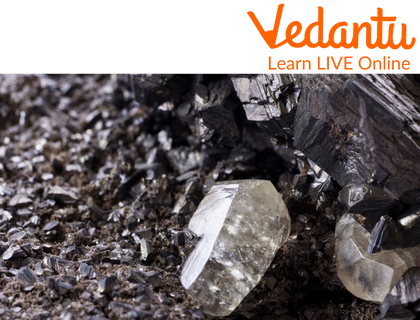
Mineral Sphalerite
FAQs on Uses of Sphalerite: Definition, Applications & Examples
1. What are the most important uses of sphalerite in various industries?
Sphalerite is primarily used as the main ore for zinc metal. Once extracted, this zinc has several critical industrial applications:
- Galvanization: A significant portion of zinc is used to coat steel and iron to protect them from rust and corrosion.
- Alloys: Zinc is alloyed with copper to create brass and with other metals to form bronze and various die-casting alloys.
- Batteries: Zinc acts as an electrode in alkaline batteries, allowing for high energy storage.
- Chemicals and Pigments: Zinc oxide, derived from sphalerite, is used in paints, cosmetics, pharmaceuticals, and as a vulcanising agent for rubber.
- Gemstones: High-quality, transparent crystals of sphalerite are sometimes cut into gemstones, although they are too soft for most jewellery.
2. What is the chemical formula of sphalerite and which metal is it the main ore of?
The chemical formula for sphalerite is (Zn, Fe)S, which is zinc sulfide, often with variable amounts of iron substituting for zinc. It is the most important and widely mined ore in the world for the extraction of zinc metal. Approximately 95% of all primary zinc production originates from sphalerite ore.
3. What are the key physical properties used to identify sphalerite?
Sphalerite can be identified by a combination of its key physical properties:
- Lustre: It has a distinctive resinous to adamantine (diamond-like) lustre, which makes it appear waxy or oily.
- Cleavage: Sphalerite exhibits perfect dodecahedral cleavage in six directions, meaning it breaks along smooth, flat planes.
- Hardness: Its hardness on the Mohs scale is relatively low, ranging from 3.5 to 4, making it easily scratched by a steel knife.
- Streak: The streak (the colour of its powder) is typically a brownish to light yellow, often with the smell of sulphur when scratched vigorously.
- Colour: Its colour is highly variable, from yellow, brown, and red to black, depending on the iron content. Iron-rich varieties are darker and opaque and are often called 'black-jack'.
4. Why is sphalerite considered valuable beyond just being a source of zinc?
Sphalerite's value extends beyond zinc because its crystal structure can host a variety of other rare and valuable elements as impurities. These elements replace zinc atoms in the mineral's lattice. As a result, sphalerite is often a significant secondary source for critical metals such as cadmium, gallium, germanium, and indium. The extraction of these trace elements during zinc processing adds considerable economic value to sphalerite mining operations.
5. How is zinc metal extracted from sphalerite ore?
The extraction of zinc from sphalerite (ZnS) is a multi-step metallurgical process as per the CBSE/NCERT curriculum. The main steps are:
- Concentration: The ore is first concentrated using the froth flotation process, which separates the sphalerite particles from gangue (impurities).
- Roasting: The concentrated ore is then heated strongly in the presence of excess air (a process called roasting). This converts the zinc sulfide (ZnS) into zinc oxide (ZnO).
2ZnS + 3O₂ → 2ZnO + 2SO₂ - Reduction: The zinc oxide is then reduced to zinc metal. This is typically done by heating it with crushed coke (a form of carbon) at a high temperature (around 1400°C).
ZnO + C → Zn + CO
The resulting zinc is then purified through distillation or electrolytic refining to achieve high purity.
6. Where in the world is sphalerite primarily found?
Sphalerite is a common mineral found worldwide in various geological environments, most often in hydrothermal veins alongside other sulfide minerals like galena and pyrite. Major commercial deposits are found in sedimentary exhalative (SedEx), Mississippi Valley-type (MVT), and volcanogenic massive sulfide (VMS) deposits. The top producing countries include China, Australia, Peru, the United States, Mexico, and Canada.
7. Why is sphalerite sometimes called 'false galena' or 'mock lead'?
Sphalerite earns the nicknames 'false galena' or 'mock lead' because it is frequently found in the same deposits as galena (the primary ore of lead) and can have a similar metallic lustre and dark colour, especially the iron-rich 'black-jack' variety. Early miners could easily mistake it for the much denser and more valuable galena. However, it can be distinguished by its lower density, brownish streak (galena has a grey-black streak), and the sulphurous odour it emits when scratched.
