







Why Understanding Planet Earth Matters in Environmental Studies
The third planet from the sun, the one, and only the Earth, is the place in the known world. Earth is the fifth-largest planet in our galaxy. Earth, our home star, is a world unlike any other.
Earth tracks the sun once every 365 days. Since our civil years have only 365 days, we add an extra leap day every four years. A day on earth is 24 hours and the earth makes a complete orbit around the sun. Earth has one moon.
Earth is the planet we live on. Earth is the third planet from the sun, after Mercury and Venus and before mars. Earth Planet is a complex structure.
What is Earth Planet?
The earth is our planet's home. We get oxygen from the earth. The earth is round. It is our planetary system's third planet. Earth is the only planet with life. The earth has seven continents that are very important for the earth.
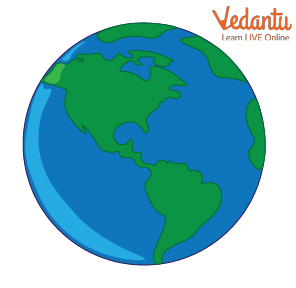
Earth Planet
Earth’s natural satellite is the Moon. There are many people living on earth. The earth provides air to breathe, food to eat, and water to drink. We celebrate Earth Day on 22 April. Earth is our home; we need to look into it. Earth has various platforms. We should not waste natural resources like coal, petroleum, water, and minerals found on earth.
Facts About Earth
Here are some simple facts about earth planet which are as follows:-
Earth is our home planet.
Earth is the third planet from the sun.
Earth goes around the sun in a circle.
Earth is the fifth-largest planet in our solar system.
71% of the earth's surface is covered with water.
Earth spines like a ball over 365 times each year.
Earth is called the blue planet because we have so much water on the earth.
Earth is 93 million away from the sun.
Earth has a diameter of 7,917.5 miles.
The air that we breathe is a mixture of gases.
Earth's atmosphere has 6 layers.
Earth's planet is made up of rock metals.
Earth has a hard surface.
Earth's shape is a perfect sphere.
Earth is very useful to know life because our planet has two important requirements for human life: oxygen and water.
It is also the perfect distance from the sun.
Earth is not too hot and too cold.
Earth’s highest mountain is Mount Everest.
Mount Everest is part of the Himalayan mountain range.
Earth is made up of many different materials.
Earth’s top part is called the North Pole.
Earth’s bottom part is called the South Pole.
Only 3% of the earth’s water is fresh.
The surface of the earth is very young.
Light reaches us from the sun in about 8 minutes.
It is locked to earth, and thus it always shows us just one side of its surface.
Earth is our wonderful world.
There are eight planets:-
Mercury
Venus
Earth
Mars
Jupiter
Saturn
Uranus
Neptune
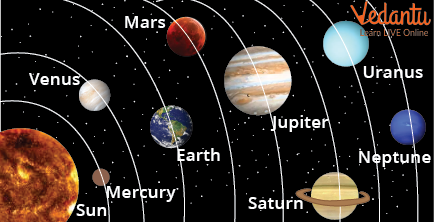
Planet
Worksheet on Planet Earth
1. The earth is a planet.
Ans: Dynamic.
2. What is the only known planet supporting life in the entire solar system?
Ans: Earth.
3: In how many days does the earth take to complete one rotation?
Ans: 365 days and 6 hours.
4: Which is the only natural satellite that revolves around the sun?
Ans: Moon.
5. Name the three landforms on earth.
Ans: Plains, Hills, Mountains, Valleys, and Plateaus.
6. Cores, Petroleum, and Coal are examples of minerals. State true or false.
Ans: True.
7. Landform with pointed peaks____.
Ans: Mountains.
8. What is the atmosphere?
Ans: The air around the earth is called the atmosphere.
9: Which landform looks like a tabletop?
Ans: Plateau.
10: How much part of the earth is covered with water?
Ans: Two third.
Summary
In our galaxy, Earth is the fifth-largest planet. The world of Earth, our home star, is unique in many ways. Every 365 days, Earth follows the sun in its orbit. We add an additional leap day every four years because our civil years only have 365 days.
Earth has a 24-hour day and revolves completely around the sun in one day. Earth has one moon. We reside on the planet Earth. Mercury, Venus, and Mars are the next two planets from the sun, and Earth is the first. This planet's structure is intricate.
FAQs on Planet Earth: Meaning, Characteristics & Key Facts
1. What is Planet Earth?
Planet Earth is the third planet from the Sun in our solar system. It is a special and unique planet because it is the only known place in the universe where life exists. It provides us with everything we need to survive, including water to drink, air to breathe, and land to live on.
2. Why is Earth often called the 'Blue Planet'?
Earth is called the 'Blue Planet' because about 71% of its surface is covered by water in oceans, seas, and lakes. When viewed from space, this vast expanse of water makes our planet look like a beautiful blue marble, giving it its famous nickname.
3. What is the true shape of the Earth?
While we often think of the Earth as a perfect ball or sphere, its true shape is an oblate spheroid. This means it is slightly flattened at the North and South Poles and bulges out a little around the equator. This shape is caused by the Earth's rotation.
4. What are the key things that make life possible on Earth?
Life is possible on Earth due to a perfect combination of factors that are not found on other planets. The three most important are:
Presence of Liquid Water: Water is essential for all known forms of life.
Oxygen-Rich Atmosphere: Our atmosphere contains the right amount of oxygen for us to breathe and also protects us from the Sun's harmful radiation.
Ideal Distance from the Sun: Earth is in the 'Goldilocks Zone,' meaning it is not too hot and not too cold, which allows water to remain liquid.
5. How do day and night happen on Earth?
Day and night are caused by the rotation of the Earth on its axis, which is an imaginary line passing through its centre. As the Earth spins, the part that faces the Sun experiences daylight. The part that is turned away from the Sun is in darkness, which we call night. It takes 24 hours for the Earth to complete one full rotation.
6. What is the difference between the Earth's rotation and revolution?
Rotation and revolution are two different movements of the Earth:
Rotation is the spinning of the Earth on its own axis. This movement causes day and night and takes about 24 hours to complete.
Revolution is the movement of the Earth in its orbit around the Sun. This journey causes the changing seasons and takes about 365 days (one year) to complete.
7. How does the atmosphere protect us?
The Earth's atmosphere acts like a protective shield. Firstly, it contains oxygen, which we need to breathe to live. Secondly, it absorbs and blocks most of the Sun's harmful ultraviolet (UV) radiation. Lastly, it also burns up most of the meteors and space rocks before they can hit the ground, protecting us from impacts.
8. If the Earth is always moving so fast, why don't we feel it?
We don't feel the Earth's movement because everything on Earth, including us, the air, and the buildings, is moving along with it at the same constant speed. It is similar to being in a car or a train moving smoothly on a straight path—you don't feel the speed unless it suddenly slows down or speeds up. Since Earth's spin is very steady, we don't notice the motion at all.
9. What are the eight planets in our solar system, in order from the Sun?
There are eight planets in our solar system. In order from the Sun, they are: Mercury, Venus, Earth, Mars, Jupiter, Saturn, Uranus, and Neptune.
