







Explore Country Names with Flags and Interesting Facts
A state, nation, or other political entity with a distinct territorial body is known as a country. It may be a sovereign state or a component of a larger state, a non-sovereign or formerly sovereign political division, a territory with a functioning government, or a geographical area containing a variety of politically distinct people who have historically been independent or otherwise associated.
Russia is the country with the largest land area, and Vatican City is the smallest. The Pitcairn Islands have the lowest population, and the country China has the highest population.
Country Symbols
The cultural, religious, or political representation of any nation or race that makes up a country is indicated by its symbols. Flags, coats of arms, and seals all use a variety of symbol categories.
Flags
Coats of arms or national emblems
Seals or stamps
National mottos
National colours
National anthems
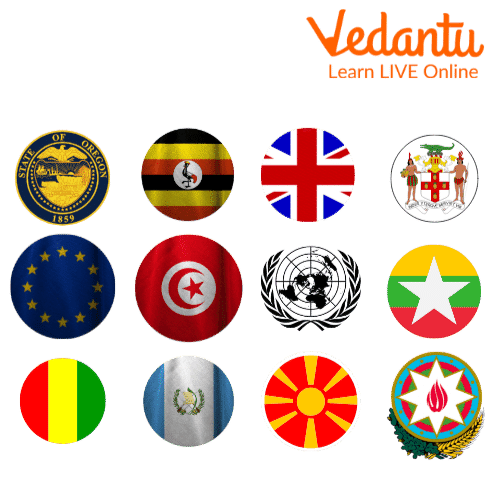
National Symbols of Different Countries
Country Classification
Many organisations look at trends to create country categories. Countries can sometimes be divided into
Developed countries
Developing countries
Today, there are 195 nations in the world. This number includes the Holy See and the State of Palestine, two non-member observer nations, together with the 193 United Nations member states.
The following nations are excluded from the total of 195 countries:
The People's Republic of China is considered to be Taiwan's representative by the United Nations.
The Cook Islands and Niue, both states in free association with New Zealand, are neither member states nor non-member observer states, although they are both recognized as having "full treaty-making ability" and are members of a number of UN specialised bodies.
Areas of Special Sovereignty and Dependencies (also Dependent Territories, Dependent Areas, Dependencies) (autonomous territories).
Other nations that the UN has acknowledged as not having independent governments.
How the World is Divided of the 195 Countries in the World
54 countries are in Africa
48 in Asia
44 in Europe
33 in Latin America and the Caribbean
14 in Oceania
2 in Northern America
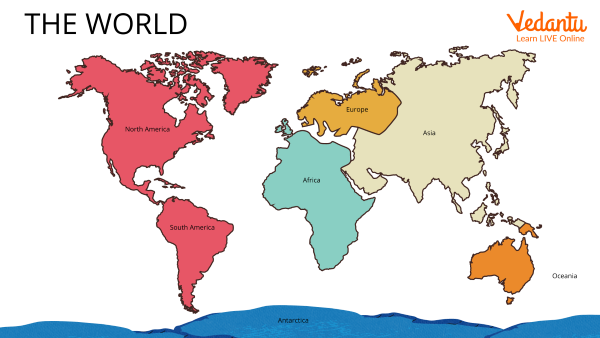
The World
Country Names
According to the alphabetical order, a list of country names is mentioned below.
Summary
In general, a country is one that has a permanent population, a clearly defined territory, a functioning government, and the ability to engage in diplomatic contacts with other governments. Global economic policies are constantly shaped by the most powerful nations, who rule the world through these characteristics: political stability, economic influence, defence spending, national arsenals, international alliances, etc. In this given article, an introduction about the meaning of a country is mentioned. General knowledge regarding the country and the symbols is briefly given. The list of names of the countries that are present on the globe is also listed in the same.
FAQs on List of Country Names
1. What is the definition of a country?
A country is a distinct region of land that has its own government, administration, and borders. It can be an independent sovereign state with full control over its territory, or a part of a larger state. Each country has its own unique laws, culture, and population.
2. How many countries are there in the world in 2025?
As of 2025, there are 195 recognised countries in the world. This total includes 193 member states of the United Nations, along with two non-member observer states: the Holy See (Vatican City) and the State of Palestine.
3. Why do we sometimes hear different numbers for the total count of countries?
The number of countries can seem to vary because different organisations and nations have different criteria for political recognition. While the UN lists 195, some countries or territories have declared independence but are not universally recognised. These regions, like Taiwan or Kosovo, are sometimes included in other lists, leading to a higher count. The official number changes only when new nations are formed or recognised by international bodies like the UN.
4. Which are the largest countries in terms of land area and population?
The largest countries are measured in two ways: by area and by population.
- By Land Area: Russia is the largest country in the world, covering over 17 million square kilometres.
- By Population: India has the world's largest population, with over 1.4 billion people, followed closely by China.
5. What is the main difference between a country and a continent?
The main difference lies in their definition and scale. A continent is one of the world's massive, continuous landmasses. There are seven continents: Asia, Africa, North America, South America, Antarctica, Europe, and Australia. A country is a smaller political division with its own government and borders, and many countries can exist within a single continent. For example, Italy, Germany, and France are all countries located on the continent of Europe. For more details, you can learn about the 7 continents and their countries.
6. What is a neighbouring country, and which countries share a border with India?
A neighbouring country is a nation that shares a land border with another country. These borders are important for trade, travel, and international relations. India shares its land boundaries with seven countries:
- Pakistan
- Afghanistan
- China
- Nepal
- Bhutan
- Bangladesh
- Myanmar
7. Why do different countries have unique flags and names?
A country's name and flag are symbols of its identity, history, and values. Names often originate from historical events, geographical features, ancient tribes, or important figures. For example, 'India' is derived from the river Indus. Flags use colours and symbols to represent the nation's ideals, struggles, and natural beauty. For instance, the green on a flag might symbolise agriculture, while a star might represent unity. These symbols help foster a sense of national pride and distinguish one country from another on the world stage.
8. Can you give some examples of countries and their capitals?
A capital is the city where a country's government is based. Here are a few examples from around the world:
- Japan: Tokyo
- United States of America: Washington, D.C.
- Egypt: Cairo
- Brazil: Brasília
- Australia: Canberra
