







Overview of Venus
Today we are going to look at the planet, Venus. Venus is the second planet in the solar system. It is the hottest and brightest planet in the Solar system. Venus used to have a big ocean like Earth but the ocean disappeared because of some unknown reasons. Venus is also known as “Morning Star” or “Evening Start” because from Earth we can see it at sunrise and sunset. Let's fasten your seat belts and get ready to land on this brightest planet in the solar system. This article consists of many interesting facts about venus for kids. So let’s dive in and learn more about this interesting planet.
How did it Get Its Name?
The name of this planet came from the Roman Goddess of love and beauty, because of its shine. Earlier only five planets were known and among those five planets, Venus was the brightest Planet. It is the only Planet named after a female. So we will refer to it as “she”.
Why Venus is called Earth’s Twin Sister
Venus is called Earth’s twin sister because both of them have approximately the same size and same weight. They both are made up of the same materials and they both have the almost same distance from the Sun. And also they both are neighbours. Also, gravity on Earth and Venus is the same.
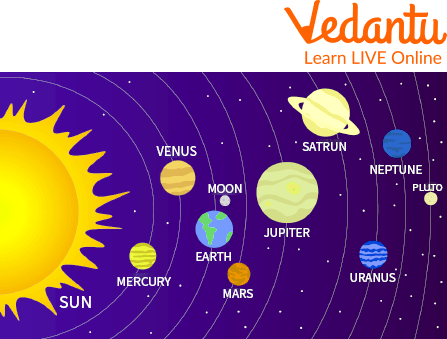
The Planets in the Solar System
Reason for Its Brightness
In the sky, there are three bright objects –
1. Sun
2. Moon
3. Venus
The reason for the brightness of Venus is due to its clouds. Venus is covered by dense clouds. These clouds are highly reflective. When sunlight reaches it, the clouds reflect the light back to space and it seems bright.
Composition of Venus
Venus is a rocky planet mainly made up of iron core and rock surface, the same as Earth. The atmosphere of Venus has mainly Carbon dioxide, Nitrogen and some other gases in very small amounts. It has thick clouds of sulphuric acids. As per the estimates, there is 96 per cent molecular nitrogen. There are also some tracks of other gases present such as water vapour, argon, helium and so on.
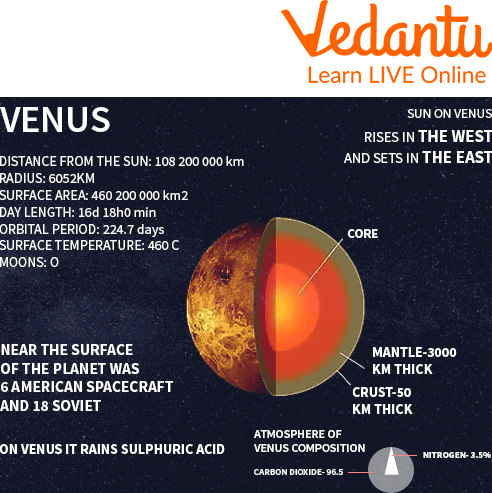
Composition of the Planet Venus
Rotation of Venus
The rotation of Venus is opposite from all other planets in the Solar system. The spin of Venus is very slow. Venus rotates from east to west. Therefore the Sun rises from the West on Venus. Here in Venus, the days are long and years are short. One day of Venus is equal to 243 days on Earth because it rotates very slowly on its axis. As shown below in the image you can see the rotation of planet Venus and Planet Earth is opposite.
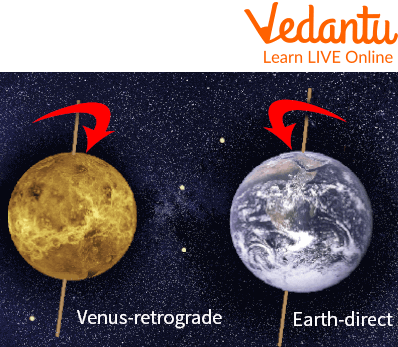
Rotation of planets Earth and Venus
Why Life is Impossible on Venus
There are several reasons for this. The first reason is the high temperature of Venus. As we know it is the hottest planet in the world. Another reason is there is no evidence of water on the planet. As humans or animals and plants can survive without water, this is also the main reason for the impossibility of life on this planet. Another reason is the atmosphere of this planet is very thick. The atmosphere is so dense that sunlight can not penetrate it.
Important facts about Venus
Distance from Sun - 108.2 million km
Length of the day on Venus - 116d 18h 0m
Orbital Period - 225 days
Distance from Earth - 253.53 million km
Diameter of Venus - 12,104 km
Mass of Venus - 4.868 × 1024
The density of Venus - 5.204 g/cm3
Summary
Now you have all the important knowledge of the planet Venus. As you all know, Venus looks like a very bright star. The Roman people knew about seven bright objects. They name the brightest star after the name of their goddess. Venus is almost the same as Earth in size, mass and gravity. Now as you have travelled to this beautiful planet, you are ready to tell your friends all the facts about this brightest planet in the solar system. We discussed the facts about venus for kids. Now, we know almost everything about the hottest and brightest planet in the solar system. I hope this article will be beneficial for you. Feel free to ask your doubts in the comments.
FAQs on Facts About Venus for Kids
1. What are some simple facts about the planet Venus for kids?
Venus is a fascinating planet with many unique features. Here are a few simple facts for students:
- It is the second planet from the Sun, right after Mercury.
- Venus is often called Earth's "twin" because they are almost the same size.
- A day on Venus is longer than its year. It takes Venus 243 Earth days to spin once, but only 225 Earth days to go around the Sun.
- It is the hottest planet in our solar system.
- Unlike most planets, Venus spins backward.
2. Why is Venus often called Earth's 'twin sister'?
Venus is called Earth's 'twin' primarily because of their similarities in size, mass, and composition. Both are rocky, terrestrial planets of a comparable physical size. However, this nickname can be misleading. Despite these structural similarities, the two planets are extremely different in terms of atmosphere, temperature, and surface conditions, making Venus completely uninhabitable for humans.
3. Can we live or breathe on Venus?
No, humans cannot live or breathe on Venus. The atmosphere is extremely toxic, made mostly of carbon dioxide with clouds of sulphuric acid. The atmospheric pressure is over 90 times that of Earth, which would crush a person. Furthermore, the surface temperature is incredibly high, around 465°C (869°F), which is hot enough to melt lead.
4. What is the weather like on Venus?
The weather on Venus is very extreme and nothing like Earth's. The planet is covered by a thick, permanent layer of clouds made of sulphuric acid, not water. These clouds create incredibly high surface pressure. The entire planet experiences a runaway greenhouse effect, trapping heat and making it the hottest planet, while winds in its upper atmosphere can reach super-hurricane speeds.
5. How many moons does Venus have?
Venus has no moons at all. It is one of only two planets in our solar system without any natural satellites, the other one being Mercury. Scientists believe that being so close to the Sun's powerful gravity makes it difficult for a planet like Venus to hold onto a moon.
6. Why is Venus the hottest planet if Mercury is closer to the Sun?
This is a great question that shows how important a planet's atmosphere is. While Mercury is closer to the Sun, it has a very thin atmosphere and cannot hold onto heat. Venus, on the other hand, has an extremely thick and dense atmosphere rich in carbon dioxide. This atmosphere acts like a thick blanket, trapping the Sun's heat in a process called the runaway greenhouse effect, which raises the temperature to extreme levels all over the planet.
7. What is unusual about how Venus spins?
What's most unusual about Venus is its rotation. It spins on its axis in the opposite direction to most other planets in the solar system, including Earth. This is known as retrograde rotation. So, if you could stand on Venus, you would see the Sun rise in the west and set in the east. It also spins very, very slowly.
8. How can a day on Venus be longer than its year?
This strange fact is due to Venus's incredibly slow rotation. A 'day' is the time it takes for a planet to spin once on its axis, while a 'year' is the time it takes to orbit the Sun. Venus spins so slowly (taking 243 Earth days) that it completes its entire orbit around the Sun (in just 225 Earth days) before it finishes a single rotation. This makes its day longer than its year.
9. What is Venus made of?
Similar to Earth, Venus is a rocky planet. It is believed to have a structure consisting of a central iron core, a rocky mantle, and a solid crust. The surface is a dry, rocky landscape with many volcanoes and mountains, but it is completely hidden from our view by its thick, permanent cloud cover.
10. Why does Venus appear so bright in our night sky?
Venus is one of the brightest objects in our night sky, often called the 'Morning Star' or 'Evening Star'. Its brightness is caused by its highly reflective atmosphere. The thick clouds of sulphuric acid that cover the planet are excellent at reflecting sunlight, bouncing a large amount of it back into space, which is why it shines so brightly when viewed from Earth.
