







Introduction to Little Creatures Bee
Have you ever seen the small organisms which are multi-legged? These are called insects. So insects are creatures which have their body in three segments and are protected by a hard shell, and yes there is one more thing and that's that most insects also have wings and antennae as well.
In this article, we are going to talk about bees. Bees are the most important and amazing creatures on our planet. We will also learn about bees, bee facts for kids, what are honey bee facts for kids, what's the difference between honey bee and bumblebee, what is honey bee for kids and many other things related to bees. So let's get started.

Bee
What are Bees? Let's Understand Bees for Kids.
Bees are small flying insects. They are different in colour, mostly their colour depends upon the area you find them.
But the small kids have seen honeybees which mostly look the same and have black stripes alternating with bands of brown or yellowish colour.
There are more than 20,000 species of bees. But the best-known kinds of bees are honeybee and a bumblebee.
They are very important insects for humankind.
Importance of Bees
Bees play a very important role in the life of human beings. They have a very important part to play in maintaining our planet.
1. They Help in Pollination
Bees are the type of insects that gardeners like because they are very helpful to them. They help with the pollination of plants and make seeds to grow more plants, which can create some tasty fruits to eat.
When bees sit on flowers the pollen gets stuck to the hair of the bees and when they move to the next plant of the same species it is transferred in adequate quantity to their stigma. So in this way, the bees help in pollination.

Bee Performing Pollination
2. They Make Honey
Another important work that bees do is that they produce honey which has numerous medicinal properties. Bees collect nectar from the plants and then convert that nectar into honey and store it in their hive. They collect the honey because flowers and their nectar are not available throughout the year so they use the stored honey throughout the year to get energy.
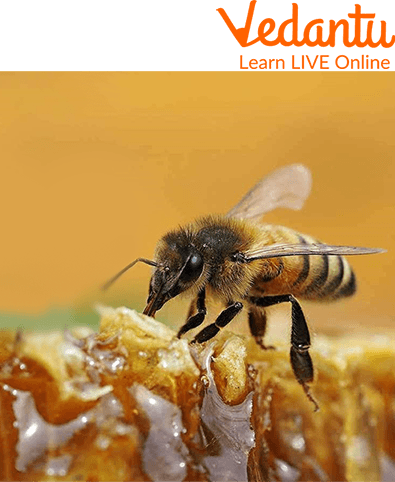
Honeybee
Difference Between Honeybees and Bumblebees
Let’s take a look at the differences between honeybees and bumblebees:
Honeybees make lots of honey. On the other hand, Bumblebees make little honey.
Honey Bees live for 3+ years while Bumble Bees life span is around 1 year.
Honey Bees make their nest above ground while Bumblebees make their nests below the ground.
If we talk about their body structure then honeybees are thin with little hair and distinctive head while Bumblebees are large, round and furry.
Honey Bees only sting once but Bumblebees can sting multiple times.
Honey bees are less effective pollinators but bumblebees are more effective pollinators.

Honey Bees vs Bumblebees
Bee Facts for Kids
Given below are some bee facts for kids:
Honeybees are great flyers; they fly at a speed of 25 km per hour.
Honeybees beat their wings 200 times per second.
Bees' eggs take 21 days to develop into an adult.
If we talk about bee language they communicate through dancing.
One queen bee was known to live for 8 years.
Queen bees lay around 1000 eggs per day.
Bees have 5 eyes and 6 legs.
Bees are not able to see red.
Bees have 170 different odour receptors which help them to distinguish flowers from each other.
What Can We do to Help Bees?
Over the past 15 years, the colonies of bees have been disappearing. There can be many reasons but there are some steps which we can take to protect the bees. Let's check some of them.
Grow bee-friendly flowers- it's one of the best ways through which we can help bees. Bees favour a wide range of flowering plants so a small area of your garden can be a lifeline for them.
Ditch the toxic stuff- Pesticides or other chemicals which we use on our plants to protect fruits or vegetables may harm the bees so stop using them.
We should buy local and organic produce- We need to understand that whenever we choose organic food, the pesticides which can harm the pollinators are not used in them, so we should appreciate the farmers who are doing their best to protect the bees.
Create a bee pond- every creature on this planet needs water for their survival so bees too need it. You can try to fill a shallow pan with pebbles and water so that bees have somewhere to land and sip some water.
Let your grass grow- let the part of your garden grow without mowing because bees live flowering weeds and grasses.
Summary
So here in this article, we learned about various facts and things about bees. We learned what are bees, why they are important to us, how they help the gardener, and what are the differences between Honeybees and Bumblebees, we also discussed the interesting facts which were related to bees and finally at the end we learned about how we can help the bees because they are the one who helps the environment in various ways. Now, we are aware of bees and their importance. We hope you enjoyed reading this article, in case of any other doubts feel free to ask in the comments.
FAQs on Facts About Bees for Kids
1. What are some of the most interesting facts about bees for kids?
Bees are fascinating insects with many cool features! Here are a few fun facts:
- Bees have five eyes – two large ones on the sides of their head and three smaller ones on top.
- They communicate with each other by performing a special 'waggle dance' to show where to find the best flowers.
- A single honey bee produces only about 1/12th of a teaspoon of honey in its entire lifetime.
- Only female bees can sting, and they usually only do it to protect their hive.
2. Why are bees so important for our planet and for us?
Bees are incredibly important because they are pollinators. This means they help plants grow by moving pollen from one flower to another. Without bees, many of the fruits, vegetables, and nuts we love to eat, like apples, almonds, and strawberries, would not be able to grow. They play a huge role in keeping nature healthy and ensuring we have food to eat.
3. Do all bees in a hive do the same job?
No, bees in a hive have different roles, much like a family. There are three main types:
- The Queen Bee: Her main job is to lay all the eggs for the colony.
- The Worker Bees: These are all female bees, and they do all the work, such as cleaning the hive, feeding the young, guarding the entrance, and collecting nectar and pollen.
- The Drones: These are male bees whose only job is to mate with a new queen.
4. How do bees make honey?
Bees make honey through a team effort. First, worker bees fly out and collect a sweet liquid called nectar from flowers using their long tongues. They store it in a special stomach. Back at the hive, they pass the nectar to other bees, who chew it and eventually place it in the honeycomb. They then fan the nectar with their wings to help the water evaporate, which turns it into the thick, sweet honey we know.
5. Is it true that honey never spoils?
Yes, it's true! Properly stored honey can last for years, even thousands of years. This is because it has very little water and is naturally acidic, which creates an environment where bacteria and other germs cannot survive. It is one of the only foods that never goes bad.
6. How do bees 'talk' to each other to show where the best flowers are?
Bees have a remarkable way of communicating called the waggle dance. When a worker bee finds a great source of nectar, it returns to the hive and performs a dance. The way it moves its body in a figure-eight pattern and wags its abdomen tells the other bees the exact direction and distance to the flowers. It's like giving them a map!
7. Why do honey bees sting, and do they die after stinging?
Honey bees sting only as a last resort to defend themselves or their hive when they feel threatened. They are not naturally aggressive. When a honey bee stings a person or another mammal, its barbed stinger gets stuck in the skin. When the bee flies away, the stinger is torn from its body, which causes the bee to die shortly after.
