







Classroom Games and Hands On Ideas for Teaching Prepositions to Kids
English grammar is incomplete without words like in, on, at, of, to, above, beneath, etc. But do you know what are these? These words are used with a noun or pronoun to define their place, position, time, or method and are called prepositions. Some additional examples of prepositions are against, among, along, towards, under, upon, below, behind, before, beside, inside, into, near, being, between, during, from, off, until, with, except, etc.
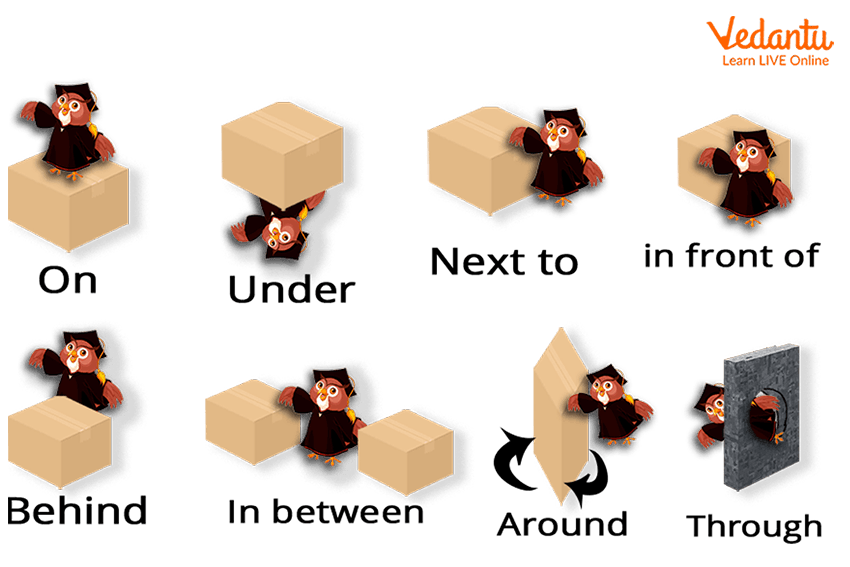
Examples of Prepositions
Teaching prepositions or other such concepts of the English language to kids can become tricky sometimes, which is why we are here to help you.
Here are some basic activities for prepositions to help children understand this important concept easily and in a fun way. So, let’s get started!
Activities for Prepositions
1. Hands-on Preposition Practice
In this activity for prepositions, each student is given the same small toy and a paper cup. Then ask the students to follow your directions using their toys. Now tell the children to put their toy “on” top of the cup, “inside” the cup, “beside” the cup, “beneath” the cup, etc. You can continue the game using different prepositions and can keep a scorecard to declare the winner. This activity will teach students prepositions of direction.
Another similar activity is to make them draw a larger shape and a smaller shape. Then give them instructions to move the smaller shape around, just like you did with the toy and paper cup above.
2. Simon Says
This is another popular game that you can use to teach prepositions to kids. Begin by making all your students stand and choose one thing in the class that everyone has and can use, for example, a chair, book, or pencil. Now give simple instructions using a preposition to describe what you need the player to do in relation to the object.
For example, if you choose a chair, you can say: Simon says stand beside your chair, Simon says sit on your chair, Simon says put your hand under your chair, etc.
Now as per the game’s rules, if a student follows a command without having a “Simon says” or does the wrong motion, they are out.
3. Missing Prepositions
You can gather some things in front of the classroom and ask the students to have a look at them. Now instruct the students to write a sentence about each item using prepositions. For example, a student can write “a pencil is lying on the floor,” or “the book is in the bag.”
Check their sentences and mark them accordingly.
Conclusion
Did you like these activities for prepositions? Aren’t they fun and creative? We have similar activities and worksheets for other important topics of English as well. Check them out on our website!
FAQs on Fun Activities to Help Children Learn Prepositions
1. What are some fun activities for teaching prepositions to children?
Fun activities for teaching prepositions to children include interactive games, movement-based tasks, and visual storytelling that show position and direction clearly.
- Preposition treasure hunt: Hide objects and give clues like “The toy is under the table.”
- Obstacle course: Ask children to crawl under, jump over, or stand between objects.
- Picture description game: Students describe where items are in a picture using in, on, behind, etc.
- Simon Says with prepositions: “Put your hands on your head.”
2. How do you teach prepositions in a fun way?
You can teach prepositions in a fun way by combining movement, visuals, and real-life examples so children physically experience position words.
- Use classroom objects to demonstrate in, on, under, and next to.
- Play role-play games where students place toys in different positions.
- Incorporate songs and action rhymes about place and direction.
3. What is a simple game to teach prepositions of place?
A simple game to teach prepositions of place is the “Where is the Teddy?” game using a toy and classroom furniture.
- Place a teddy bear on the chair, under the desk, or behind the door.
- Ask, “Where is the teddy?”
- Students answer using a full sentence: “The teddy is under the desk.”
4. Why are games important when teaching prepositions to kids?
Games are important when teaching prepositions because they turn abstract grammar rules into concrete, physical experiences.
- Children learn better through movement and play.
- Games improve memory of position words like between and in front of.
- They encourage speaking practice in complete sentences.
5. How can you use classroom objects to teach prepositions?
You can use classroom objects to teach prepositions by physically placing items in different positions and asking students to describe them.
- Put a book on the table.
- Place a pencil under the chair.
- Stand between two students.
6. What are the best preposition songs or movement activities for children?
The best preposition songs and movement activities are action-based songs that require children to follow directions using position and direction words.
- Songs with commands like “Sit on the floor” or “Stand behind your chair.”
- Action rhymes that include over, under, and around.
- Dance routines where students move in front of or next to a partner.
7. How do you explain prepositions of place to a child?
You explain prepositions of place to a child by saying they are words that tell us where something is.
- Give simple examples: “The cat is on the mat.”
- Use gestures to show under, behind, and next to.
- Let the child move objects to show meaning.
8. What is a creative worksheet activity for practicing prepositions?
A creative worksheet activity for practicing prepositions is a picture-labeling or drawing task where students complete sentences about object positions.
- Provide a picture and ask students to fill in blanks: “The ball is under the table.”
- Ask students to draw a cat on the roof or in the box.
- Include matching exercises with images and prepositions of place.
9. How can storytelling help teach prepositions?
Storytelling helps teach prepositions by placing characters and objects in clear positions within a narrative context.
- Create a story like: “The rabbit is in the garden and hides behind a tree.”
- Ask students to act out the story.
- Pause and ask, “Where is the rabbit now?”
10. What are common mistakes children make with prepositions?
Common mistakes children make with prepositions include confusing similar position words and omitting them in sentences.
- Mixing up in and on.
- Saying “The book is the table” instead of “The book is on the table.”
- Confusing behind and in front of.
