









How MS Excel Formulas and Functions Work with Syntax and Examples
MS Excel Formulas and Functions are powerful tools that help users perform calculations, analyze data, and automate tasks within spreadsheets. In computer science and data management, Excel plays a crucial role in organizing, processing, and interpreting numerical and textual data efficiently. Formulas allow users to perform custom calculations, while functions are predefined operations designed to simplify complex tasks. Understanding MS Excel formulas and functions is essential for students, professionals, and businesses that rely on data-driven decision-making and computational accuracy.
Definition and Meaning
MS Excel Formulas and Functions refer to expressions and built-in commands used to perform calculations and data processing in Microsoft Excel.
- Formula - A user-defined expression that performs calculations using cell references, constants, and operators.
- Function - A predefined formula provided by Excel to perform specific tasks such as SUM, AVERAGE, or IF.
- Cell Reference - The address of a cell such as A1 or B5 used in formulas.
- Argument - The values or references passed to a function.
How It Works / Working Principle
The working of MS Excel formulas and functions is based on mathematical logic and cell referencing. Excel calculates results automatically when values change.
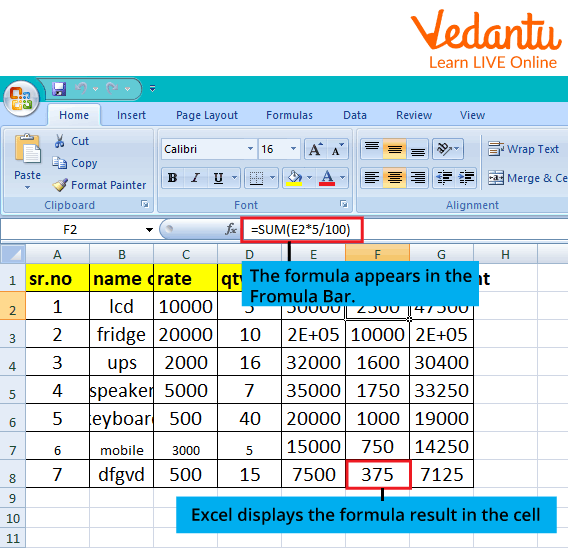
- Every formula in Excel begins with an equals sign (=).
- Users enter numbers, operators such as +, -, *, /, and cell references.
- Excel processes the expression based on operator precedence rules.
- For functions, Excel uses predefined syntax and calculates the result based on provided arguments.
- The result is displayed in the cell, and updates automatically when input data changes.
Formula Entry Bracket in MS Excel:
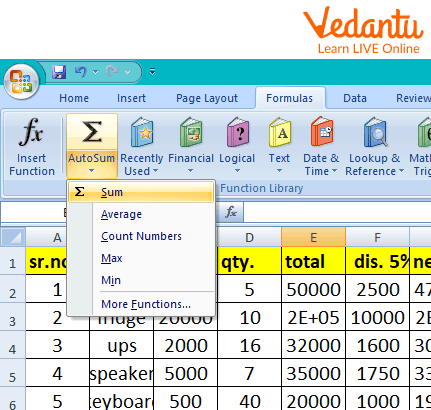
Autosum Tool in MS Excel:
Types and Classification
MS Excel formulas and functions can be classified into different categories based on their purpose.
Types of MS Excel Functions
| Category | Purpose | Examples |
|---|---|---|
| Mathematical | Perform arithmetic calculations | SUM, PRODUCT, ROUND |
| Statistical | Analyze data sets | AVERAGE, COUNT, MAX, MIN |
| Logical | Perform decision making | IF, AND, OR |
| Text | Manipulate text data | LEFT, RIGHT, CONCAT |
| Date and Time | Work with dates and time values | TODAY, NOW |
These categories help users select appropriate functions for specific tasks in Excel spreadsheets.
Syntax and Example
General Formula Syntax
=A1 + B1Function Syntax
=FUNCTION_NAME(argument1, argument2, ...)Example
=SUM(A1:A5)This example calculates the total of values from cell A1 to A5. The SUM function automatically adds all selected cells.
Features and Characteristics
- Automatic recalculation when data changes.
- Supports relative, absolute, and mixed cell references.
- Wide range of built-in functions.
- Supports nested functions.
- Error detection and correction features.
Advantages
- Saves time in performing repetitive calculations.
- Improves accuracy in data processing.
- Easy to use with graphical interface tools like AutoSum.
- Supports complex financial and statistical analysis.
Disadvantages / Limitations
- Errors can occur due to incorrect cell references.
- Complex nested formulas can be difficult to understand.
- Limited handling of extremely large data sets compared to database systems.
Applications and Use Cases
- Budget planning and financial analysis.
- Student grade calculation and report preparation.
- Inventory management.
- Data analysis and statistical reporting.
- Business forecasting and trend analysis.
Quick Facts About MS Excel Formulas And Functions
| Feature | Details |
|---|---|
| Software | Microsoft Excel |
| First Released | 1985 |
| Used For | Data calculation and analysis |
| Common Functions | SUM, IF, VLOOKUP, AVERAGE |
| Platform Support | Windows, macOS, Web |
MS Excel formulas and functions are widely used across industries for efficient data management and computation.
Key Terms / Glossary
| Term | Meaning |
|---|---|
| Cell Reference | Address of a cell in a worksheet |
| Range | Group of selected cells |
| Argument | Input value passed to a function |
| Nested Function | Function used inside another function |
Interesting Facts About MS Excel Formulas And Functions
- Excel supports more than 450 built-in functions.
- The AutoSum feature automatically detects adjacent number ranges.
- Functions can be nested up to multiple levels for complex calculations.
- Excel recalculates formulas instantly when referenced data changes.
- Logical functions enable decision-based automation within spreadsheets.
- Excel formulas are widely used in financial modeling worldwide.
Conclusion
MS Excel formulas and functions are essential tools for performing accurate calculations and managing data efficiently. They simplify complex mathematical, logical, and statistical operations within spreadsheets. Understanding MS Excel formulas and functions in computer science helps students and professionals automate tasks, improve productivity, and make data-driven decisions. Mastery of these tools enhances analytical skills and supports practical applications across education, business, and technology.
FAQs on MS Excel Formulas and Functions Explained for Beginners
1. What are MS Excel formulas and functions?
MS Excel formulas and functions are built-in tools used to perform calculations, data analysis, and logical operations in spreadsheets.
- Formula is a user-defined expression that starts with =, such as =A1+B1.
- Function is a predefined formula like SUM(), AVERAGE(), or IF().
- Used widely in data processing, reporting, and exam-oriented practical tasks.
2. How do formulas and functions work in MS Excel?
In MS Excel, formulas and functions work by taking cell references, values, or arguments as input and returning a calculated output.
- Every formula begins with the = operator.
- Functions follow a specific syntax, such as =SUM(A1:A10).
- Excel automatically recalculates results when input data changes.
3. What is the basic syntax of an Excel function with example?
The basic syntax of an Excel function consists of a function name followed by arguments inside parentheses.
- General syntax: =FUNCTION_NAME(argument1, argument2)
- Example: =AVERAGE(A1:A5)
- Arguments can be numbers, cell references, ranges, or logical values.
4. What are the main types of functions in MS Excel?
MS Excel provides different types of functions categorized based on their purpose in data analysis and computation.
- Mathematical and Statistical: SUM(), COUNT(), AVERAGE()
- Logical: IF(), AND(), OR()
- Text: CONCAT(), LEFT(), RIGHT()
- Date and Time: NOW(), TODAY()
- Lookup and Reference: VLOOKUP(), HLOOKUP(), XLOOKUP()
5. What is the difference between a formula and a function in Excel?
The main difference is that a formula is a custom expression, while a function is a predefined built-in operation in Excel.
- Formula: =A1+A2+A3
- Function: =SUM(A1:A3)
- Functions simplify complex calculations and reduce errors.
6. What are cell references in Excel formulas?
Cell references in Excel formulas are addresses of cells used to retrieve data for calculations.
- Relative reference: A1 (changes when copied)
- Absolute reference: $A$1 (remains fixed)
- Mixed reference: $A1 or A$1
7. What are commonly used Excel functions for exams and interviews?
Some Excel functions are frequently asked in school exams, competitive exams, and job interviews for data analysis roles.
- SUM() and AVERAGE() for calculations
- IF() for decision making
- VLOOKUP() or XLOOKUP() for data retrieval
- COUNT() and COUNTA() for counting data
8. What are the advantages of using functions in MS Excel?
Using functions in MS Excel improves efficiency, accuracy, and automation in spreadsheet-based data processing.
- Reduces manual calculation errors
- Saves time with automated computations
- Supports large datasets and business analytics
- Useful in finance, statistics, and database management tasks
9. What are common errors in Excel formulas and how can they be fixed?
Common Excel formula errors occur due to incorrect syntax, invalid references, or wrong data types.
- #DIV/0!: Division by zero
- #NAME?: Misspelled function name
- #REF!: Invalid cell reference
- Fix by checking syntax, references, and input values.
10. What are real-world applications of MS Excel formulas and functions?
MS Excel formulas and functions are widely used in business, education, and data analysis for managing and processing structured data.
- Financial calculations and budgeting
- Data analysis and reporting
- Student result processing in schools and colleges
- Inventory and database management
