









What Is a Homologous Series Definition General Formula Properties and Examples
A homologous series is a collection of molecules with comparable chemical characteristics and functional groups that differ by CH2 from one another. In organic molecules with the same general formula, carbon chains of various lengths have been discovered. A series of organic compounds are formed by organic compounds that differ from one another by a repeating unit and have the same general formula.
This article will study homologous compounds, homologous series of alcohol, and homologous series of alkanes.
Homologous Series of Carbon Compounds
The functional groups are the same for all members of this series. They have identical physical qualities that increase in mass in a fixed gradation. The characteristics of CH3OH, C2H5OH, and C3H7OH are similar and vary gradually as the molecular mass of subsequent members of the series increases. This is due to the fact that as the molecular mass of the compounds grows, so does the number of bonds. As a result, properties such as melting and boiling points, solubility, and other properties that are dependent on the mass and the total number of bonds in a compound alter gradually as the molecular masses of the compounds increase.
Homologous Series of Hydrocarbons
Hydrocarbons can be classified into four groups, namely, Alkanes, Alkenes, Alkynes, and Arenes.
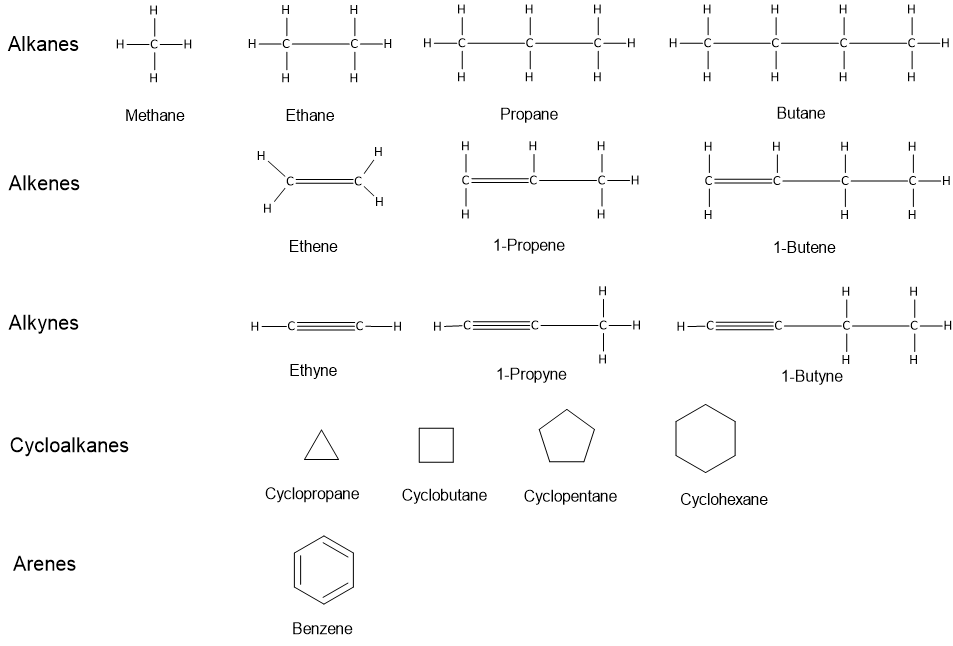
Examples of Hydrocarbons
Homologous Series of Alkanes
Physical Properties of Alkanes:
Solubility: Alkanes are often non-polar compounds due to the small difference in electronegativity between carbon and hydrogen and the covalent character of the C-C or C-H bond.
Polar molecules are soluble in polar solvents, while non-polar molecules are soluble in non-polar solvents, as we know. As a result, alkanes are hydrophobic, meaning they are water-insoluble.
Boiling Point: We see an increase in intermolecular Van Der Waals forces as the molecular size or surface area of the molecule grows.
The boiling point of alkanes rises as their molecular weight rises.
In comparison to their structural isomers, straight-chain alkanes appear to have a greater boiling point.
Melting Point: The melting point of alkanes follows the same pattern as their boiling point, i.e., it rises as molecular weight rises.
This is due to the fact that higher alkanes are solids, making intermolecular forces of attraction difficult to overcome.
Homologous Series of Alkanes are Shown Below in the Table:
Homologous Series of Alkenes
The alkenes form a homologous series.
A Hydrocarbon Homologous Series is a Series of Hydrocarbons Which:
Have the same general formula
In molecular formulas, they differ from neighbouring molecules by CH2.
Demonstrate a steady change in physical attributes, such as boiling and melting points.
chemical qualities that are similar
The homologous series of alkenes have the general formula CnH2n, where n is the number of carbon atoms. The alkene homologous series begins with ethene C2H4 because alkenes are hydrocarbons with at least one carbon-carbon double bond.
The compounds are termed similarly to alkanes but with the suffix "ene" instead of "ane" at the end.
Homologous Series of Alkene is Shown Below:
Homologous Series of Alkynes
The general formula of alkynes is CnH2n-2.
The compounds are termed similarly to alkanes but with the suffix "yne" instead of "ane" at the end.
Alkyne Homologous Series Is Shown in the Table Below:
Functional Groups and Homologous Series
Homologous Series of Alcohol
Alcohol is an organic molecule having an aliphatic carbon atom bearing the hydroxyl (OH) functional group. We often represent alcohols by the general formula ROH, where R is an alkyl group because OH is the functional group of all alcohols. Alcohol is found in abundance in nature. The active element in alcoholic beverages is ethyl alcohol (ethanol), although it is merely one of a group of chemical molecules known as alcohols. In addition to cholesterol and carbs, the family includes other well-known compounds.
Alcohols are given the suffix -ol by the IUPAC system of nomenclature.
An Example of Homologous Series of Alcohol is Shown Below:
Homologous Series of Aldehyde
Aldehyde is a compound containing CHO group
The functional group aldehydes are thought to be the most important. They're commonly referred to as the formyl group. The dehydration of alcohols gives rise to aldehydes. The carbonyl group is linked to at least one hydrogen atom in aldehydes.
Aldehydes are given the suffix -al by the IUPAC system of nomenclature.
Properties
Compounds in a homologous series bearing the same functional group generally display similar chemical properties. The size of the compounds increases in a homologous series with an increase in the number of carbon atoms, thereby raising the molecular weight of the compounds. Increased weight and size sometimes influence the chemistry of the compound such as reactivity and rate of reaction.
Progression of size and weight in a homologous series increases the boiling points of the compounds. For example, ethane has a higher boiling point than methane; the molecules with increasing length have more surface area and experience greater Van der Waals forces with neighbouring molecules.
Uses
Methane gas is found in natural gas, it is used for cooking and heating.
Propane gas is used in cylinders.
Octane is present in gasoline (petrol) and serves as fuel.
Cycloalkanes are found in natural gas, kerosene, diesel and serve as fuels, it is used in motor fuels and oils.
Alkenes can be used as fuels and solvents.
Alkenes due to their reactivity serves as starting material for the synthesis and manufacture of alcohols, plastics, liquors, detergents, and fuels.
Acetylene (C2H2) is used for welding and cutting metals in oxy-acetylene torches.
Acetylene is used in manufacturing for PVC, polyvinyl acetate, polyvinyl ether, orlon and neoprene rubbers.
Interesting Facts
Alkenes are often referred to as olefins.
Alkynes are often referred to as acetylenes.
Key Features
Homologous series is a family of compounds that can be represented by a general formula.
The compounds in a series have similar chemical properties.
Homologous series of hydrocarbons are classified as Alkanes, Alkenes, Alkynes, and Arenes.
Homologous series of Alkanes have general formula: CnH2n+2
Homologous series of Alkenes have general formula: CnH2n
Homologous series of Alkynes have general formula: CnH2n-2
Arenes are cyclic unsaturated compounds with at least one aromatic ring.
Did You Know?
Ethanol, or ethyl alcohol, is the “alcohol” in alcoholic beverages including wine, beer, and spirits. It is the only kind of alcohol that can be consumed without producing substantial bodily harm.
Alcohol is a sedative. This means that it causes the brain's activity to slow down.
According to the National Survey on Drug Use and Health (NSDUH), 86.4 percent of individuals have consumed alcohol at least once in their lives.
According to the NSDUH, 70.1 percent of American adults consumed alcohol in the previous year, and 56.0 percent consumed alcohol in the preceding month.
The effects of alcohol are numerous. It causes the release of dopamine, a neurotransmitter linked to pleasure and contentment, in the brain.
Another benefit of using alcohol is the reduction of stress. An increase in the absorption of another neurotransmitter called GABA causes this.


FAQs on Homologous Series in Organic Chemistry
1. What is a homologous series in organic chemistry?
A homologous series is a family of organic compounds that have the same functional group, similar chemical properties, and differ from each other by a repeating –CH2– unit. In a homologous series:
- All members have the same general formula.
- Successive members differ by 14 u in molar mass (mass of –CH2–).
- They show a gradual change in physical properties like boiling point and melting point.
- They undergo similar types of chemical reactions due to the same functional group.
2. What is the general formula of a homologous series?
The general formula of a homologous series is an algebraic formula that represents all members of that series. Examples include:
- Alkanes: CnH2n+2
- Alkenes: CnH2n
- Alkynes: CnH2n−2
- Alcohols: CnH2n+1OH
3. Why do members of a homologous series have similar chemical properties?
Members of a homologous series have similar chemical properties because they contain the same functional group. The functional group determines the type of chemical reactions a compound undergoes. For example:
- All alcohols contain the –OH group and undergo oxidation or esterification.
- All carboxylic acids contain the –COOH group and react with bases to form salts.
4. How do successive members of a homologous series differ from each other?
Successive members of a homologous series differ by a single –CH2– group and an increase of 14 u in molar mass. For example, in the alkane series:
- Methane: CH4
- Ethane: C2H6
- Propane: C3H8
5. What is the difference between homologous series and isomers?
A homologous series consists of compounds differing by –CH2– units, while isomers have the same molecular formula but different structural arrangements. Key differences include:
- Homologous series: different molecular formulas, same functional group.
- Isomers: same molecular formula, different structural formulas.
- Example of homologous compounds: C2H6 and C3H8.
- Example of isomers: C4H10 (n-butane and isobutane).
6. Can you give an example of a homologous series with formulas?
An example of a homologous series is the alkene series with general formula CnH2n. Some members include:
- Ethene: C2H4
- Propene: C3H6
- Butene: C4H8
7. How do physical properties change in a homologous series?
In a homologous series, physical properties change gradually as molecular mass increases. Common trends include:
- Boiling point and melting point generally increase.
- Density usually increases.
- Solubility in water may decrease as the carbon chain becomes longer (for many organic compounds).
8. What are the main characteristics of a homologous series?
The main characteristics of a homologous series include a common functional group, same general formula, and a difference of –CH2– between members. Specifically:
- Same functional group.
- Same general formula.
- Successive members differ by –CH2–.
- Similar chemical properties.
- Gradual change in physical properties.
9. Why is the concept of homologous series important in organic chemistry?
The concept of a homologous series is important because it helps organize and predict the properties of large numbers of organic compounds. It allows chemists to:
- Predict molecular formulas using a general formula.
- Anticipate chemical reactions based on the functional group.
- Understand trends in boiling point, melting point, and solubility.
10. Do all organic compounds belong to a homologous series?
No, not all organic compounds belong to a homologous series, but many common families do. Compounds belong to a homologous series only if they:
- Have the same functional group.
- Follow a regular pattern differing by –CH2–.
- Fit a specific general formula.
