









An Overview of Class 11 Chemistry To Prepare Crystals Of Potash Alum From The Crude Sample Experiment
The potassium sulphate dodecahydrate is chemically known as potash alum. Evaporation or crystallisation can be used for separation, but crystallisation is a better method of separating the mixture than evaporation. This is because, on evaporation, some solid particles in the mixture get decomposed leaving behind impurities whereas, in crystallisation, pure crystals of solids are obtained.
Pure Potash alum can be used for water purification and fire textiles. It retains a variety of extremely complex species, such as aluminium polymers, depending on the many circumstances, such as dosage, pH, and the pace and mixing of the hydroxide supplement.
Table of Content
Aim
Apparatus Required
Theory
Procedure
Observations
Result
Precautions
Lab Manual Questions
Viva Questions
Practical Based Questions
Aim
To prepare crystals of Potash alum from the crude sample.
Apparatus Required
Crude Sample of Potash Alum
A China Dish
A Funnel
An Evaporating Dish
A Glass Rod
Beaker (400 ml)
Water
Alcohol
Theory
Potash alum is chemically known as potassium sulphate, which is very soluble in water.
Potash alum dissolved in water along with solid impurities which are insoluble in water can be separated by filtration.
After concentrating the filtrate, alum crystals that are pure separate as they cool. The mother liquor retains the soluble contaminants.
Filtration
The technique of removing solid particles from a liquid or gaseous fluid by passing the fluid through a filter media while keeping the solid particles behind. The desired product could be either the fluid that has been cleared or the fluid that has had its solid particles removed.
Concentration
A solute and a solvent are separated during a concentration procedure.
Crystallisation
Crystallisation takes place in two main stages. The first is nucleation, which is the formation of crystals from a supercooled liquid or a supersaturated solvent. The second process, known as crystal growth, results in an increase in particle size and a crystallised state.
Procedure
1. Preparation of Alum Solution
A 400 ml beaker is required. Add 25–30 ml of water and 5–6 grams of the crude potash alum sample to it.
To clarify the solution, shake the beaker's contents.
The sample's total amount of alum should be warmed up to dissolve it.
2. Filtration of the Solution Followed By Concentration of Filtrate to Crystallisation Point
Filter the mixture, then put the filtrate in a China bowl.
The solution should be reduced to about one-third of its original volume in the China dish by heating it over a sand bath or wire gauge.
With a glass rod, the solution is thoroughly swirled while it warms up to prevent the development of a crust on the dish's edge.
Remove a drop of the solution from the glass rod's end and blow it out to chill it.
The glass rod's appearance of a thin crust indicates that the crystallisation point has been reached. At this point, turn off the heat by turning off the burner.
Place the heated, saturated solution in a dish for crystallisation.
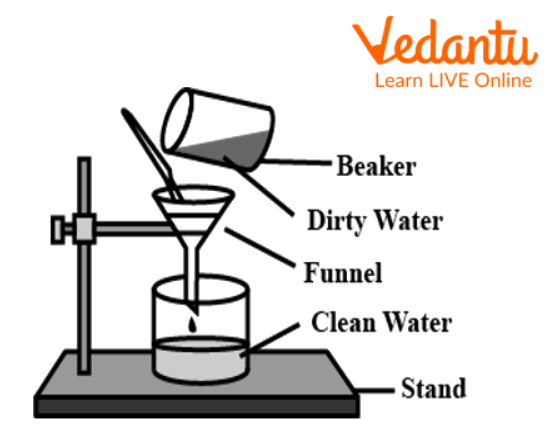
Filtration of the solution
3. Cooling Hot Solution
Place the dish containing the hot, saturated solution atop a beaker of fully filled water and let it slowly cool for a while.
Alum crystals that are clear, colourless and octahedral start to break apart.
The crystallisation is finished in around 30 minutes.
4. Separation of Crystals
Carefully pour off the mother liquor.
Cleanse the crystal alum in a cool alcohol and water solution.
Remove the crystals from the solution-soaked filter paper.
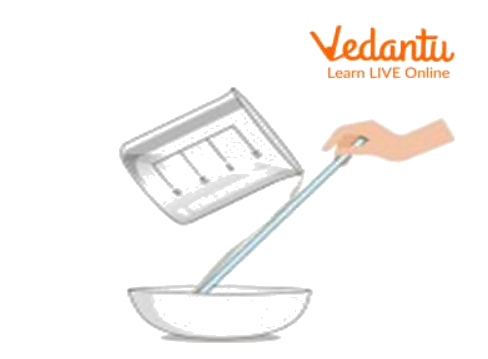
Filtrate to China dish
5. Drying
Transferring the crystals to another filter paper, dry them by gently pushing in between the filter paper’s folds.
Put the crystals in a dry test tube and close the lid.
Observations
Result
From this crystal alum experiment, we separated crystals of alum from its impure sample and obtained transparent colourless crystals of potash alum.
Precautions
Only the amount of filtrate needed to cause crystallisation should be evaporated.
Never let it get too hot or dry. Avoid heating the solution too much, so spilling of hot solution can prevent it.
The solution should be gently chilled without being disturbed. Never let it cool down quickly.
Wash crystals in liquid to get crystals in solid form.
Lab Manual Questions
1. Why are the alum crystals washed with an alcohol-water mixture rather than deionized water?
Ans: A vacuum filter is used to separate the alum crystals from the solution, and they are then cleaned with a solution of alcohol and water. The crystals are not dissolved by this washing liquid; it only eliminates any contaminants from them. Since alcohol is more volatile than water, it also helps to dry the crystals quickly.
2. How to calculate the crystallisation of a sample?
Ans: The easiest way to compute the % crystallisation if your sample has a sharp melting point is to make the ratio of the experimental heat of fusion to the theoretical value for 100% crystalline material.
3. What is the need of heating crude samples?
Ans: On heating potash alum, it loses water of crystallisation. It loses water molecules and gets converted into anhydrous potassium aluminium sulphate.
4. What is the principle behind crystallisation?
Ans: The limited solubility of a substance in a solvent at a particular temperature, pressure, etc. forms the basis of the crystallisation principle. A crystalline solid will emerge if these circumstances are altered to a situation where the solubility is reduced.
Viva Questions
1. What is the purpose of crystallisation in Labs?
Ans: Crystallisation is mostly used in the organic chemistry lab to purify impure solids.
2. What is meant by the saturated solution?
Ans: A solution is said to be saturated when it has dissolved all the solute it can.
3. What is the chemical name of the potash alum?
Ans: Aluminium sulphate
4. What are the characteristics of crystals?
Ans: They are transparent solids with definite pattern arrangements of atoms within them.
5. What are the uses of potash alum in daily life?
Ans: Potash alum is a natural substance used for water purification, fireproof textiles and in baking powders.
6. What is the pH of the potash alum?
Ans: The pH of the Potash alum is around 3.5.
7. What are the three types of crystallisation?
Ans: Evaporative crystallisation, cooling crystallisation from solution or the melt and reactive crystallisation or precipitation.
8. Why doesn't the hot, saturated solution cool down immediately?
Ans: Crystals enlarge as the saturated fluid slowly cools. Instead of providing a massy substance with improper geometry, it aids in their better separation into units.
9. What is meant by solubility?
Ans: The ability of a substance, the solute, to form a solution with another substance, the solvent.
10. What is meant by crude substance?
Ans: Crude substances are in a natural or unrefined state and have not yet been used in manufacturing processes.
Practical-Based Questions
Which filter paper is used in laboratories, mainly for filtration?
Whatman 41
Whatman 1
Whatman 42
None of the above
Ans: Whatman 41 filter paper is commonly used for quantitative and qualitative analysis in laboratories.
What is the colour of the crystals of the potash alum?
White
Colourless
Green
Red
Ans: Potash alum is a colourless crystal.
Select common laboratory solvents for crystallisation.
Water
Ethanol
Acetone
All f the above
Ans: Water, ethanol and acetone are common solvents used for crystallisation.
What is the product obtained when potash alum reacts with an excess of NaOH?
Clear solution
A white precipitate
A bluish precipitate
A yellowish precipitate
Ans: Reaction of NaOH with potash alum results in the formation of water-soluble sodium aluminate.
What is the chemical formula of a potash alum?
K2SO4.Al2(SO4)3.24H2O
K2SO4.Al2(SO4)3.12H2O
KSO4.Al2(SO4)3.24H2O
K2SO4.Al(SO4)3.24H2O
Ans: The chemical formula of potash alum is K2SO4.Al2(SO4)3.24H2O.
Choose the order of preparation of potash alum.
Preparation of solution-cooling-filtration-separation-drying
Preparation of solution-filtration-cooling-separation-drying
Preparation of solution-separation-filtration-cooling-drying
Drying-preparation of solution-cooling-separation-filtration
Ans: Preparation of potash alum from crude follows the order: Preparation of solution-filtration-cooling-separation-drying.
What are the metals present in the potash alum?
Aluminium, Iron
Potassium, Iron
Aluminium, Phosphorus
Potassium, Aluminium
Ans: Potassium and aluminium are the metals present in potash alum.
Potash alum turns blue litmus paper red. It is ________ in nature.
Basic
Acidic
Neutral
None of the above
Ans: Acid turns blue litmus to red. This implies potash alum is acidic in nature.
What technique is used to isolate the alum after it was recrystallized?
Gravity filtration
Centrifugal filtration
Vacuum filtration
Hot filtration
Ans: Vacuum filtration is used to isolate the alum after it was recrystallized.
What property of potash alum makes it useful for the purification of water?
Solubility in water
Removal of hardness
Melting point
None of the above
Ans: Potash alum help in the removal of hardness from water.
Conclusion
From the above crystal alum experiment, we concluded that pure potash alum can be separated from crude samples through crystallisation. Evaporation is also a method to separate pure samples, but it is not as effective in separating the mixture as crystallisation. This is because some solid particles in a mixture dissolve during evaporation, leaving impurities behind, but pure solid crystals are produced during crystallisation.


FAQs on Class 11 Chemistry To Prepare Crystals Of Potash Alum From The Crude Sample Experiment
1. What are the key steps expected in the Class 11 Chemistry practical for preparing crystals of potash alum from a crude sample?
For the CBSE Class 11 practical exam, the preparation of potash alum crystals involves several important steps:
- Dissolution: The crude sample of potash alum is dissolved in a minimum amount of distilled water with a small amount of dilute sulphuric acid, and gently warmed to create a saturated solution.
- Filtration: The hot solution is filtered to remove any insoluble impurities.
- Concentration: The filtered solution is heated gently to evaporate excess water until the crystallisation point is reached.
- Crystallisation: The concentrated solution is then allowed to cool down slowly and undisturbed. As it cools, pure crystals of potash alum will form.
- Separation and Drying: The crystals are separated from the mother liquor, washed with a small amount of ice-cold water, and then dried between folds of filter paper.
2. In the preparation of potash alum, why is a small amount of dilute sulphuric acid added to the solution before crystallisation?
A small amount of dilute sulphuric acid is a crucial addition to prevent the hydrolysis of aluminium sulphate (Al₂(SO₄)₃). Without the acid, aluminium sulphate would react with water to form a gelatinous white precipitate of aluminium hydroxide, Al(OH)₃. This precipitate would contaminate the final potash alum crystals, making them impure and reducing the overall quality of the yield.
3. What factors can affect the percentage yield of potash alum crystals in the experiment, and how can they be controlled?
Several factors are critical for achieving a high percentage yield in this experiment. Important factors include:
- Rate of Cooling: The solution must be cooled slowly and without disturbance. Rapid cooling results in the formation of small, poorly-defined crystals instead of large, pure ones.
- Concentration: Overheating the solution during concentration can lead to the decomposition of the alum. The solution should only be heated until the crystallisation point is reached.
- Filtration Losses: Care must be taken during the filtration of the hot solution to avoid losing a significant amount of the dissolved sample.
- Washing: The final crystals should be washed with a very small amount of ice-cold water or an alcohol-water mixture, as potash alum is soluble in water and excessive washing (especially with warm water) will dissolve the product and lower the yield.
4. Why is it important to cool the concentrated solution of potash alum slowly and without disturbance?
Cooling the saturated solution slowly is essential for growing large, well-defined, and pure crystals. Slow cooling allows the ions (K⁺, Al³⁺, SO₄²⁻) sufficient time to arrange themselves into a stable crystal lattice, resulting in the characteristic octahedral shape of potash alum. If the solution is cooled rapidly or disturbed, it promotes rapid nucleation, leading to the formation of many small, impure, and poorly-formed crystals.
5. How is potash alum, being a double salt, different from a complex salt? This is an important distinction for viva questions.
The key difference lies in how they behave in an aqueous solution.
- A double salt, like potash alum (K₂SO₄.Al₂(SO₄)₃.24H₂O), completely dissociates into its simple constituent ions when dissolved in water. It will give positive tests for K⁺, Al³⁺, and SO₄²⁻ ions.
- A complex salt, like potassium ferrocyanide (K₄[Fe(CN)₆]), does not completely dissociate. It yields a complex ion, [Fe(CN)₆]⁴⁻, which remains intact in the solution. It will give a test for K⁺ ions but not for Fe²⁺ or CN⁻ ions.
6. What are the expected observations when a pure sample of potash alum is heated strongly?
Upon heating, potash alum shows distinct changes. Firstly, on gentle heating to about 365 K, it dissolves in its own water of crystallisation, appearing to melt. On stronger heating, it loses all 24 water molecules and swells up to form a porous, amorphous mass called 'burnt alum'. If heated to a very high temperature (red heat), it decomposes to give potassium sulphate, alumina (Al₂O₃), and sulphur trioxide gas.
7. What is the chemical formula for potash alum and why is its molar mass important for the experiment?
The correct chemical formula for potash alum is K₂SO₄.Al₂(SO₄)₃.24H₂O. Calculating its molar mass (approximately 948.7 g/mol) is a very important step for determining the theoretical yield of the experiment. By comparing the actual mass of crystals obtained (actual yield) with the theoretical yield calculated from the starting materials, you can determine the percentage yield, which is a key indicator of the experiment's success and efficiency.
8. What are the expected shape and colour of pure potash alum crystals as per the Class 11 syllabus?
According to the CBSE Class 11 chemistry practical syllabus for the 2026-27 session, pure crystals of potash alum are expected to be colourless, transparent solids with a distinct octahedral geometrical shape. The formation of clear, well-defined octahedral crystals is a primary indicator of a successful crystallisation process.
