









An Overview of Class 11 Biology Identification Of Virtual Specimens With Their Characteristics Experiment
Introduction
Like humans are unique from one another,every species has distinct characteristics.Specimens are living organisms that are beneficial for biological research.Specimens are used for identification and examination of species.Microscopic organisms are viewed through slides in microscope.Classification and identification are crucial factor as they enable us to perceive the connections and relationships between things better.Classification deals with different features.For instance, the two kingdoms of plants and animals make up the initial division of living things in the kingdom classification scheme. The classification system underwent changes as microorganisms were identified . Nowadays, a five kingdom classification is frequently employed.
Table of Contents:
Aim
Apparatus Required
Theory
Procedure
Observation
Classification
Diagnostic features
Features
Result
Precautions
Lab Manual Questions
Viva Questions
Practical Based Questions
Summary
Frequently Asked Questions
Aim:
To identify species with characteristics by observing specimens/slides/models.
Apparatus Required:
Slides of amoeba
Hydra
Liver Fluke
Ascaris
Earthworm
Leech
Models,photographs or specimens of prawn
Silkworm
Honeybee
Snail
Starfish
Shark
Rohu
Frog
Lizard
Pigeon
Rabbit
Microscope.
Theory:
A scientific tool that aids in the observation and interpretation of the natural world by biologists is the classification of species into recognisable and distinct entities. The pioneering work of Carl Linnaeus, who used binomial nomenclature and external morphology to distinguish between species, is still used today. The principles of current taxonomy are more based on evolutionary links and features. For example:There are 34 sections in the leech body, each having a small anterior. Earthworms have a muscular, segmented body.
Procedure:
Observe the specimen and identify it .
For microscopic organisms,adjust the microscope to focus the slide clearly.
Observe the slide and identify the organism.
Write down the features of the specimens/slides.
Observation:
Amoeba
Classification
Phylum -Protozoa
Class -Sarcodina
Diagnostic Features
Ectoplast, the outside section of the cytoplasm, and endoplast, the interior portion, make up the cytoplasm.
Osmotic pressure is maintained by a single nucleus and a simple contractile vacuole.
Features
One-celled microscopic organisms that are transparent and invisible to the naked eye.
The development of transient cytoplasmic extensions known as pseudopodia, which are amoebas' most unique morphological feature
Both for moving around and for catching food, these fake feet are used.
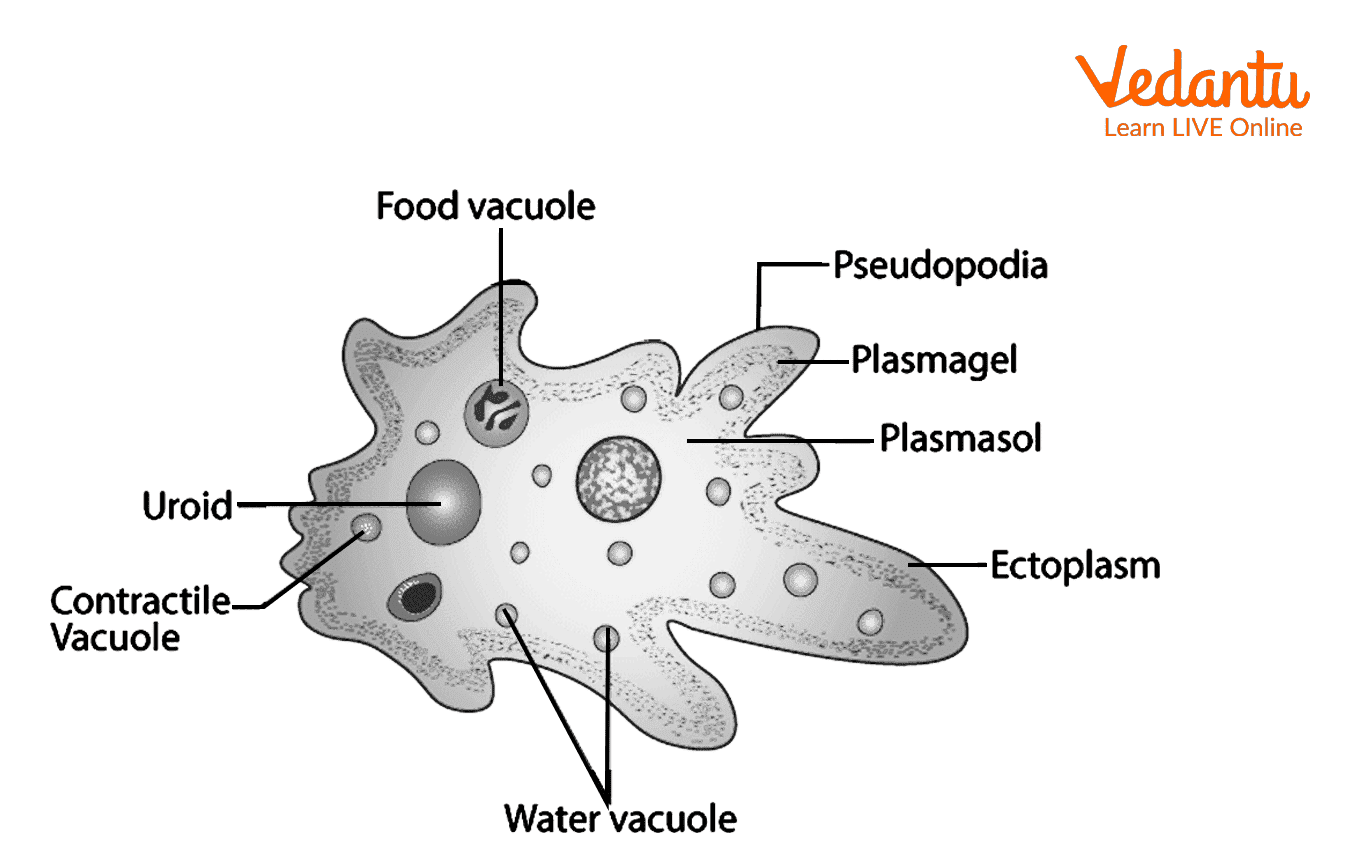
Amoeba
Hydra
Classification
Phylum -Cnidaria
Class -Hydrozoa
Diagnostic Features
Hydra is a coelenterate with a tubular or cylindrical body that resembles polyps or polypoids.
Their bodies are small tubes with several tentacles on one end.
Features
A hydra spends the majority of its existence inactively waiting for food to come to it rather than actively seeking it out.
having extremely extendable tentacles that can reach a great distance in the surrounding water, in radial symmetry.
The gastrodermis is the inner layer while the epidermis is the outer layer.
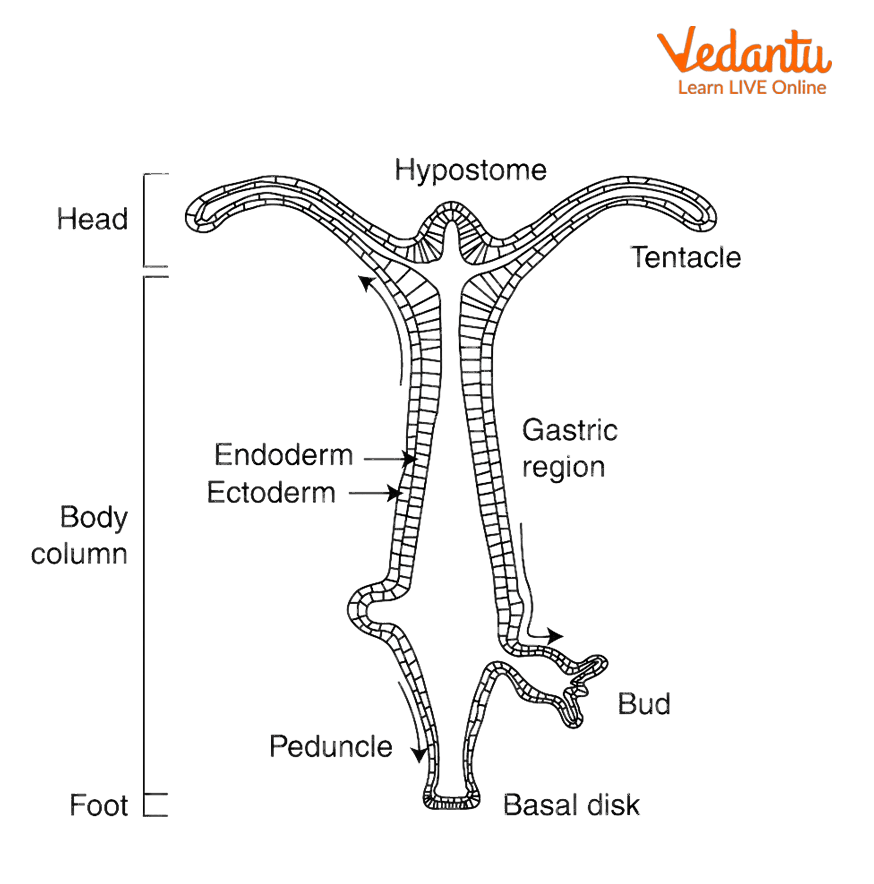
Hydra
Liver Fluke
Classification
Phylum - Platyhelminthes
Class - Trematoda
Diagnostic Features
Flukes are shaped like leaves, and they have an acetabulum, or ventral sucker, that can be used to attach to host tissues. Flukes also have an oral sucker surrounding their mouth.
The tegument covers the body. They are hermaphrodites and have full reproductive systems for both sexes.
Features
They can be found anywhere and are between 5 millimetres (0.2 inches) and several centimetres in size.
They eat mostly blood and have basic digestive systems.
There is no cavity in the body.
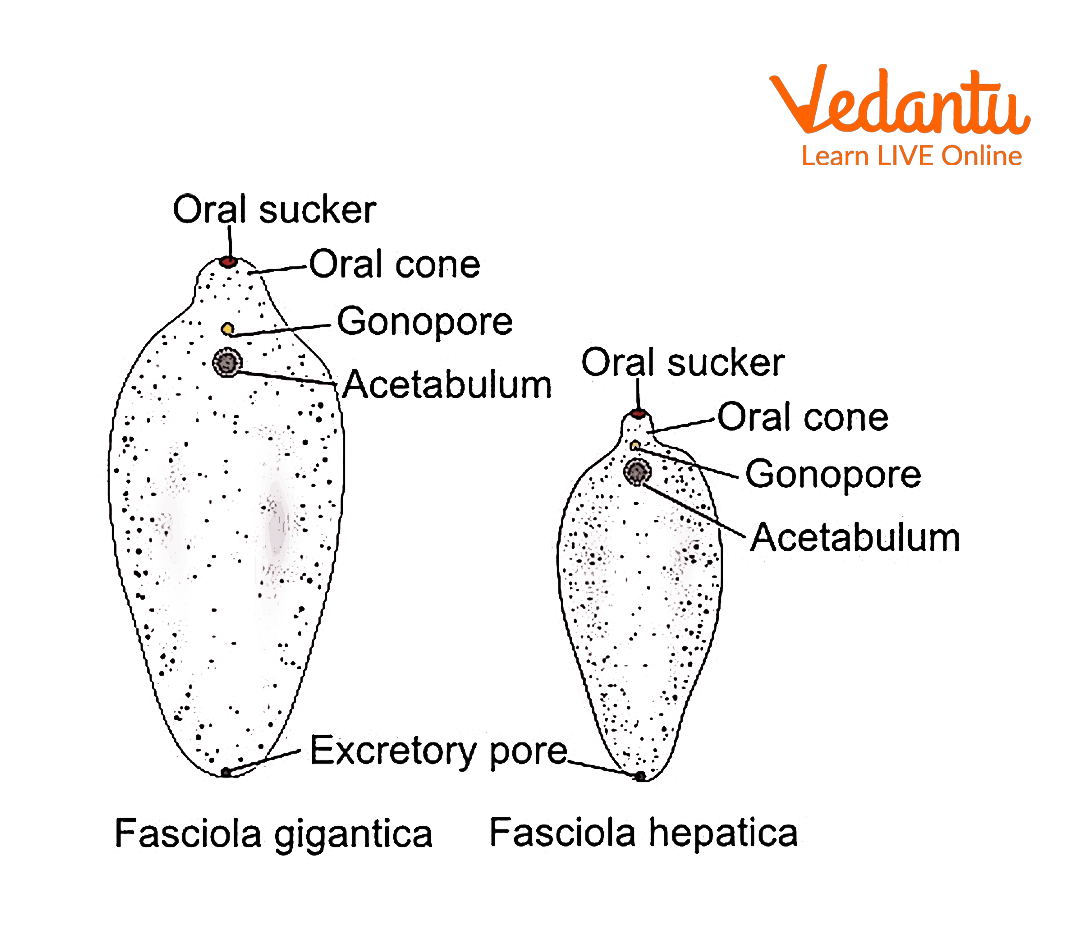
Liver Fluke
Ascaris
Classification
Phylum -Aschelminthes
Kingdom - Nematoda
Diagnostic features
Males are smaller at 15-31 cm and typically have curled tails, whilst females are 20-35 cm long with straight tails.
Three lips are present on the front end of the body in adults of both sexes.
Features
Ascaris has a pseudocoelom, also known as a false cavity, in which mesoderm-derived tissue only partially lines the cavity-filled with fluid. Metamerism, which refers to the ability to repeat segments, is not present in worms.
Most free-living roundworm habitats are located in freshwater environments.
Humans are one of the many hosts for parasitic roundworms.
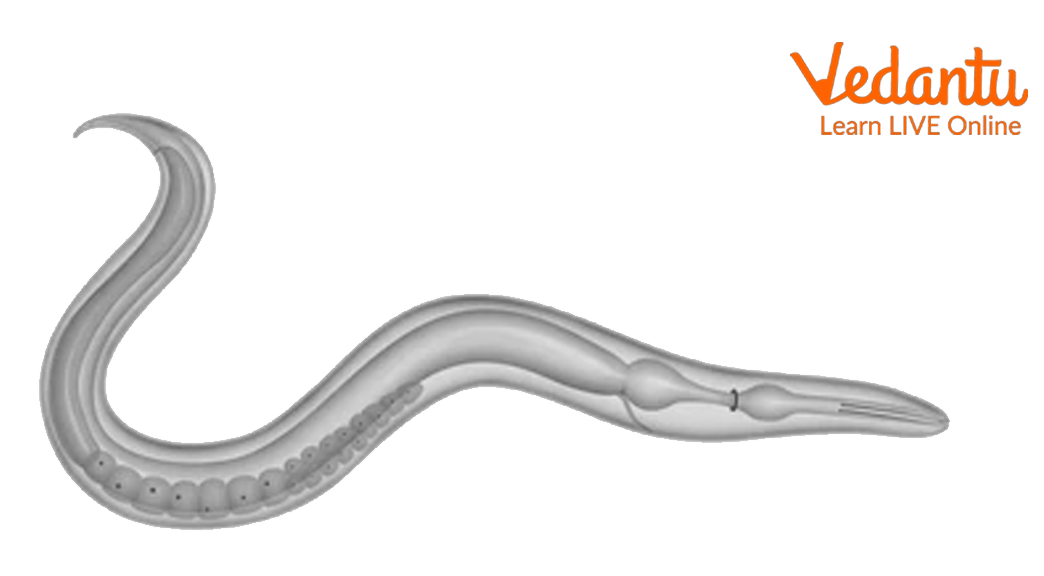
Ascaris
Leech
Classification
Phylum - Annelida
Kingdom - Hirudinea
Diagnostic Features
They are often dark in colour, frequently brown, occasionally black, or deep green.
Other species have spots and stripes, while some have no markings at all.
Features
The segmented worms known as leeches have suction cups on each end.
33 segments, or somites, make up their 33-segmented body. Further divisions into annuli or rings are made for each segment.
Leeches adopt a distinctive wave-like swimming technique to move across the water.
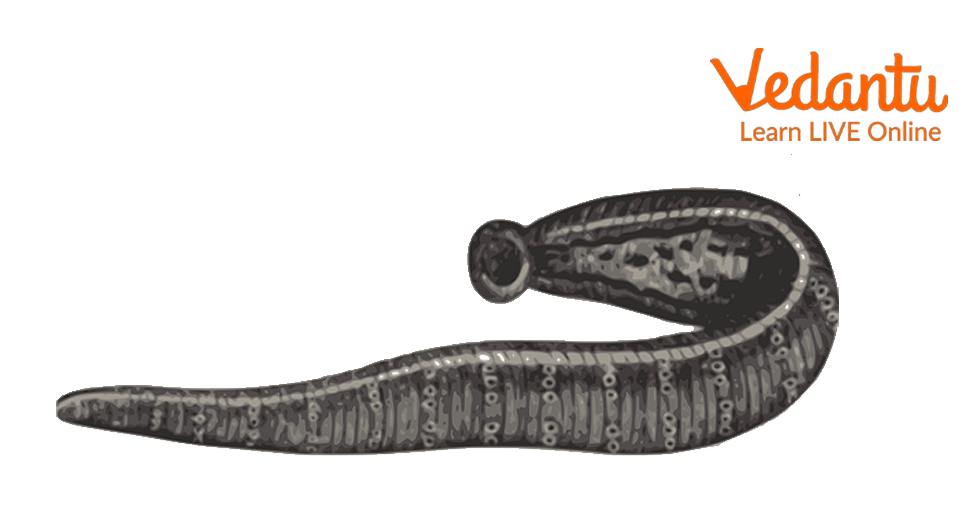
Leech
Earthworm
Classification
Phylum - Annelida
Class - Oligochaeta
Diagnostic Features
The earthworm has a thin non-cellular cuticle covering its body wall.
A layer of the epidermis, two layers of muscle, and the coelomic epithelium (inner layer) are wrapped beneath this cuticle.
Features
Earthworms have identical bodies on both sides, which is referred to as bilateral symmetry.
They lack scales and limbs.
Some worms have light-sensing organs, and many have sense organs that allow them to detect chemical changes in their surroundings.
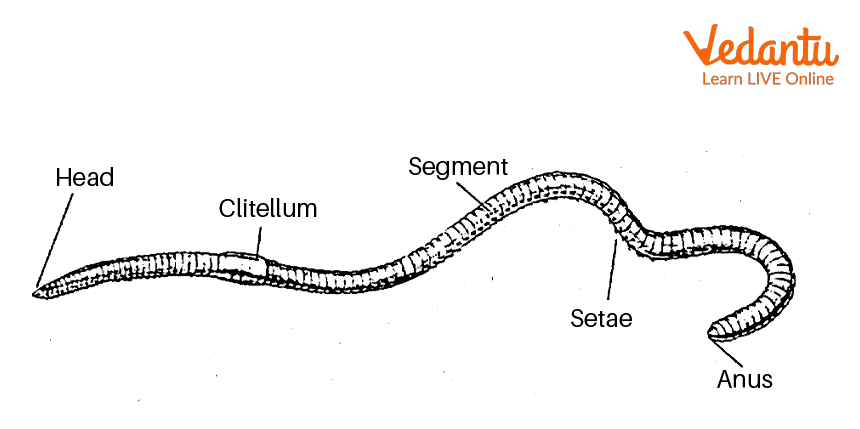
Earthworm
Prawn
Classification
Phylum -Annelida
Class -Crustacea
Diagnostic Features
There are six different, moveable segments that make up the abdomen.
Each segment is covered in a tough cuticle that is divided into a ventral sternum, two lateral pleurons, and a dorsal, convex tergum.
A median triangular component known as the telson is located at the end of the abdomen. There are no appendages on it.
Features
Prawns are crustaceans that have a shell, three pairs of clawed legs, five pairs of walking legs, and a tail. The average size is from 15 to 20 cm, but it is varied.
The body is elongated, with an anterior cephalothorax and a posterior abdomen.
Branchiostegite, or gill cover, is the part of the carapace that hangs loosely on the sides and encloses the gills.
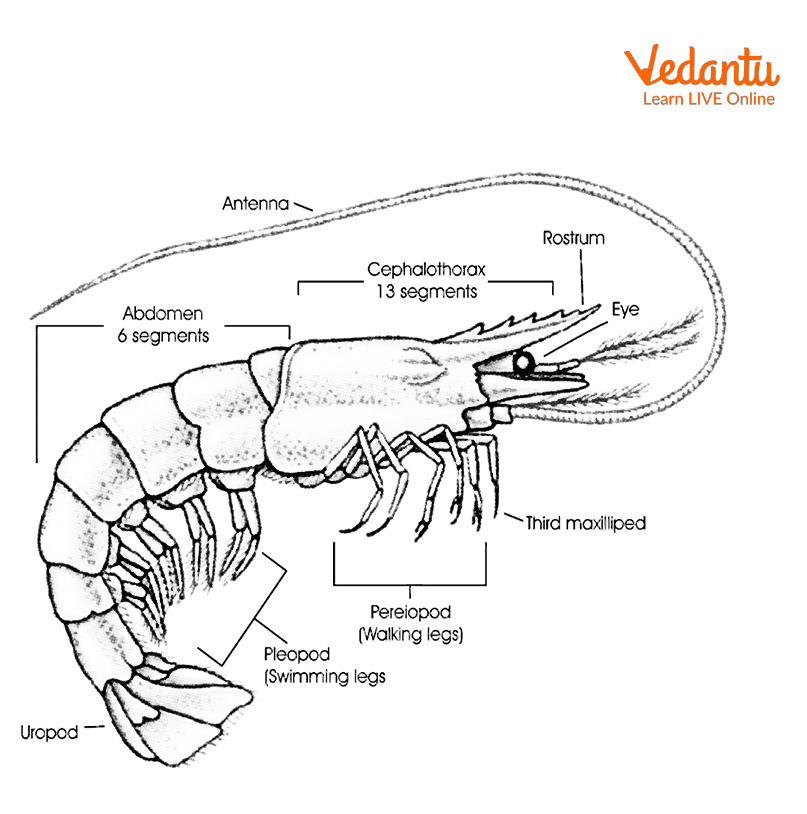
Prawn
Silkworm
Classification
Phylum -Arthropoda
Class -Insecta
Diagnostic Features
The wings are cream in colour with dark veins that reach the edges.
has a body with dense spikes.
Features
Bombyx mori, which refers to "silkworm of the mulberry tree," is the scientific term given to silkworms.
Silkworms start off as worm-like larvae with three separate insect body components. The silkworm eventually transforms into a scaly, four-winged moth after spending some time in a cocoon.
Larvae that have just hatched are roughly 2 to 3 mm (0.08 to 0.12 inch) long.
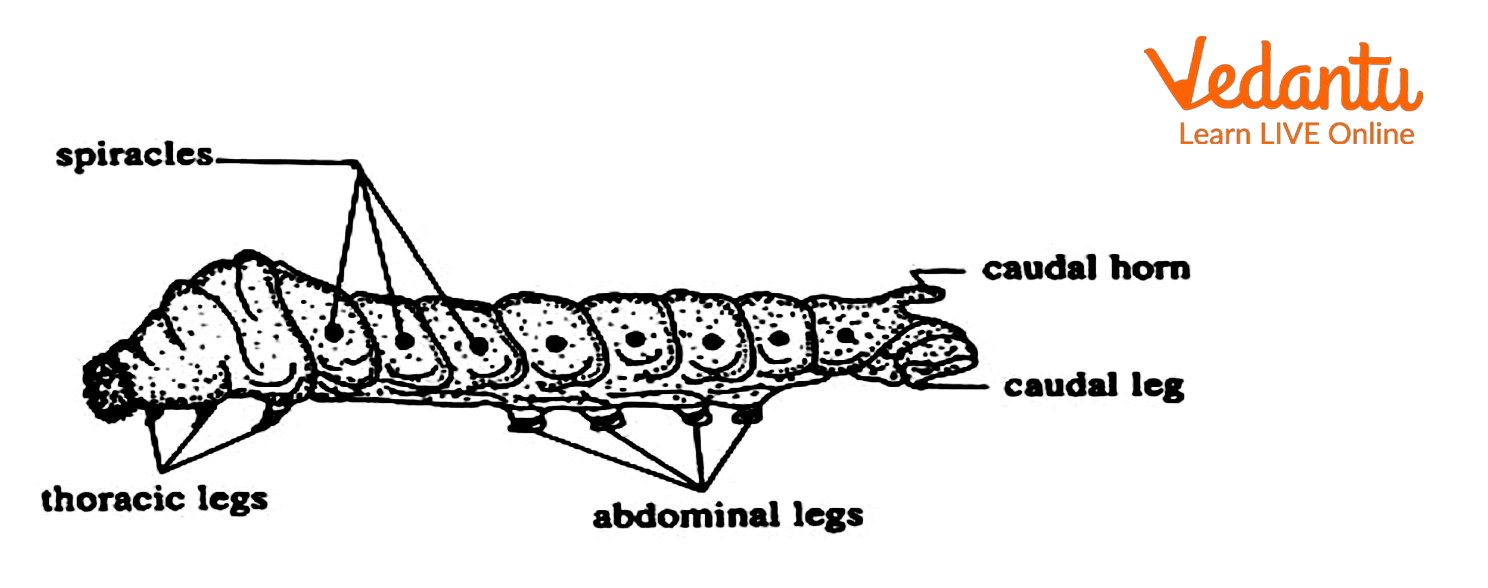
Silkworm
HoneyBee
Classification
Phylum -Arthropoda
Kingdom-Insecta
Diagnostic Features
The colour of the head and thorax, or middle, varies depending on the strain and is slightly bristly.
On top of the head are two big compound eyes and three small eyes, or ocelli.
Features
Their bodies are thick and oval.
There are two female castes and two sexes of honeybees, male and female. The two female castes are known as workers, which are larger than workers and are defined as females who do not reach sexual maturity. Only in the early summer are the males, or drones, present. They are bigger than the workers. The drones lack stingers, although the workers and queens do.
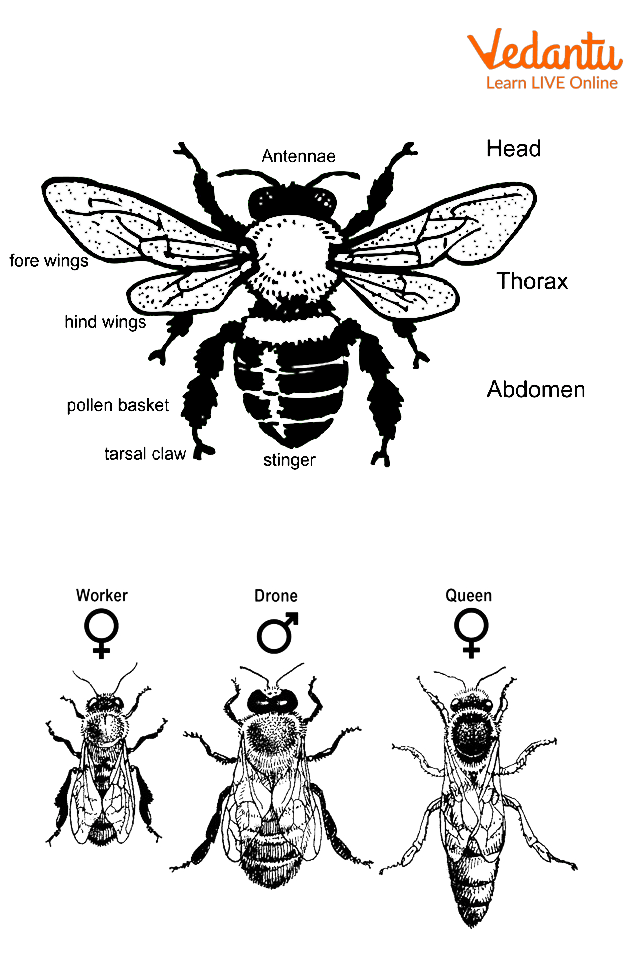
Honey bee
Snail
Classification
Phylum - Mollusca
Class - Gastropoda
Diagnostic Features
A large, spirally coiled, dextral spherical shell surrounds the body.
The shell is a wide cone that is spirally wound around a central axis, the columella.
The apex of the shell is its topmost point.
The whorls get bigger starting from the apex, with the body whorl being the biggest.
Features
A family of big freshwater snails with a gill and an operculum are known as apple snails. These snails have lungs and gills that function as independent respiratory organs and are divided by the mantle cavity.
The operculum has concentric growth rings surrounding its core or nucleus.
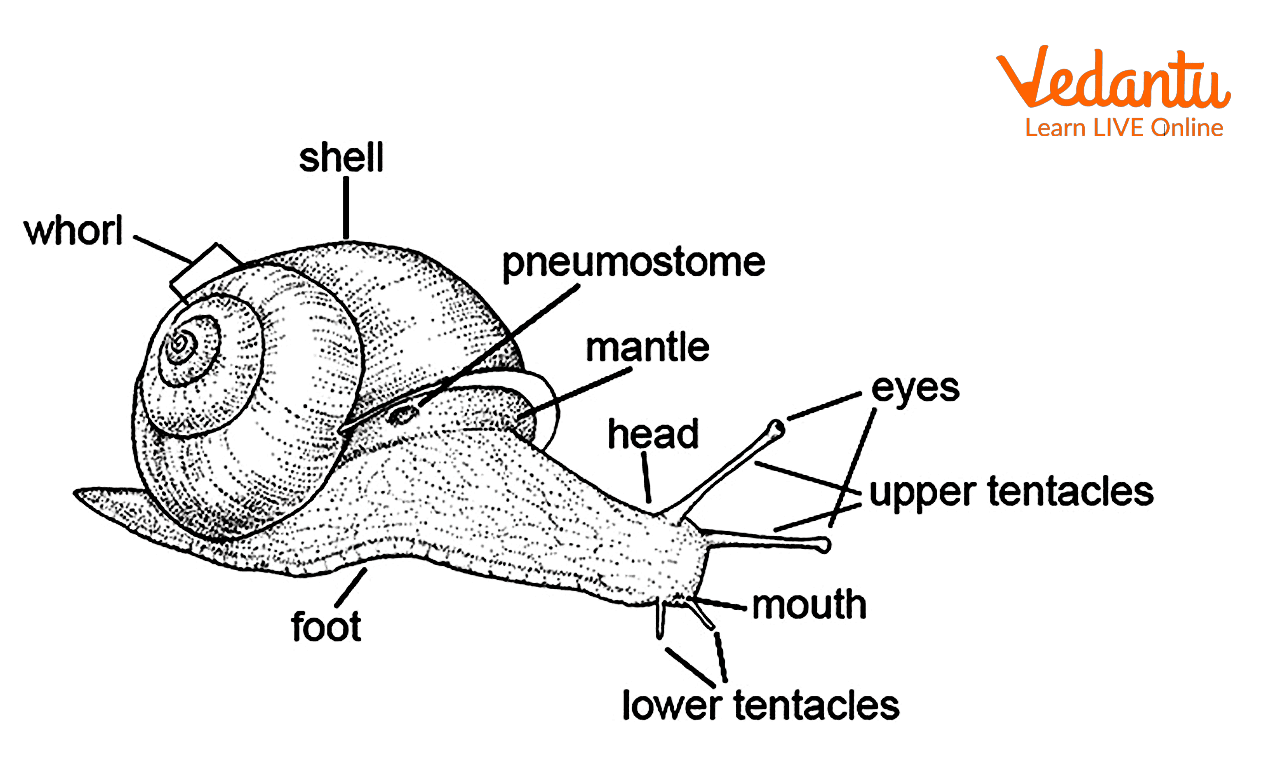
Apple snail
Star Fish
Classification
Phylum -Echinodermata
Class -Asteroidea
Diagnostic Features
The radial shape of a starfish, which frequently has five limbs spread apart from a central body .
They lack a backbone and have hard plates under their skin as well as mouth present in the middle of their ventral surface.
Features
They move around by using thousands of tiny tube feet on the underside of each arm. A starfish's circulatory system is made of sea water rather than blood.
Water is pumped into its body and through tube feets. A starfish can grasp and release rocks, coral, or the sand in order to move itself forward by pumping water into the tube feet in a rippling effect down its arms. Starfish can hold on to their prey firmly because of their tube feet.
A unique characteristic shared by the majority of sea stars is the capacity to devour prey external to their bodies.
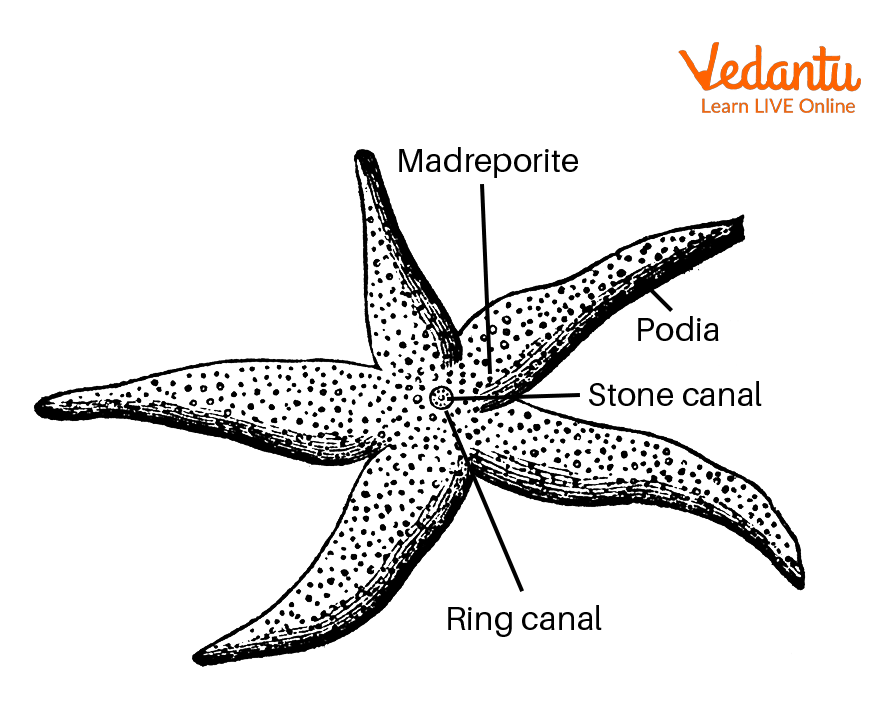
Starfish
Shark
Classification
Phylum - Chordata
Superclass - Pisces
Class - Chondrichthyes
Diagnostic Features
Long (equal to or longer than the head), broad-tipped pectoral fins.
Light blue to white below, dark blue to bluish-black above.
eyes are big.
The mouth region and snout's conical underside are dusky or bluish-black.
Features
Sharks have denticles all over their body, are cold-blooded, and breathe through their gills (tooth-like scales). Several essential mammalian characteristics are also absent in sharks: They lack a neocortex (part of the brain involved in perception and thought, among other things) milk production, and hair growth.Sharks are fish.
Sharks lack skeletons. Instead of having a bone skeleton, they have soft cartilage.
Sharks can move through the water more easily and consume less energy while swimming because cartilage is more flexible and lighter than bone.
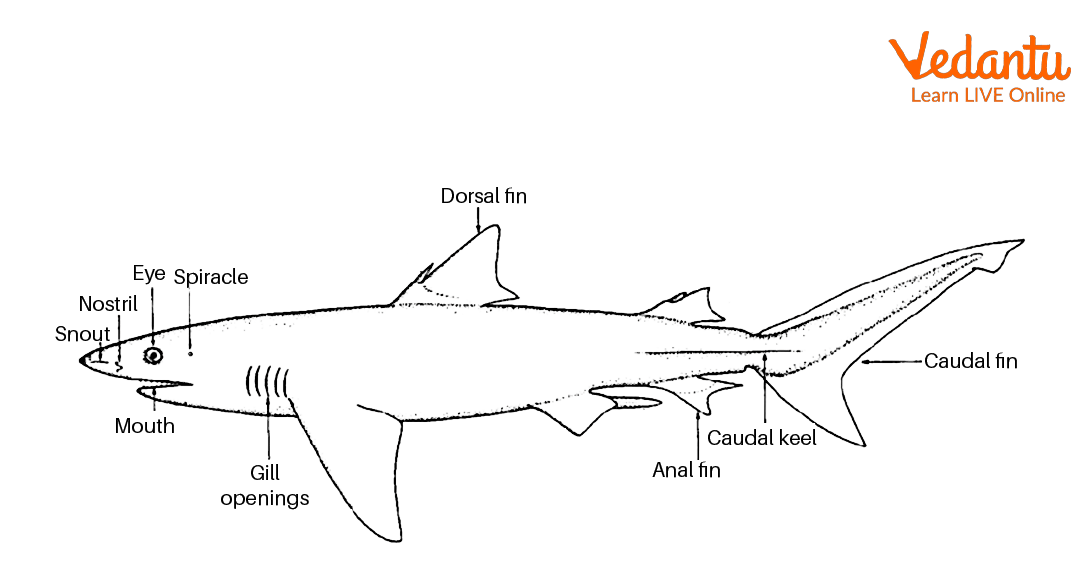
Shark
Rohu
Classification
Phylum - Chordata
Class - Osteichthyes
Diagnostic Features
The mouth is smaller and the head is triangular. The rohu's body is shaped like a spindle. Its body colour is silvery on the ventro-lateral sides and blackish on the dorsal side.
Features
bone cavities.
Complete separation of oxygenated and deoxygenated blood in a four-chambered heart.
They have a sleek body with a gaping, huge oval.
Cycloid scales cover their entire body.
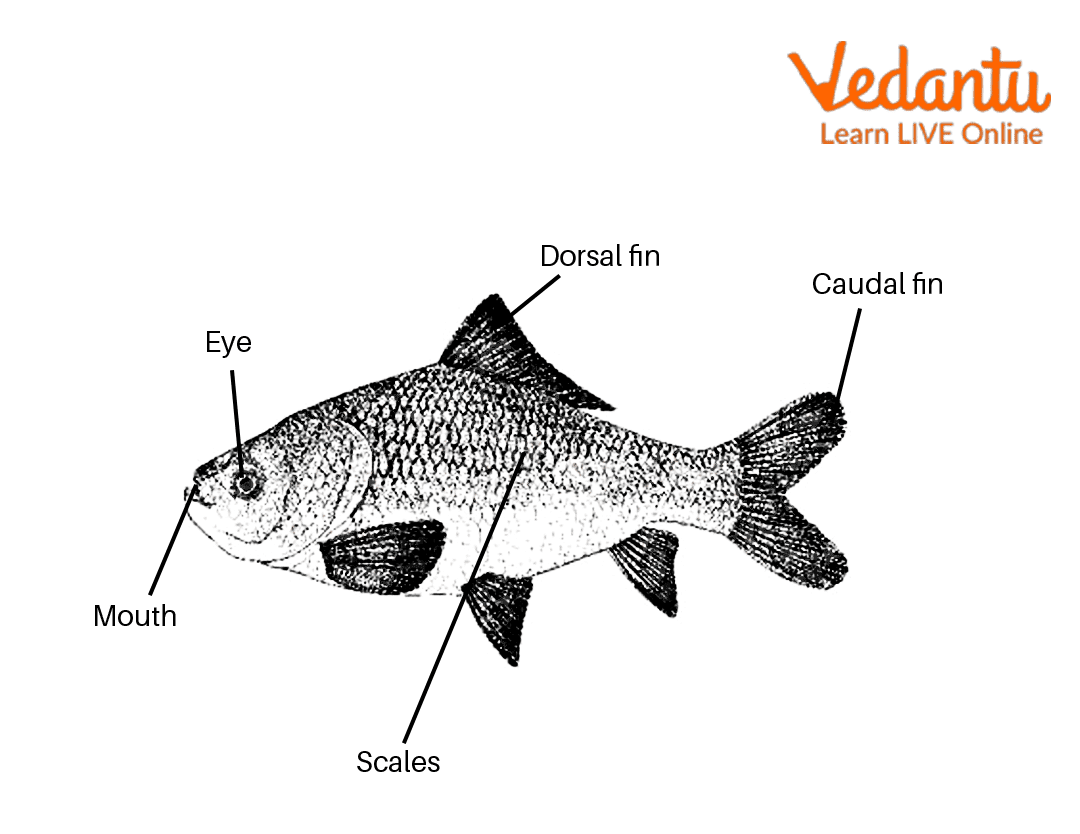
Rohu
Frog
Classification
Phylum - Chordata
Class - Amphibia
Diagnostic Features
They have scars that cover the eardrums behind their eyes. On the other hand, toads have smaller legs.
Moist skin that is sticky.
Features
Frogs have outwardly facing eyes, no tail, and powerful, webbed hind feet that are designed for swimming and leaping.
A few frog species, like poison dart frogs, are particularly hazardous, whereas others only have minor poisons.
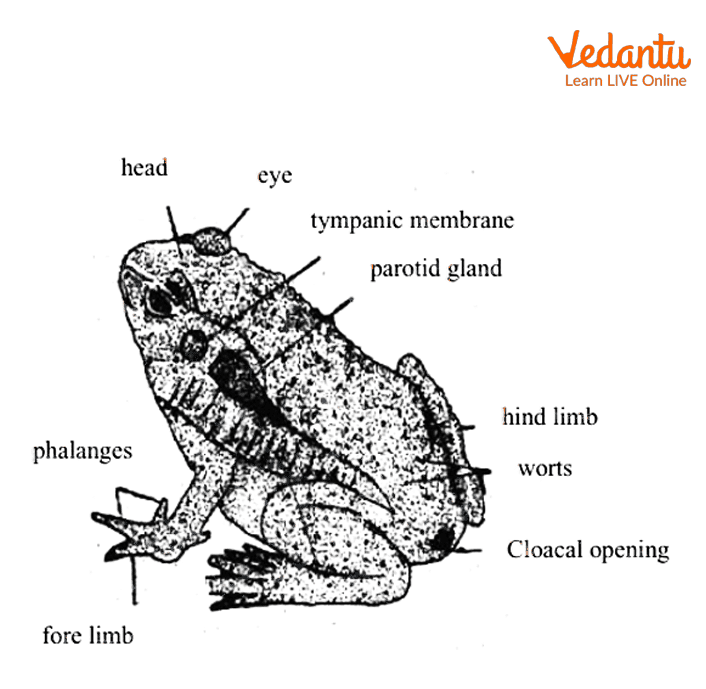
Frog
Lizard
Classification
Phylum - Chordata
Class - Reptilia
Diagnostic Features
Lizards have a flexible head, paired male copulatory organs, and scales.
Although some lizards lack legs, most lizards have a somewhat cylindrical shape, four well-developed legs, a tail that is slightly longer than the head and body put together, and flexible lower eyelids.
Their sizes range from one inch.
Features
The lizards are four-legged creatures with external ears, movable eyelids, a small neck, and a lengthy tail that they can lose to run away from predators.
Unlike mammals, lizards don't have ear flaps. Instead, they have audible ear holes that allow them to hear, and their eardrums are close to the skin's surface.
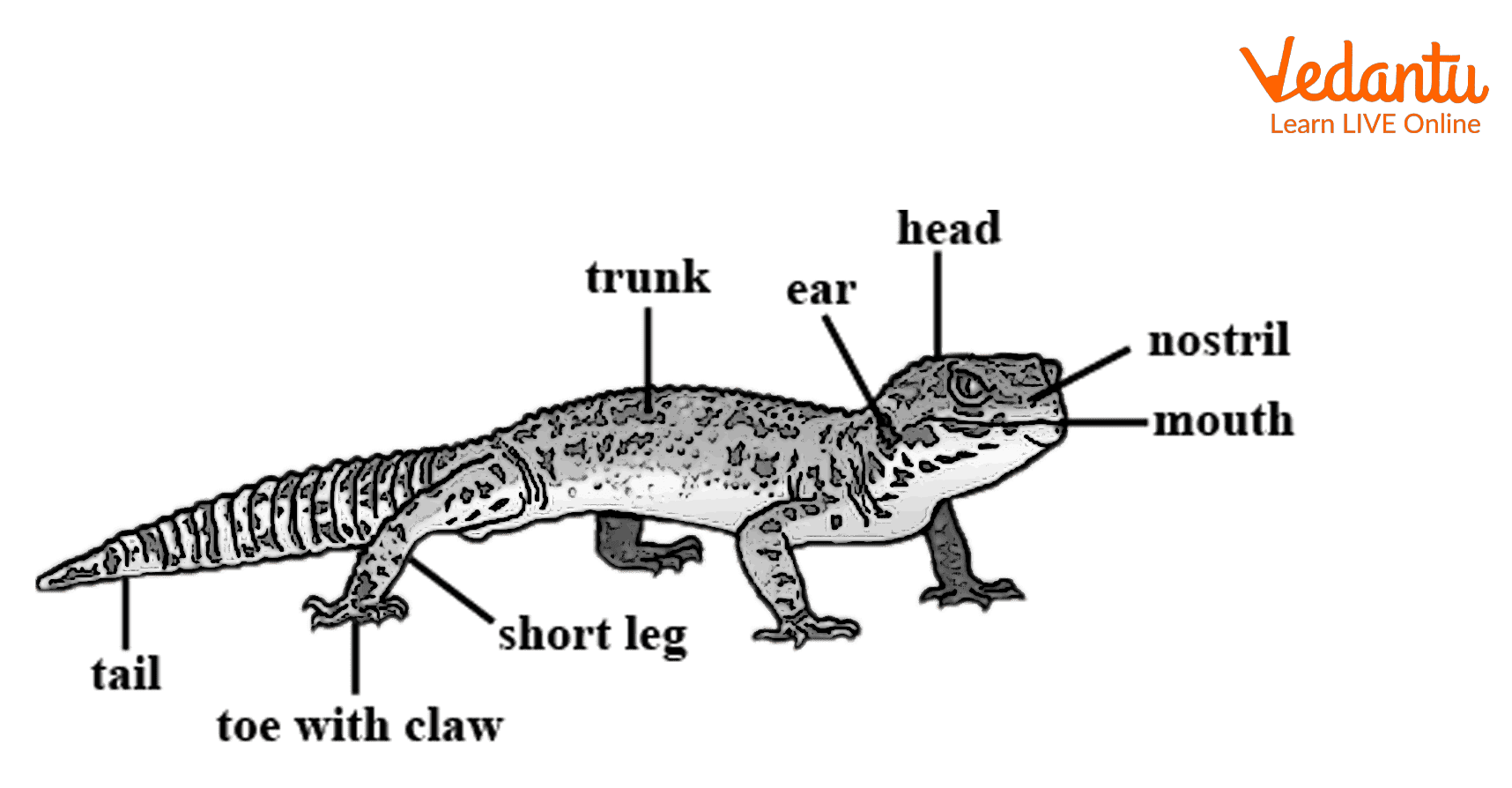
Lizard
Pigeon
Classification
Phylum - Chordata
Class - Aves
Diagnostic Features
Birds have short necks, thick bodies, and short, narrow bills.
The pigeon's eyes are attached to the side.
An operculum or cere, a patch of exposed, pale, inflated soft skin, appears at the base of the upper beak.
Features
Pigeons' small, streamlined bodies, which are shaped like boats, are perfectly suited for their life in the air.
A pigeon's body is made up of the head, neck, trunk, and tail.
The head is the frontmost component of the body and is relatively small, round, and positioned there.
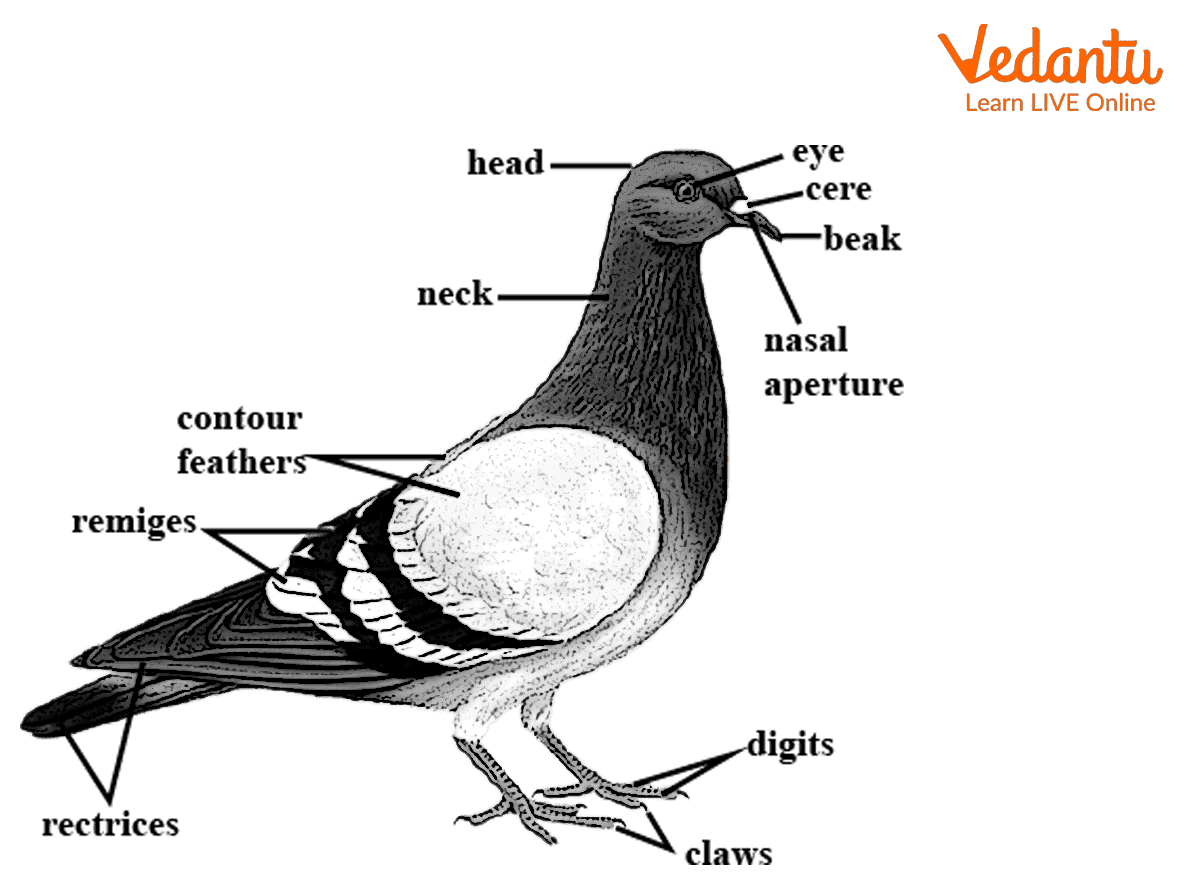
Pigeon
Rabbit
Classification
Phylum - Chordata
Class - Mammalia
Diagnostic Features
A rabbit's body is rather thick, and it's back is rounded.
The trunk bears two pairs(Forelimbs and hindlimbs) of pentadactyl limbs. Both pairs of limbs take part in locomotion and support the weight of the body.
Features
Small, fuzzy creatures, rabbits have huge, powerful hind legs and long ears. They also have short, fluffy tails. They possess two sets of pointed incisors (front teeth).
Behind the top incisors, they additionally have two peg teeth. Their teeth are designed exclusively for chewing and continue to erupt throughout their entire lifespan.
Depending on the breed, rabbit weight ranges from 3 to 20 pounds.
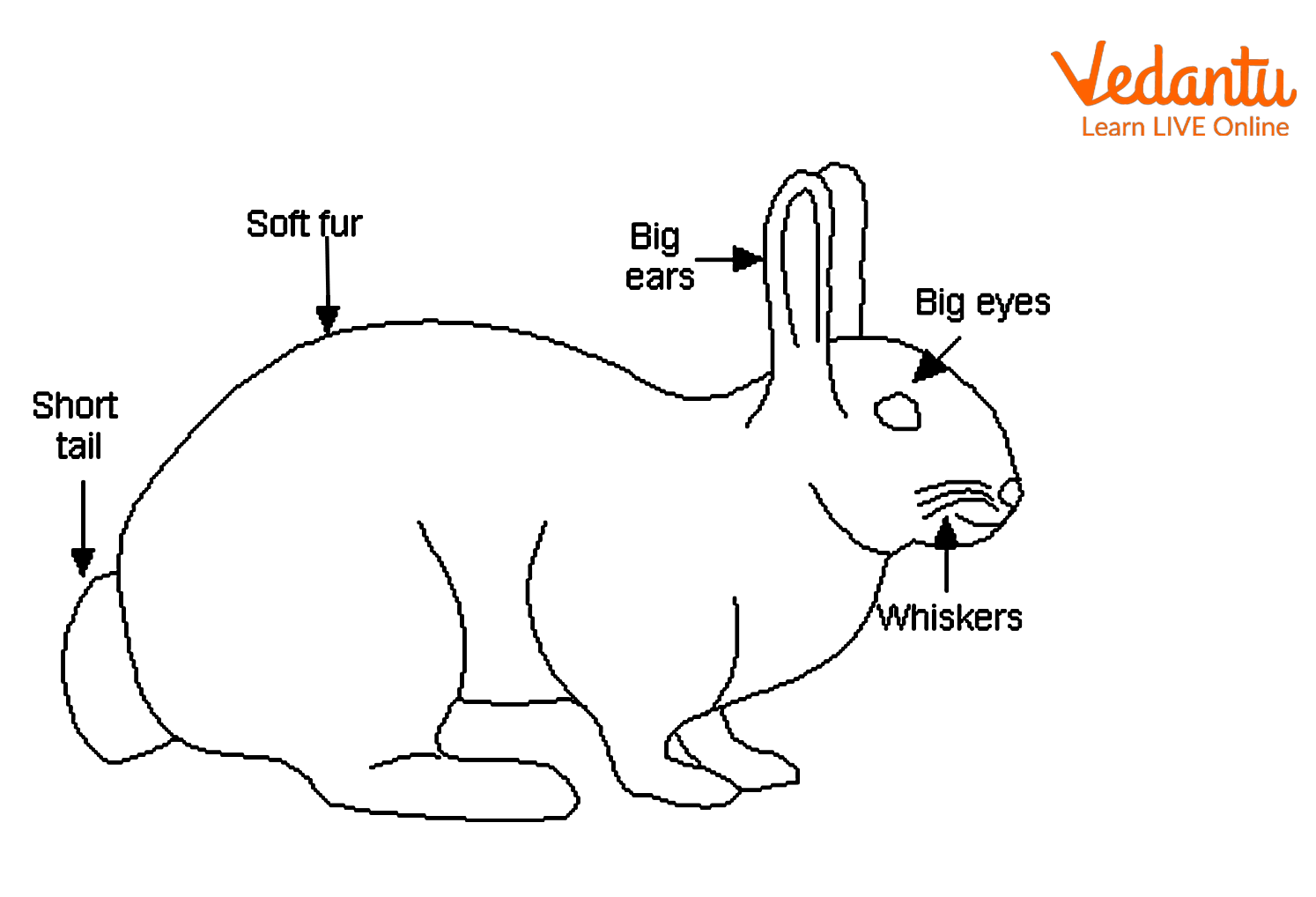
Rabbit
Result:
Thus the specimens are identified and their characteristics are noted.
Precautions:
Do not tilt the jar in which model is kept.
Do not touch the slide in the middle ,then the slide will not be clear.
Handle the microscope and the slide carefully.
Do not write on the specimens.
Lab Manual Questions
1. What are the important differences between workers,queens and drones in honey bees?
Ans: drone- It is a male honey bee.they have big eyes.
Workers- They are female honey bees.
Queen- Body size is larger.it is the mother bee.
2. Mention differences between male and female roundworms?
Ans: male roundworm is shorter while female roundworm is larger.male appear hooked tail while female have straight tail.
3. Is the shell of the snail plain or spirally coiled?
Ans: Snail shells are spiral shaped.
3. How many arms do starfish have?
Ans: Starfish have five arms but some species have a large number of arms.
Viva Questions
1. How many regions can you divide the lizard body?
Ans: Lizard body has four parts-the head,neck,trunk,tail.
2. How is a pigeon’s beak?
Ans: Pigeons have cone ,short beaks.
3. Why is pigeon placed in phylum chordata?
Ans: Pigeon is placed in phylum chordata as it is bilaterally symmetrical(while cutting the body both sides are identical),nerve cord.
4. Where is the mouth located in rohu?
Ans: Mouth is bounded by lips. It is located at the end of the head region.
5. Why is the specimen called starfish?
Ans: Starfish are orange in colour. It is star shaped.
6. Mention the class of Pila.Give one reason.
Ans: Pila is soft and they have a true body cavity.
7. What is the colour of an earthworm?
Ans: Earthworms are deep brown in colour.
8. What is the tail made up of in pigeons?
Ans: It contains a shaft and feathers.
9. Why are lizards grouped in class Reptilia?
Ans: lizards are grouped in class reptilia as they are ectothermic (taking heat from the sun).
10. How long does a honey bee live?
Ans: A honey bee lives for eight weeks to five years.
Practical Based Questions
1. This is not the locomotory organ of protozoans
A.Flagella
B.Cilia
C.Parapodia
D.Pseudopodia
Answer: C.Parapodia
2. When touched with needle ,Amoeba will
A.Split instantly
B.Die
C.Move away
D.Develop pseudopodia
Answer: C.Move away
3.Hydra is placed under the phylum cnidaria as it has
A.Cnidoblasts
B.Tentacles
C.Hypostome
D.Interstitial cells
Answer: A.Cnidoblasts
4.The exterior of Ascaris is covered by
A.Pellicle
B.Epidermis
C.Sclerites
D.Cuticle
Answer: D.Cuticle
5. Haemoglobin is dissolved in plasma in
A.Earthworm
B.Ascaris
C.Tapeworm
D.Insects
Answer: A.Earthworm
6. The process of rearing a silkworm for silk is known as
A.Agriculture
B.Pisciculture
C.Sericulture
D.None of the above
Answer: C.Sericulture
7.Amongst honey bees,the workers are
A.Female
B.Male
C.Both females and males
D.Hermaphrodite
Answer: A.Female
8. The snail has a power of
A. self-contracting
B. self-collecting
C. self-revealing
D. self-expressing
Answer: B.Self collecting
9. Water vascular system (ambulacral system) is typically found in
A.Hydra
B.Sponge
C.Earthworm
D.Star fish
Answer: D.Starfish
10. A student was given a specimen to identify on the basis of the characteristics given below.
1.They are metamerically segmented.
2.Presence of closed circulatory system.
3.They have circular and longitudinal muscles for locomotion.
Identify the specimen.
A.Frog
B.Pheretima
C.Cockroach
D.Rabbit
Answer: B.Pheretima
Summary
The identification of specimens /slides/models are done through their features .Animals and microscopic organisms are different in their appearance and functions.


FAQs on Class 11 Biology Identification Of Virtual Specimens With Their Characteristics Experiment
1. What type of questions are asked from the 'Identification of Virtual Specimens' section in the Class 11 Biology practicals?
In the practical exam, you'll typically be asked to identify a given virtual specimen, which could be an image or a short video of an animal or plant. You will then need to state its classification (like Phylum and Class) and list two or three key identifying characteristics. Sometimes, a neat, labelled diagram is also required as part of the question.
2. How should I write my answer for a specimen identification question to get full marks?
To score full marks in specimen identification, you should present your answer clearly and accurately. Follow these steps:
- Correctly identify the specimen (e.g., Frog).
- State the classification accurately (e.g., Phylum Chordata, Class Amphibia).
- List at least two distinct identifying features (e.g., moist, smooth skin; webbed hind limbs).
- Draw a neat, labelled diagram if it is asked for in the question.
3. Which animal specimens are most important for the Class 11 practical exam for the 2026-27 session?
While the exact specimens can vary, you should focus on representatives from different major phyla. The most frequently asked specimens include the Earthworm (Annelida), Cockroach (Arthropoda), Bony Fish (Chordata), and Frog (Chordata). It is crucial to know their specific identifying features as per the CBSE syllabus.
4. What are the key points to look for when identifying plant specimens like moss or a fern?
When identifying plant specimens, focus on their main structural characteristics. For Moss, look for a simple plant body that isn't differentiated into true roots, stems, and leaves. For a Fern, identify its well-differentiated body, which includes leaves (called fronds), a stem (rhizome), and roots. Also, check the underside of the leaves for spore-producing structures called sori.
5. How many marks are usually given for specimen identification in the final practical exam?
In the Class 11 Biology practical exam, the spotting or identification section carries significant weight. Typically, each spot is worth a few marks, which are broken down. For example, you might get 1 mark for correct identification and 1 mark for listing two correct characteristic features. Always refer to the specific marking scheme provided during your examination.
6. Why is it important to write the phylum and class, not just the name of the specimen?
Simply naming the specimen (e.g., "Starfish") only shows basic recognition. Stating the Phylum (Echinodermata) and Class (Asteroidea) demonstrates a deeper scientific understanding. It shows the examiner that you know its classification and relationship to other organisms, which is a key concept in biology and is essential for scoring higher marks.
7. What is a common mistake students make in this section that leads to losing marks?
A very common mistake is writing general features instead of specific, identifying ones. For instance, for a fish, saying "it lives in water" is too general. A better, mark-scoring point would be "its body is covered with overlapping cycloid/ctenoid scales" or "respiration occurs through gills." Being specific is the key to a good score.
8. How does studying virtual specimens help in understanding the 'Animal Kingdom' chapter better?
Studying virtual specimens is a practical application of what you learn in theory. It helps you visually connect the features you read about, like metameric segmentation in an earthworm or jointed appendages in a cockroach, to the actual animal. This practical observation makes the characteristics of different phyla and classes easier to remember for your theory exams as well.
