








How Does Fertilization Occur in Biology? NEET Exam Explained
Fertilization is a crucial biological process at the heart of sexual reproduction, uniting male and female gametes to form a new organism. For NEET aspirants, a clear understanding of fertilization underpins many essential questions in Biology, especially in chapters related to human reproduction, genetics, and developmental biology. Mastery of this concept boosts conceptual clarity and problem-solving skills, making it a must-know topic for scoring well in NEET Biology.
What is Fertilization?
Fertilization refers to the process by which the nucleus of a male gamete (sperm) fuses with the nucleus of a female gamete (egg or ovum) to form a diploid zygote. This event restores the normal chromosome number and marks the starting point for the development of a new individual. Fertilization is not just a mechanical joining of two cells - it is a highly coordinated sequence of biochemical and cellular events.
Core Ideas and Fundamentals of Fertilization
Types of Fertilization
Fertilization can occur in two main ways: external and internal. The type depends on the species’ reproductive adaptation.
- External Fertilization: Gametes fuse outside the body, typically in aquatic environments (e.g., fish, amphibians).
- Internal Fertilization: Gametes fuse inside the body of the female (e.g., reptiles, birds, mammals).
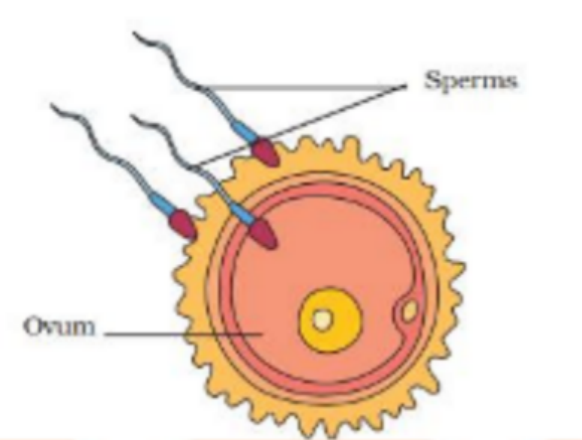
Key Stages of Fertilization
- Sperm approaches the ovum, guided by chemical signals (chemotaxis).
- Sperm binds to the egg’s outer layer (zona pellucida in mammals).
- Acrosome reaction occurs - enzymes from the sperm’s acrosome help it penetrate the egg’s layers.
- Fusion of sperm and egg plasma membranes.
- Cortical reaction in the egg blocks entry of additional sperms (prevents polyspermy).
- Nuclei of sperm and egg fuse (karyogamy), forming the diploid zygote.
Result of Fertilization
The key product is a zygote, which is diploid (has two sets of chromosomes, one from each parent). This zygote undergoes mitotic divisions (cleavage), eventually developing into a new organism. Fertilization ensures genetic variation and species continuity.
Important Sub-Concepts Related to Fertilization
Gametes
Gametes are specialized sex cells (sperm in males, ovum in females) that carry only one set of chromosomes (haploid). Their union during fertilization restores the normal chromosome number in offspring.
Polyspermy and Its Prevention
Polyspermy occurs when more than one sperm fertilizes an ovum. This usually leads to abnormal development and is mostly fatal. Nature prevents this via the cortical reaction, which rapidly hardens the zona pellucida after the first sperm enters, blocking others from fusing.
Fertilization Envelope
After the cortical reaction, an impenetrable barrier forms around the egg (fertilization envelope in many species). This protects the developing zygote.
Significance of Fertilization
- Restores diploid chromosome number in the zygote
- Activates metabolic processes in the egg, kickstarting development
- Introduces genetic variation through recombination of parental genes
Principles and Relationships in Fertilization
While fertilization is primarily a cellular and molecular event, some principles and relationships are key for NEET:
- Species-Specific Recognition: Sperm and egg interaction is mediated by specific proteins ensuring only same-species fertilization.
- Timing: In mammals, fertilization typically occurs in the ampulla region of the fallopian tube and must happen soon after ovulation for success.
- Restoration of Chromosome Number: Fertilization mathematically ensures the maintenance of a constant chromosome number across generations (n from sperm + n from egg = 2n zygote).
Advantages and Features of Internal Fertilization
- Protection of gametes and developing embryo from environmental hazards
- Higher rates of successful fertilization compared to external methods
- Facilitates greater parental care and development within the body (seen in mammals, birds, reptiles)
Why is Fertilization Important for NEET?
Fertilization is a foundational concept in NEET Biology syllabi and is often tested in questions involving human reproduction, genetics, developmental biology, and evolutionary significance. Understanding fertilization equips students to answer direct and applied questions, interpret diagrams, and tackle case-based problems. It also helps link topics such as inheritance, embryonic development, and reproductive health, providing a cohesive understanding of human and animal biology.
How to Study the Concept of Fertilization Effectively for NEET
- Draw labeled diagrams of the fertilization process, especially for human reproduction
- Revise the stages of fertilization and their sequence repeatedly
- Understand the difference between external and internal fertilization, with examples
- Memorize key terms: acrosome reaction, cortical reaction, zona pellucida, zygote
- Practice MCQs focused on the mechanism and significance of fertilization
- Link the concept with related topics like gametogenesis, embryogenesis, and genetic inheritance
- Review common exam diagrams and previous years’ NEET questions for exam familiarity
Common Mistakes Students Make in Fertilization
- Confusing fertilization with other reproductive processes like implantation
- Mixing up external and internal fertilization and their examples
- Forgetting the precise sequence of events during fertilization
- Not understanding the prevention mechanisms against polyspermy
- Neglecting diagram labeling in the exam
Quick Revision Points for Fertilization
- Fertilization unites haploid gametes to form a diploid zygote
- Occurs internally in mammals (ampulla of fallopian tube)
- Acrosome reaction - sperm releases enzymes to penetrate the egg
- Cortical reaction - prevents entry of more sperms (blocks polyspermy)
- Ensures genetic variation and stability of chromosome number
- Diagrams of fertilization are frequently asked in NEET exams
- Know the difference between external and internal fertilization with examples
FAQs on Biology Fertilization for NEET: Complete Overview and Key Steps
1. What is fertilization in biology (NEET)?
Fertilization in biology, especially for NEET, is the process where a male and female gamete fuse to form a zygote. This is a vital step in sexual reproduction.
Key points:
- The fusion happens between the male sperm and the female egg (ovum).
- Leads to the formation of a diploid zygote.
- Ensures the combination of genetic material from both parents.
2. Where does fertilization occur in humans (NEET)?
In humans, fertilization usually occurs in the ampulla region of the fallopian tube.
Main points for NEET:
- Location: Fallopian tube (specifically, the ampullary-isthmic junction).
- This region provides the ideal environment for sperm and egg fusion.
- This fact is a commonly tested detail in NEET biology.
3. What are the steps involved in fertilization (NEET)?
The process of fertilization involves a sequence of well-defined steps essential for NEET.
Key steps:
- Sperm transport to the egg in the female reproductive tract.
- Recognition and binding of sperm with the zona pellucida of the ovum.
- Acrosomal reaction leading to penetration of the egg membrane.
- Cortical reaction to prevent polyspermy.
- Fusion of genetic material to form the zygote.
4. Why is fertilization necessary in sexual reproduction (NEET)?
Fertilization is necessary to combine male and female genetic material, restoring the diploid chromosome number in offspring.
Importance:
- Ensures genetic variation, a core concept in NEET biology.
- Initiates embryonic development.
- Merges two haploid gametes to form a genetically unique zygote.
5. What are the types of fertilization? (NEET)
Fertilization can be classified mainly into two types based on the location where fusion occurs.
Types:
- External fertilization: takes place outside the body (e.g., aquatic animals like frogs and fish).
- Internal fertilization: occurs within the body of the female (e.g., humans, reptiles, birds).
6. What is the significance of the cortical reaction during fertilization?
The cortical reaction is critical to prevent entry of additional sperm (polyspermy) after the first sperm fuses with the egg.
Significance:
- Modifies the zona pellucida to block further sperm entry.
- Maintains diploid chromosome number in the zygote.
- Ensures normal embryonic development, a key NEET concept.
7. What are the main differences between self-fertilization and cross-fertilization? (NEET)
Self-fertilization and cross-fertilization differ in the origin of the gametes involved.
Main differences:
- Self-fertilization: Both gametes come from the same individual (e.g., some plants, hermaphrodites).
- Cross-fertilization: Gametes come from two different individuals (e.g., humans, most animals).
- Cross-fertilization promotes genetic diversity—a core NEET topic.
8. How does fertilization restore the diploid number of chromosomes? (NEET)
Fertilization restores the diploid chromosome number by merging two haploid gametes (sperm and egg).
Process:
- Sperm (n) and Egg (n) each have half the usual chromosome number.
- Fusion creates the zygote (2n) with a complete chromosome set.
- This restoration is central in NEET genetics questions.
9. Name the layers an animal sperm must penetrate to fertilize the ovum. (NEET)
An animal sperm must cross several protective layers to fertilize the ovum.
Layers:
- Corona radiata
- Zona pellucida
- Vitelline membrane
10. Explain the term syngamy in relation to fertilization. (NEET)
Syngamy is the technical term for the process where two gametes fuse during fertilization.
Explanation:
- Fusion of male and female gametic nuclei.
- Results in the formation of a zygote.
- Another term for syngamy is fertilization—a core NEET concept.
11. What happens to the zygote after fertilization? (NEET)
After fertilization, the zygote undergoes several rapid cell divisions called cleavage.
Events after fertilization:
- Cleavage: Repeated mitotic divisions.
- Formation of morula and blastula stages.
- Implantation into the uterus wall.
12. What prevents polyspermy during fertilization? (NEET)
The cortical reaction and changes in the zona pellucida prevent polyspermy during fertilization.
Mechanisms:
- Exocytosis of cortical granules alters the egg’s membranes.
- Blocks entry of additional sperm.
- Ensures formation of a healthy, diploid zygote.
