




Write the general characters of class Aves.
Answer
 Verified
598.2k+ views
Hint: They belong to phylum Chordata of the animal kingdom. They are able to maintain constant body temperature and are called homoiothermous animals.
Complete answer:
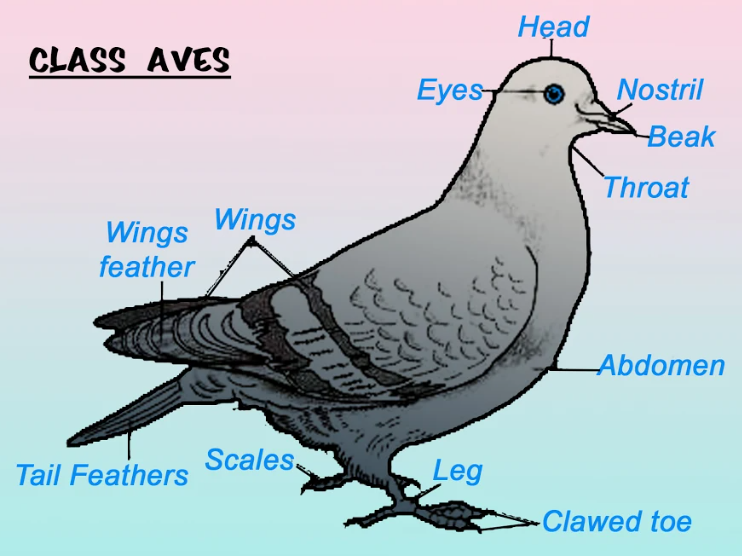
Class Aves was from the superclass Tetrapoda (bears limbs), of division Gnathostomata (bears jaw) of division Vertebrata. There are about 9,000 species in this class. Aves are adapted to fly using their feathers. They are the most beautiful and visually stunning features such as bright and contrasting colors. Example: Columba (Pigeon), Pavo (Peacock).
Additional Information: The characteristic features of Aves are described below:-
-The most important features of aves were the presence of feathers. So, most of them can fly except flightless birds like Ostrich.
-They possess beak.
-It also has a sharp sight.
-It has a special organ called the syrinx for producing the voice.
-The forelimbs are modified into wings.
-The birds have 12 pairs of cranial nerves.
-For walking, swimming, or clasping to the tree branches, they have modified hind limbs with scales.
-Except for the oil gland at the base of the tail, Skin is completely dry without glands.
-Endoskeleton is fully bony and long bones are hollow with air cavities.
-The heart is completely four-chambered.
-They are homoiothermous animals.
-Respiration is by lungs. Air sacs connected to lungs supplement respiration.
-Sexes are separate.
-It also exhibits sexual dimorphism.
-Fertilization is internal.
-The eggs have four embryonic membranes, that are chorion, amnion, allantois, and yolk sac.
-They are oviparous and development is direct.
Note: Class Aves were classified into two categories. They are Archaeornithes and Neornithes. The birds in the Archaeornithes were extinct and had a toothed beak with a long lizard-like tail. The Neornithes include extant as well as extinct birds and they have no teeth and a short tail.
Complete answer:
Class Aves was from the superclass Tetrapoda (bears limbs), of division Gnathostomata (bears jaw) of division Vertebrata. There are about 9,000 species in this class. Aves are adapted to fly using their feathers. They are the most beautiful and visually stunning features such as bright and contrasting colors. Example: Columba (Pigeon), Pavo (Peacock).
Additional Information: The characteristic features of Aves are described below:-
-The most important features of aves were the presence of feathers. So, most of them can fly except flightless birds like Ostrich.
-They possess beak.
-It also has a sharp sight.
-It has a special organ called the syrinx for producing the voice.
-The forelimbs are modified into wings.
-The birds have 12 pairs of cranial nerves.
-For walking, swimming, or clasping to the tree branches, they have modified hind limbs with scales.
-Except for the oil gland at the base of the tail, Skin is completely dry without glands.
-Endoskeleton is fully bony and long bones are hollow with air cavities.
-The heart is completely four-chambered.
-They are homoiothermous animals.
-Respiration is by lungs. Air sacs connected to lungs supplement respiration.
-Sexes are separate.
-It also exhibits sexual dimorphism.
-Fertilization is internal.
-The eggs have four embryonic membranes, that are chorion, amnion, allantois, and yolk sac.
-They are oviparous and development is direct.
Note: Class Aves were classified into two categories. They are Archaeornithes and Neornithes. The birds in the Archaeornithes were extinct and had a toothed beak with a long lizard-like tail. The Neornithes include extant as well as extinct birds and they have no teeth and a short tail.
Recently Updated Pages
Master Class 12 Economics: Engaging Questions & Answers for Success

Master Class 12 English: Engaging Questions & Answers for Success
Master Class 12 Social Science: Engaging Questions & Answers for Success
Master Class 12 Maths: Engaging Questions & Answers for Success
Master Class 12 Physics: Engaging Questions & Answers for Success
Master Class 9 General Knowledge: Engaging Questions & Answers for Success
Trending doubts
One Metric ton is equal to kg A 10000 B 1000 C 100 class 11 physics CBSE
Difference Between Prokaryotic Cells and Eukaryotic Cells
Find the value of the expression given below sin 30circ class 11 maths CBSE
Two of the body parts which do not appear in MRI are class 11 biology CBSE
1 ton equals to A 100 kg B 1000 kg C 10 kg D 10000 class 11 physics CBSE
Draw a diagram of nephron and explain its structur class 11 biology CBSE