




Which ribs show bucket handle type movement
A) Rib No. 1-2
B) Rib No. 3-5
C) Rib No. 6-10
D) Rib No. 11-12
Answer
 Verified
663k+ views
Hint: Bucket handle movement is the movement which causes the change in diameter of the thorax transversely.
Complete Answer:
In humans, the vertebral column is dorsally placed and comprises 26 units called vertebrae. The human chest cavity has important organs - the heart and lungs.
A ribcage protects these vital fragile organs. In humans, this rib cage consists of 12 pairs of ribs. Each rib is a flattened bone which is dorsally connected to the vertebral column and ventrally connected to the sternum.
This connection to the sternum may be direct in case of true ribs, indirect in case of floating ribs, and absent in case of false ribs.
The bucket handle movement of the ribs allows the thorax to transversely change in diameter. The ribs generally move around two axes.
The anterior part of the ribs is about 4 centimeters lower than the posterior part and the middle of the rib is lower than both the anterior and the posterior end.
The movement of the vertebral joint at rib 6 to rib 10 is about the anteroposterior axis this results in raising and lowering of the middle of the rib thus causing the bucket handle movement.
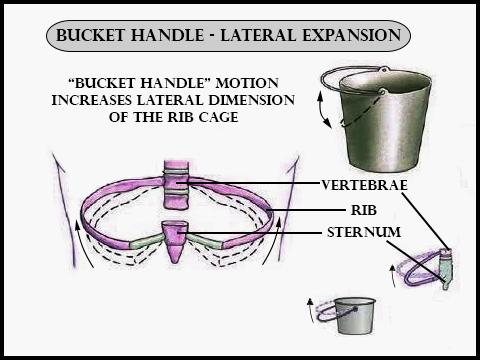
Note: Rib 3- 5 have a pump handle like movement, Rib 11- 12 have a caliper type movement. Rib movements are important for the movement of the upper portion of the body, the range of motion would be extremely limited and rigid without these movements. The bucket handle movement is responsible for breathing as the intercostal muscles bring about this movement by contraction and increasing the thoracic volume.
Complete Answer:
In humans, the vertebral column is dorsally placed and comprises 26 units called vertebrae. The human chest cavity has important organs - the heart and lungs.
A ribcage protects these vital fragile organs. In humans, this rib cage consists of 12 pairs of ribs. Each rib is a flattened bone which is dorsally connected to the vertebral column and ventrally connected to the sternum.
This connection to the sternum may be direct in case of true ribs, indirect in case of floating ribs, and absent in case of false ribs.
The bucket handle movement of the ribs allows the thorax to transversely change in diameter. The ribs generally move around two axes.
The anterior part of the ribs is about 4 centimeters lower than the posterior part and the middle of the rib is lower than both the anterior and the posterior end.
The movement of the vertebral joint at rib 6 to rib 10 is about the anteroposterior axis this results in raising and lowering of the middle of the rib thus causing the bucket handle movement.
Note: Rib 3- 5 have a pump handle like movement, Rib 11- 12 have a caliper type movement. Rib movements are important for the movement of the upper portion of the body, the range of motion would be extremely limited and rigid without these movements. The bucket handle movement is responsible for breathing as the intercostal muscles bring about this movement by contraction and increasing the thoracic volume.
Recently Updated Pages
Write any three differences between metals and nonmetals class 10 social science CBSE

Amit standing on a horizontal plane finds a bird flying class 10 maths CBSE
Two circles of radii 5 cm and 3 cm intersect at two class 10 maths CBSE
Solve the following i John and Jivanti together have class 10 maths CBSE
What is the relation between orthocenter circumcentre class 10 maths CBSE
Two plane mirrors are inclined at 70circ A ray incident class 10 physics CBSE
Trending doubts
Explain the Treaty of Vienna of 1815 class 10 social science CBSE
1 GB equals how many MB?
10 examples of evaporation in daily life with explanations
What is the full form of POSCO class 10 social science CBSE
Which is the hottest planet in the Solar system A Earth class 10 social science CBSE
Name any four life processes in living things class 10 biology CBSE