



What is the relation between orthocenter, circumcentre, and centroid?
Answer
 Verified
585k+ views
Hint: First, we shall analyze the given information so that we can able to answer the question. Here, in this question, we are asked to calculate the necessary relation between the orthocenter, the circumcenter, and the centroid of a triangle.
Complete step by step answer:
The orthocenter of a triangle is nothing but the point where all the three altitudes intersect each other (i.e.) it is the point where the perpendicular drawn from the vertices to the opposite sides of the triangle cut each other.
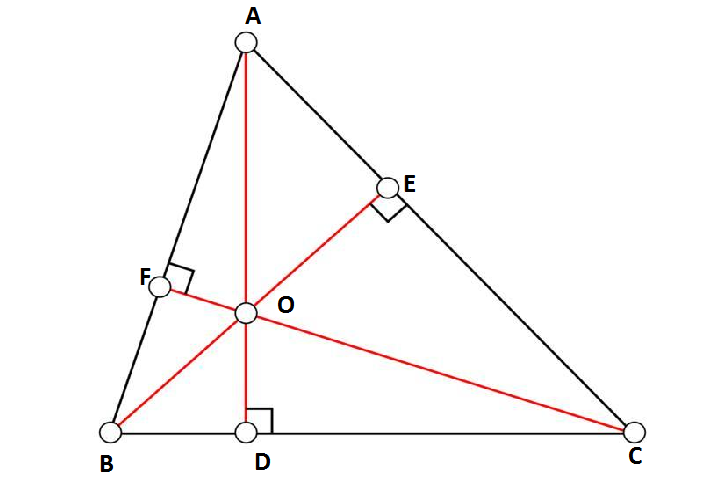
Here the altitudes AD, BE and CF intersect at O. Hence, O is the orthocenter of this triangle.
The circumcenter of a triangle is nothing but the point where the perpendicular bisectors of the sides of the triangle intersect each other (i.e.) it is the point of concurrency of the bisector of the sides.
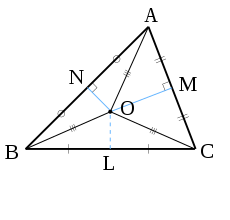
In the above figure, O is the circumcenter of the triangle.
The centroid of a triangle is nothing but the point where all the three medians of the triangle intersect each other (i.e.) it is the point of intersection of all three medians.
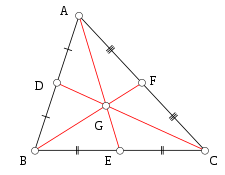
Here the medians AE, BF, and CD intersect at G. Hence, G is the centroid of this triangle.
Here, we are asked to calculate the relation between the orthocenter, circumcenter, and centroid.
Suppose H be the orthocenter, O be the circumcenter and G be the centroid.
Since these three points lie on the same line, these points are said to be the collinear points.
Also, it is a known fact that the centroid divides the orthocenter and the circumcenter internally in the ratio $2:1$
Hence, $\dfrac{{HG}}{{GO}} = 2:1$
Note: From the above explanation, we can understand that when we take an isosceles triangle, the centroid, the orthocenter, and the circumcenter lie on the same line whereas when we take an equilateral triangle, the centroid, the orthocenter, and the circumcenter coincide at a point. This is the required relation between orthocenter, circumcentre, and centroid.
Complete step by step answer:
The orthocenter of a triangle is nothing but the point where all the three altitudes intersect each other (i.e.) it is the point where the perpendicular drawn from the vertices to the opposite sides of the triangle cut each other.
Here the altitudes AD, BE and CF intersect at O. Hence, O is the orthocenter of this triangle.
The circumcenter of a triangle is nothing but the point where the perpendicular bisectors of the sides of the triangle intersect each other (i.e.) it is the point of concurrency of the bisector of the sides.
In the above figure, O is the circumcenter of the triangle.
The centroid of a triangle is nothing but the point where all the three medians of the triangle intersect each other (i.e.) it is the point of intersection of all three medians.
Here the medians AE, BF, and CD intersect at G. Hence, G is the centroid of this triangle.
Here, we are asked to calculate the relation between the orthocenter, circumcenter, and centroid.
Suppose H be the orthocenter, O be the circumcenter and G be the centroid.
Since these three points lie on the same line, these points are said to be the collinear points.
Also, it is a known fact that the centroid divides the orthocenter and the circumcenter internally in the ratio $2:1$
Hence, $\dfrac{{HG}}{{GO}} = 2:1$
Note: From the above explanation, we can understand that when we take an isosceles triangle, the centroid, the orthocenter, and the circumcenter lie on the same line whereas when we take an equilateral triangle, the centroid, the orthocenter, and the circumcenter coincide at a point. This is the required relation between orthocenter, circumcentre, and centroid.
Recently Updated Pages
A Paragraph on Pollution in about 100-150 Words

Write any three differences between metals and nonmetals class 10 social science CBSE
Amit standing on a horizontal plane finds a bird flying class 10 maths CBSE
Two circles of radii 5 cm and 3 cm intersect at two class 10 maths CBSE
Solve the following i John and Jivanti together have class 10 maths CBSE
What is the relation between orthocenter circumcentre class 10 maths CBSE
Trending doubts
Explain the Treaty of Vienna of 1815 class 10 social science CBSE
10 examples of evaporation in daily life with explanations
What is the full form of POSCO class 10 social science CBSE
Make a sketch of the human nerve cell What function class 10 biology CBSE
The uses of bleaching powder are A It is used bleaching class 10 chemistry CBSE
Choose the feminine form of the given noun Fox AFoxess class 10 english CBSE