




Which part of the brain is more developed in humans?
(a)Medulla
(b)Cerebellum
(c)Cerebrum
(d)Optic lobes
Answer
 Verified
611.7k+ views
Hint: This part of the brain if removed, then the organism becomes a simple reflex organism. It is the center of intelligence. The Broca’s area or area of the brain related to speech is located in this part.
Complete step-by-step answer:
In Natural evolution, we, humans are one of the most superior forms of evolution. This is due to the higher intelligence acquired by us. The biggest part of our human brain is Cerebrum. The cerebrum has 2 hemispheres that are left and right hemispheres. It plays many vital functions of the brain.
Additional Information:
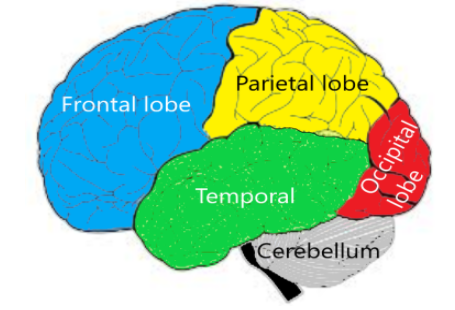
The brain has mainly three parts:
-Cerebrum: largest one of the brain. It performs functions like sensing, vision, hearing, speech, reasoning, emotions, learning, and movement.
-Cerebellum: is located under the cerebrum and it coordinates muscle movements, maintains posture and balance.
-Brainstem: It connects the cerebrum and cerebellum to the spinal cord. It performs many automatic functions like breathing, heart rate, body temperature, vomiting, etc.
-The cerebrum is divided into right and left hemispheres in which they perform the functions opposite of the body; the right hemisphere controls the left side of the body while the left hemisphere maintains the right side of the body.
-The cerebrum is divided into four lobes and they are the frontal lobe, parietal lobe, occipital lobe, and temporal lobe.
So, the correct answer is, ” Cerebrum.”
Note:
Frontal lobe
-Personality, behavior, emotions
-Judgment, planning, problem-solving
-Body movement (motor strip)
Parietal lobe
-Interprets language, words
-Sense of touch, pain, temperature (sensory strip)
-Spatial and visual perception
Occipital lobe
-Interprets vision (color, light, movement)
Temporal lobe
-Understanding language (Wernicke’s area)
-Memory
-Hearing
-Sequencing and organization
Complete step-by-step answer:
In Natural evolution, we, humans are one of the most superior forms of evolution. This is due to the higher intelligence acquired by us. The biggest part of our human brain is Cerebrum. The cerebrum has 2 hemispheres that are left and right hemispheres. It plays many vital functions of the brain.
Additional Information:
The brain has mainly three parts:
-Cerebrum: largest one of the brain. It performs functions like sensing, vision, hearing, speech, reasoning, emotions, learning, and movement.
-Cerebellum: is located under the cerebrum and it coordinates muscle movements, maintains posture and balance.
-Brainstem: It connects the cerebrum and cerebellum to the spinal cord. It performs many automatic functions like breathing, heart rate, body temperature, vomiting, etc.
-The cerebrum is divided into right and left hemispheres in which they perform the functions opposite of the body; the right hemisphere controls the left side of the body while the left hemisphere maintains the right side of the body.
-The cerebrum is divided into four lobes and they are the frontal lobe, parietal lobe, occipital lobe, and temporal lobe.
So, the correct answer is, ” Cerebrum.”
Note:
Frontal lobe
-Personality, behavior, emotions
-Judgment, planning, problem-solving
-Body movement (motor strip)
Parietal lobe
-Interprets language, words
-Sense of touch, pain, temperature (sensory strip)
-Spatial and visual perception
Occipital lobe
-Interprets vision (color, light, movement)
Temporal lobe
-Understanding language (Wernicke’s area)
-Memory
-Hearing
-Sequencing and organization
Recently Updated Pages
Master Class 11 Social Science: Engaging Questions & Answers for Success

Master Class 11 Physics: Engaging Questions & Answers for Success
Master Class 11 Maths: Engaging Questions & Answers for Success
Master Class 11 Economics: Engaging Questions & Answers for Success
Master Class 11 Computer Science: Engaging Questions & Answers for Success
Master Class 11 Chemistry: Engaging Questions & Answers for Success
Trending doubts
One Metric ton is equal to kg A 10000 B 1000 C 100 class 11 physics CBSE
There are 720 permutations of the digits 1 2 3 4 5 class 11 maths CBSE
1 Quintal is equal to a 110 kg b 10 kg c 100kg d 1000 class 11 physics CBSE
State and prove Bernoullis theorem class 11 physics CBSE
Difference Between Prokaryotic Cells and Eukaryotic Cells
Discuss the various forms of bacteria class 11 biology CBSE