




Which one of the following sets of animals share a four chambered heart?
Answer
 Verified
559.2k+ views
Hint: Heart is a muscular and important organ or major organ of the body. It comes under the circulatory system as its function is to pump blood throughout the body. If a heart stops working the person could die. It is that essential organ. The heart is about the size of our fist located behind and slightly left of the breastbone. Functions of the heart include pumping oxygenated blood to the other body parts. Pumping hormones and other vital substances to different body parts also receiving deoxygenated blood and carrying metabolic waste products from the body.
Complete answer:
As we discussed some of the important functions of the heart, now let us know about the structure.
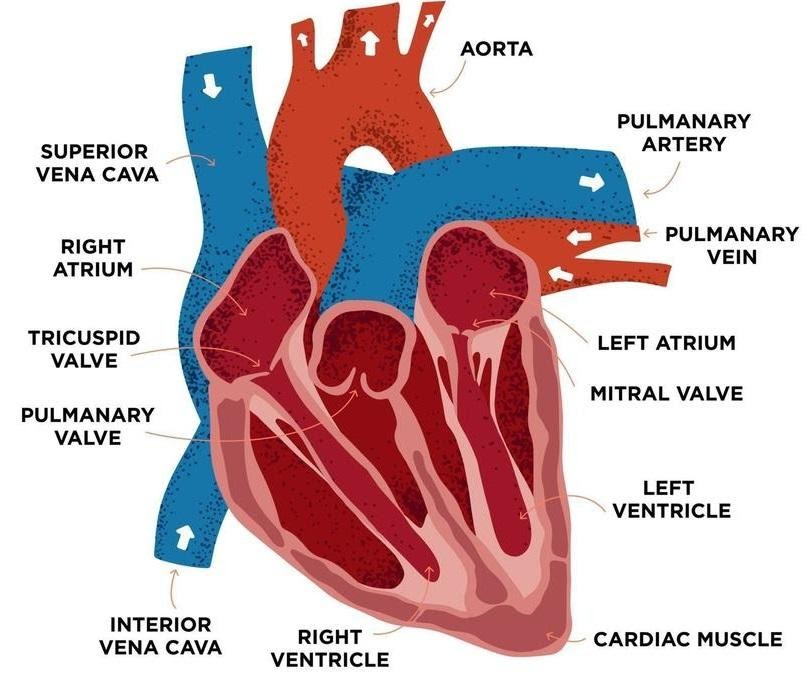
Animals sharing four chambered hearts are- crocodiles, birds, mammals. Crocodiles fall into the category of amphibians but it is exceptional. Humans as mammals also have four chambered hearts. The heart is divided into four chambers- upper left and right atria and lower and right ventricles.
Commonly the right atrium and ventricle are referred together as the right heart and their left atrium and left ventricle are called the left heart. In a healthy heart blood flows one way through the heart due to heart valves which prevent backflow of blood. There are two types of valves which prevent the blood bi-cuspid valve and tricuspid valve. The heart is enclosed in a protective sac called pericardium which contains a small amount of fluid.
The walls of the heart are made up of three layers- epicardium, myocardium and endocardium. In the center mediastinum, in a thoracic vertebra \[T5 - T8\], the human heart is located. The back surface of the heart lies near the vertebral column and the front surface sits behind the sternum which is the breastbone and rib cartilages.
The upper part of the heart is located as the attachment point of several large blood vessels- the vena cava aorta and pulmonary trunk. The lower tip of the heart apex lies to the left of the sternum between the junction of fourth and fifth ribs near their articulation with the costal cartilages.
The heart has four chambers as we know, two upper atria the receiving chambers and two lower ventricles the discharging chambers. The distinction is on the surface of the heart called coronary sulcus. The cardiac skeleton is dense connective tissue and gives structure to the heart.
Note:
It forms the atrioventricular septum which separates the atria from the ventricles and the fibrous rings which serve as bases for the four heart valves. An adult heart beats \[100,000\] times a day. If the heart is closer to \[100\] beats per day. a normal resting heart beats \[60 - 100\] times per minute. It depends on the cardiovascular fitness.
Complete answer:
As we discussed some of the important functions of the heart, now let us know about the structure.
Animals sharing four chambered hearts are- crocodiles, birds, mammals. Crocodiles fall into the category of amphibians but it is exceptional. Humans as mammals also have four chambered hearts. The heart is divided into four chambers- upper left and right atria and lower and right ventricles.
Commonly the right atrium and ventricle are referred together as the right heart and their left atrium and left ventricle are called the left heart. In a healthy heart blood flows one way through the heart due to heart valves which prevent backflow of blood. There are two types of valves which prevent the blood bi-cuspid valve and tricuspid valve. The heart is enclosed in a protective sac called pericardium which contains a small amount of fluid.
The walls of the heart are made up of three layers- epicardium, myocardium and endocardium. In the center mediastinum, in a thoracic vertebra \[T5 - T8\], the human heart is located. The back surface of the heart lies near the vertebral column and the front surface sits behind the sternum which is the breastbone and rib cartilages.
The upper part of the heart is located as the attachment point of several large blood vessels- the vena cava aorta and pulmonary trunk. The lower tip of the heart apex lies to the left of the sternum between the junction of fourth and fifth ribs near their articulation with the costal cartilages.
The heart has four chambers as we know, two upper atria the receiving chambers and two lower ventricles the discharging chambers. The distinction is on the surface of the heart called coronary sulcus. The cardiac skeleton is dense connective tissue and gives structure to the heart.
Note:
It forms the atrioventricular septum which separates the atria from the ventricles and the fibrous rings which serve as bases for the four heart valves. An adult heart beats \[100,000\] times a day. If the heart is closer to \[100\] beats per day. a normal resting heart beats \[60 - 100\] times per minute. It depends on the cardiovascular fitness.
Recently Updated Pages
Master Class 11 English: Engaging Questions & Answers for Success

Master Class 11 Social Science: Engaging Questions & Answers for Success
Master Class 11 Maths: Engaging Questions & Answers for Success
Master Class 11 Biology: Engaging Questions & Answers for Success
Master Class 11 Physics: Engaging Questions & Answers for Success
Master Class 11 Chemistry: Engaging Questions & Answers for Success
Trending doubts
One Metric ton is equal to kg A 10000 B 1000 C 100 class 11 physics CBSE
Difference Between Prokaryotic Cells and Eukaryotic Cells
Find the value of the expression given below sin 30circ class 11 maths CBSE
Difference between physical and chemical change class 11 chemistry CBSE
Two of the body parts which do not appear in MRI are class 11 biology CBSE
Draw a diagram of a plant cell and label at least eight class 11 biology CBSE