




Which of the following is the correct sequence of evolution in vertebrates?
A) Bony fish – amphibians – reptiles – birds
B) Birds – bony fish – amphibians – reptiles
C) Amphibians – reptiles – bony fish – birds
D) Reptiles – birds – bony fish – amphibians
E) Reptiles – birds – amphibians – bony fish
Answer
 Verified
605.7k+ views
Hint:Charles Darwin concluded that existing living forms share similarities to varying degrees not only among themselves but also with life forms that existed millions of years ago. There has been gradual evolution of life forms with variation in characteristics.
Complete answer:
The early vertebrates were jawless fish, similar to living hagfish. They lived between 500 and 600 million years ago. They had a cranium but no vertebral column. The first vertebrate to evolve is the bony fish which evolved from a jawless fish.
The amphibians evolved next after fish. The first amphibians have evolved from a lobe-finned fish ancestor about 365 million years ago. They are the first vertebrates to live on land, but they had to return to water to reproduce. For this reason, they had to live near water bodies. They had few characteristics of fish in their early life.
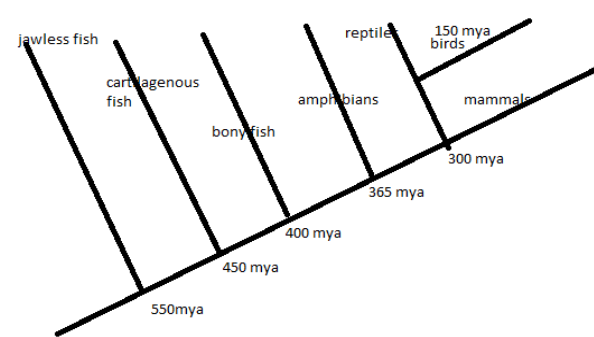
The reptiles evolved from the amphibians. They lived completely on land. They laid amniotic eggs and had fertilization. They were the first vertebrates that didn't have to return to water for reproduction.
Reptiles developed certain added features such as feather, hollow bones, and warm body. These animals were called birds or Aves.
Thus, the correct option is ‘A’ (Bony fish – amphibians – reptiles – birds)
Note:Mammals and birds both evolved from reptiles like ancestors. All vertebrates before the evolution of birds and mammals were ectothermic. Ectothermic means regulating the body temperature from the outside through behavioural changes like hiding under a rock in shade to keep cool on a hot, sunny day. Mammals and birds are endothermy means they can regulate the body temperature from the inside through metabolic and other physical changes.
Complete answer:
The early vertebrates were jawless fish, similar to living hagfish. They lived between 500 and 600 million years ago. They had a cranium but no vertebral column. The first vertebrate to evolve is the bony fish which evolved from a jawless fish.
The amphibians evolved next after fish. The first amphibians have evolved from a lobe-finned fish ancestor about 365 million years ago. They are the first vertebrates to live on land, but they had to return to water to reproduce. For this reason, they had to live near water bodies. They had few characteristics of fish in their early life.
The reptiles evolved from the amphibians. They lived completely on land. They laid amniotic eggs and had fertilization. They were the first vertebrates that didn't have to return to water for reproduction.
Reptiles developed certain added features such as feather, hollow bones, and warm body. These animals were called birds or Aves.
Thus, the correct option is ‘A’ (Bony fish – amphibians – reptiles – birds)
Note:Mammals and birds both evolved from reptiles like ancestors. All vertebrates before the evolution of birds and mammals were ectothermic. Ectothermic means regulating the body temperature from the outside through behavioural changes like hiding under a rock in shade to keep cool on a hot, sunny day. Mammals and birds are endothermy means they can regulate the body temperature from the inside through metabolic and other physical changes.
Recently Updated Pages
Master Class 12 Economics: Engaging Questions & Answers for Success

Master Class 12 English: Engaging Questions & Answers for Success
Master Class 12 Social Science: Engaging Questions & Answers for Success
Master Class 12 Maths: Engaging Questions & Answers for Success
Master Class 12 Physics: Engaging Questions & Answers for Success
Master Class 9 General Knowledge: Engaging Questions & Answers for Success
Trending doubts
One Metric ton is equal to kg A 10000 B 1000 C 100 class 11 physics CBSE
Difference Between Prokaryotic Cells and Eukaryotic Cells
Two of the body parts which do not appear in MRI are class 11 biology CBSE
Find the value of the expression given below sin 30circ class 11 maths CBSE
1 ton equals to A 100 kg B 1000 kg C 10 kg D 10000 class 11 physics CBSE
Draw a diagram of nephron and explain its structur class 11 biology CBSE