




Which of the following is correct about astronomical telescope
A. It consists of two diverging lenses
B. Its objective is a concave lens
C. Its eyepiece is a convex lens with greater focal length than the objective
D. The final image in this telescope is inverted
Answer
 Verified
562.8k+ views
Hint:First of all we need to define the astronomical telescope and its working principle with the help of a ray diagram which is generally seen inside the telescope.Once we know how a telescope is made up, we can form the image with the help of a ray diagram.
Complete answer:
Astronomical Telescope:It is an optical instrument which is used to see the magnified image of distant heavenly bodies. It works on the principle that when an object is to be magnified that is placed at a larger distance from the objective lens of the telescope that it will produce a virtual, inverted and magnified image of that object and the least distance of distinct vision from the eye held close to the eyepiece lens.
Ray diagram:
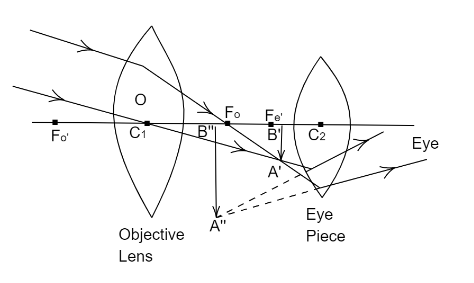
This is the ray diagram of a telescope which shows the working principle of the astronomical telescope. When a parallel beam of light coming from heavenly body falls on the objective lens. The objective lens forms a real, inverted and diminished image which we can see in the figure A’B’. Now this A’B’ image acts as an object for eyepiece lens where the image lies between the focal of the eyepiece and center of the lens $C_2$. Now the image from this lens is a virtual, inverted and highly magnified image of the object that is formed at infinity.
Therefore from the above diagram and discussion we can say the correct option is (D).
Note: The lenses present in the telescope are both convex lenses. And also remember that the final image of an object formed by an astronomical telescope is always inverted with respect to the object. The heavenly bodies are stars, planets and satellites and are spherical in shape.
Complete answer:
Astronomical Telescope:It is an optical instrument which is used to see the magnified image of distant heavenly bodies. It works on the principle that when an object is to be magnified that is placed at a larger distance from the objective lens of the telescope that it will produce a virtual, inverted and magnified image of that object and the least distance of distinct vision from the eye held close to the eyepiece lens.
Ray diagram:
This is the ray diagram of a telescope which shows the working principle of the astronomical telescope. When a parallel beam of light coming from heavenly body falls on the objective lens. The objective lens forms a real, inverted and diminished image which we can see in the figure A’B’. Now this A’B’ image acts as an object for eyepiece lens where the image lies between the focal of the eyepiece and center of the lens $C_2$. Now the image from this lens is a virtual, inverted and highly magnified image of the object that is formed at infinity.
Therefore from the above diagram and discussion we can say the correct option is (D).
Note: The lenses present in the telescope are both convex lenses. And also remember that the final image of an object formed by an astronomical telescope is always inverted with respect to the object. The heavenly bodies are stars, planets and satellites and are spherical in shape.
Recently Updated Pages
Which of the following graphs shows the variation of class 12 physics CBSE

Draw a labelled diagram of the human male reproductive class 12 biology CBSE
Describe the experiment to compare the emf of two cells class 12 physics CBSE
What is standard hydrogen electrode
What is conventional current and electric current class 12 physics CBSE
2Bromopentane is treated with an alcoholic KOH solution class 12 chemistry CBSE
Trending doubts
Draw a labelled sketch of the human eye class 12 physics CBSE
Which are the Top 10 Largest Countries of the World?
Differentiate between homogeneous and heterogeneous class 12 chemistry CBSE
Draw ray diagrams each showing i myopic eye and ii class 12 physics CBSE
Which is the correct genotypic ratio of mendel dihybrid class 12 biology CBSE
What is the Full Form of PVC, PET, HDPE, LDPE, PP and PS ?