




Which of the following curves represents Henry's law?
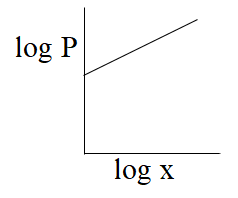
(A)-
(B)-
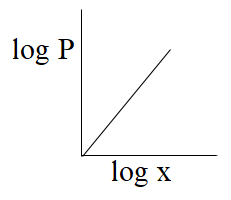
(C)-
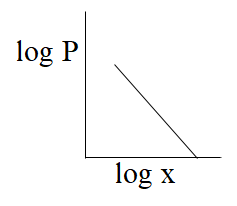
(D)-
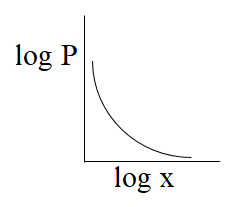
Answer
 Verified
627.9k+ views
Hint: To get know about the curve or graph from the above given options which is representing Henry's Law, first we have to change the Henry’s Law equation into the logarithm form.
Complete step by step answer:
- Henry’s Law states that, the amount of any gas which is dissolved in any solvent is directly proportional to the partial pressure of that gas with the solvent in the equilibrium condition.
Mathematically Henry’s Law shown as follow:
${\text{m = KP}}$……….. (i)
Where, x = amount of dissolved gas
P = partial pressure of gas in atm
K = Henry’s constant.
Now taking log on both sides of equation (i), we get
${\text{log (x) = log (KP)}}$
${\text{log x = log K + log P}}$
Or ${\text{log P = log K - log x}}$………….. (ii)
Now, compare the equation (ii) with the straight line equation i.e. ${\text{y = mx}}$
So, we get ${\text{y = logP}}$
${\text{mx = - log x}}$
Slope ${\text{m = - 1}}$
Intercept ${\text{C = log K}}$.
From the above comparison of henry’s equation with the straight line equation it is clear that straight line of the graph or curve doesn’t goes through the origin as it has some value of intercept which is equal to ${\text{logK}}$, & slope of the graph is negative as value of m is -1.
So, from the above all graphs only the graph which is given option (C) represents henry's law.
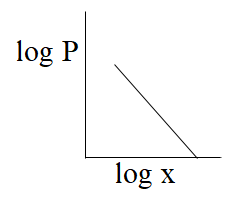
The correct answer is option “C” .
Note: In this question some of you may consider this equation ${\text{log x = log K + log P}}$ only to find the graph which is representing henry’s law but that will be wrong because the quantity present on the left side represents the y-axis and in all options in y-axis, ${\text{log x}}$ is not given. That’s why we rearrange the ${\text{log x = log K + log P}}$ equation to equation (ii).
Complete step by step answer:
- Henry’s Law states that, the amount of any gas which is dissolved in any solvent is directly proportional to the partial pressure of that gas with the solvent in the equilibrium condition.
Mathematically Henry’s Law shown as follow:
${\text{m = KP}}$……….. (i)
Where, x = amount of dissolved gas
P = partial pressure of gas in atm
K = Henry’s constant.
Now taking log on both sides of equation (i), we get
${\text{log (x) = log (KP)}}$
${\text{log x = log K + log P}}$
Or ${\text{log P = log K - log x}}$………….. (ii)
Now, compare the equation (ii) with the straight line equation i.e. ${\text{y = mx}}$
So, we get ${\text{y = logP}}$
${\text{mx = - log x}}$
Slope ${\text{m = - 1}}$
Intercept ${\text{C = log K}}$.
From the above comparison of henry’s equation with the straight line equation it is clear that straight line of the graph or curve doesn’t goes through the origin as it has some value of intercept which is equal to ${\text{logK}}$, & slope of the graph is negative as value of m is -1.
So, from the above all graphs only the graph which is given option (C) represents henry's law.
The correct answer is option “C” .
Note: In this question some of you may consider this equation ${\text{log x = log K + log P}}$ only to find the graph which is representing henry’s law but that will be wrong because the quantity present on the left side represents the y-axis and in all options in y-axis, ${\text{log x}}$ is not given. That’s why we rearrange the ${\text{log x = log K + log P}}$ equation to equation (ii).
Recently Updated Pages
Which of the following graphs shows the variation of class 12 physics CBSE

Draw a labelled diagram of the human male reproductive class 12 biology CBSE
Describe the experiment to compare the emf of two cells class 12 physics CBSE
What is standard hydrogen electrode
What is conventional current and electric current class 12 physics CBSE
2Bromopentane is treated with an alcoholic KOH solution class 12 chemistry CBSE
Trending doubts
Draw a labelled sketch of the human eye class 12 physics CBSE
Which are the Top 10 Largest Countries of the World?
Differentiate between homogeneous and heterogeneous class 12 chemistry CBSE
Draw ray diagrams each showing i myopic eye and ii class 12 physics CBSE
Which is the correct genotypic ratio of mendel dihybrid class 12 biology CBSE
What is the Full Form of PVC, PET, HDPE, LDPE, PP and PS ?