




Which of the following animals has a compound stomach (rumen)?
A. Dog
B. Rat
C. Horse
D. Cow
Answer
 Verified
591k+ views
Hint: Ruminants are organisms that have a compound stomach. Compound stomach or rumen is the largest part where the main digestion occurs in ruminants. Microbial fermentation is included in this specialized stomach.
Complete answer:
Ruminants are animals including herbivore mammals that have specialized stomachs for the digestion of plant-based products. Cattle, sheep, buffalo, goats, and cows are ruminants. These animals have a very different digestive system than humans. Humans have a single main digesting unit called the stomach. But ruminants have four compartments in their stomach. These compartments are called the omasum, abomasum, rumen, and reticulum. Rumen and reticulum are involved in microbial fermentation. The rumen is the largest compartment where the main digestion occurs. Fermentation occurs in the rumen to digest plant-based food which is mainly in the form of cellulose. Cellulose is hard to digest and thus requires microbial action. Microbial actions degrade the complex plant carbohydrates. After this, the fermented ingesta is formed which is called cud. The cud is then subjected to regurgitated or chewed again and is mixed with saliva. Saliva is an important medium for microbes to work. This is the reason why cows are seen chewing most of the time. Rechewing the cud ensures proper digestion and breakdown of plant matter. This type of digestion is called rumination. The term ‘ruminare’ itself means to chew again.
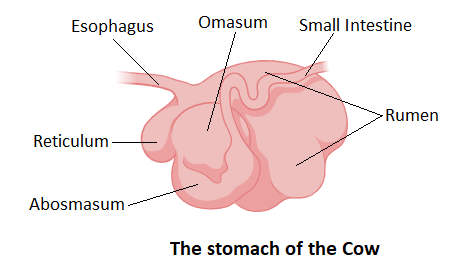
Thus, from the above discussion, we can conclude that the correct answer is option D.
Note: The omasum and abomasum are the compartments that received the regurgitated food. Here, the final digestion occurs with the release of enzymes. Also, microbes that were proliferated in rumen get digested here. After the final digestion, food moves to the small intestine where absorption of nutrients occurs.
Complete answer:
Ruminants are animals including herbivore mammals that have specialized stomachs for the digestion of plant-based products. Cattle, sheep, buffalo, goats, and cows are ruminants. These animals have a very different digestive system than humans. Humans have a single main digesting unit called the stomach. But ruminants have four compartments in their stomach. These compartments are called the omasum, abomasum, rumen, and reticulum. Rumen and reticulum are involved in microbial fermentation. The rumen is the largest compartment where the main digestion occurs. Fermentation occurs in the rumen to digest plant-based food which is mainly in the form of cellulose. Cellulose is hard to digest and thus requires microbial action. Microbial actions degrade the complex plant carbohydrates. After this, the fermented ingesta is formed which is called cud. The cud is then subjected to regurgitated or chewed again and is mixed with saliva. Saliva is an important medium for microbes to work. This is the reason why cows are seen chewing most of the time. Rechewing the cud ensures proper digestion and breakdown of plant matter. This type of digestion is called rumination. The term ‘ruminare’ itself means to chew again.
Thus, from the above discussion, we can conclude that the correct answer is option D.
Note: The omasum and abomasum are the compartments that received the regurgitated food. Here, the final digestion occurs with the release of enzymes. Also, microbes that were proliferated in rumen get digested here. After the final digestion, food moves to the small intestine where absorption of nutrients occurs.
Recently Updated Pages
Master Class 11 Social Science: Engaging Questions & Answers for Success

Master Class 11 English: Engaging Questions & Answers for Success
Master Class 11 Maths: Engaging Questions & Answers for Success
Master Class 11 Chemistry: Engaging Questions & Answers for Success
Master Class 11 Biology: Engaging Questions & Answers for Success
Master Class 11 Physics: Engaging Questions & Answers for Success
Trending doubts
One Metric ton is equal to kg A 10000 B 1000 C 100 class 11 physics CBSE
Difference Between Prokaryotic Cells and Eukaryotic Cells
How many of the following diseases can be studied with class 11 biology CBSE
Draw a diagram of a plant cell and label at least eight class 11 biology CBSE
Two of the body parts which do not appear in MRI are class 11 biology CBSE
Which gas is abundant in air class 11 chemistry CBSE