




Which is not a vestigial organ in the human body?
(a)Tail-bone
(b)Ear muscle
(c)Wisdom teeth
(d)Nail
Answer
 Verified
597.9k+ views
Hint: A vestigial organ is said to be a rudimentary nonfunctional organ in the body of an animal which is a remnant of the functional organ that was present in the ancestors of that animal, but gradually diminished during evolution as it was no longer needed.
Complete answer:
Vestigial organs are non-functional organs that are present as a remnant of the past organs. The organ which is not vestigial in the body of humans is the nail. A nail is a claw-like keratinized plate found at the top of fingers and toes and is responsible for protecting those tips. Nails are found in most primates and are the equivalent of claws found in other animals. A nail is made up of a tough protein known as alpha-keratin and consists of a nail bed, nail plate, and nail matrix.
Additional Information: Let us look at the other structures mentioned in the options:
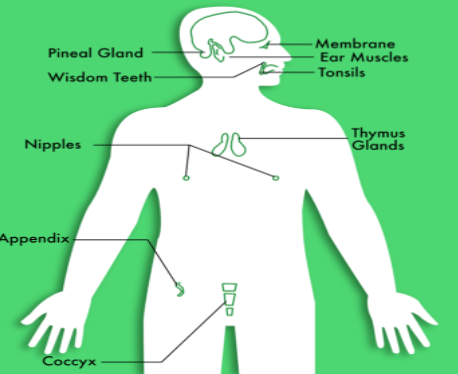
Tail-bone: The tailbone is used by mammals for balance during movement and thus was also used by our ancestors for similar purposes. But once humans learned how to walk, this tailbone became useless and thus became fused vertebrae known as coccyx during evolution.
Ear muscle: Ear muscles are tiny, small muscles around the ear which help move the ear too and fro to hear the incoming sound waves better. This was useful for our ancestors in order to detect predators but once humans became skillful and made weapons there was no longer use for these muscles and it gradually became a vestigial structure.
Wisdom teeth: Wisdom teeth were useful in our ancestors as there was no dental hygiene during those times and many teeth used to fall away. But with evolution, as the jaw became smaller and dental hygiene improved, there was not much use of the wisdom tooth and it became vestigial.
So, the correct option is 'Nail'.
Note: -Erector pili and body hair is another such example which is a vestigial structure that was used by our ancestors to look bigger in size to frighten their predators.
-Appendix was used by our ancestors to digest plant compounds like cellulose and it is of no use to us now, thus it is also vestigial.
-Male nipples are formed during the fetus formation but are vestigial in nature.
Complete answer:
Vestigial organs are non-functional organs that are present as a remnant of the past organs. The organ which is not vestigial in the body of humans is the nail. A nail is a claw-like keratinized plate found at the top of fingers and toes and is responsible for protecting those tips. Nails are found in most primates and are the equivalent of claws found in other animals. A nail is made up of a tough protein known as alpha-keratin and consists of a nail bed, nail plate, and nail matrix.
Additional Information: Let us look at the other structures mentioned in the options:
Tail-bone: The tailbone is used by mammals for balance during movement and thus was also used by our ancestors for similar purposes. But once humans learned how to walk, this tailbone became useless and thus became fused vertebrae known as coccyx during evolution.
Ear muscle: Ear muscles are tiny, small muscles around the ear which help move the ear too and fro to hear the incoming sound waves better. This was useful for our ancestors in order to detect predators but once humans became skillful and made weapons there was no longer use for these muscles and it gradually became a vestigial structure.
Wisdom teeth: Wisdom teeth were useful in our ancestors as there was no dental hygiene during those times and many teeth used to fall away. But with evolution, as the jaw became smaller and dental hygiene improved, there was not much use of the wisdom tooth and it became vestigial.
So, the correct option is 'Nail'.
Note: -Erector pili and body hair is another such example which is a vestigial structure that was used by our ancestors to look bigger in size to frighten their predators.
-Appendix was used by our ancestors to digest plant compounds like cellulose and it is of no use to us now, thus it is also vestigial.
-Male nipples are formed during the fetus formation but are vestigial in nature.
Recently Updated Pages
Write any three differences between metals and nonmetals class 10 social science CBSE

Amit standing on a horizontal plane finds a bird flying class 10 maths CBSE
Two circles of radii 5 cm and 3 cm intersect at two class 10 maths CBSE
Solve the following i John and Jivanti together have class 10 maths CBSE
What is the relation between orthocenter circumcentre class 10 maths CBSE
Two plane mirrors are inclined at 70circ A ray incident class 10 physics CBSE
Trending doubts
Explain the Treaty of Vienna of 1815 class 10 social science CBSE
1 GB equals how many MB?
10 examples of evaporation in daily life with explanations
What is the full form of POSCO class 10 social science CBSE
Which is the hottest planet in the Solar system A Earth class 10 social science CBSE
Name any four life processes in living things class 10 biology CBSE