




Which cell division is found during cleavage?
(a)Amitosis
(b)Mitosis
(c)Closed mitosis
(d)Meiosis
Answer
 Verified
598.5k+ views
Hint: Cleavage is the cell division in the early embryonic stages. It is followed by the process of fertilization when the cyclin-dependent kinase complex is activated. It increases the number of cells and nuclear mass without the increase in cytoplasmic mass and differs from normal cell division.
Complete answer:
Mitosis occurred during the cleavage division. Cleavage involves cytokinesis and karyokinesis (mitosis) together. Mitotic apparatus consists of a central spindle and the polar esters which are made up of polymers of tubulin protein known as microtubules. They are nucleated by centrosomes. The centrosomes are organized by the sperm as basal bodies. The process of cytokinesis is interfered with by the contractile ring which is made up of polymers of actin protein known as microfilaments. The process of karyokinesis and cytokinesis are independent but are coordinated processes. Cytokinesis requires the mitotic apparatus while mitosis can be performed in the absence of cytokinesis.
Additional Information: Amitosis: It is the cell division that occurs directly. It is also known as karyo stenosis. It does not take place by the process of mitosis and cell proliferation. It involves cell division in eukaryotes. Ciliates which contain polyploid micronucleus divide mitotically. It results in a random distribution of parental alleles. The paired structures are not pulled in the opposite direction by a mitotic spindle to form daughter cells in Amitosis.
Closed mitosis: During closed mitosis the chromosome divides with an intact cell nucleus. Most animals perform shape change which is known as the mitotic cell rounding. They do so to adopt a near-spherical morphology at the initial stage of mitosis. During mitotic cell division, many human cells are produced.
Meiosis: Meiosis best place in sexually reproducing organisms which is a special type of cell division of germ cells. This process results in the production of gametes such as sperm or egg cells. This process takes place in two rounds. It results in four cells which include one copy of each paternal and maternal chromosome which is haploid. The genetic material of the copies of the paternal and maternal chromosome is crossed over which creates a combination of code on each chromosome. These haploid cells fuse to form two copies of each chromosome again which is known as a zygote.
So, the correct answer is 'mitosis'.
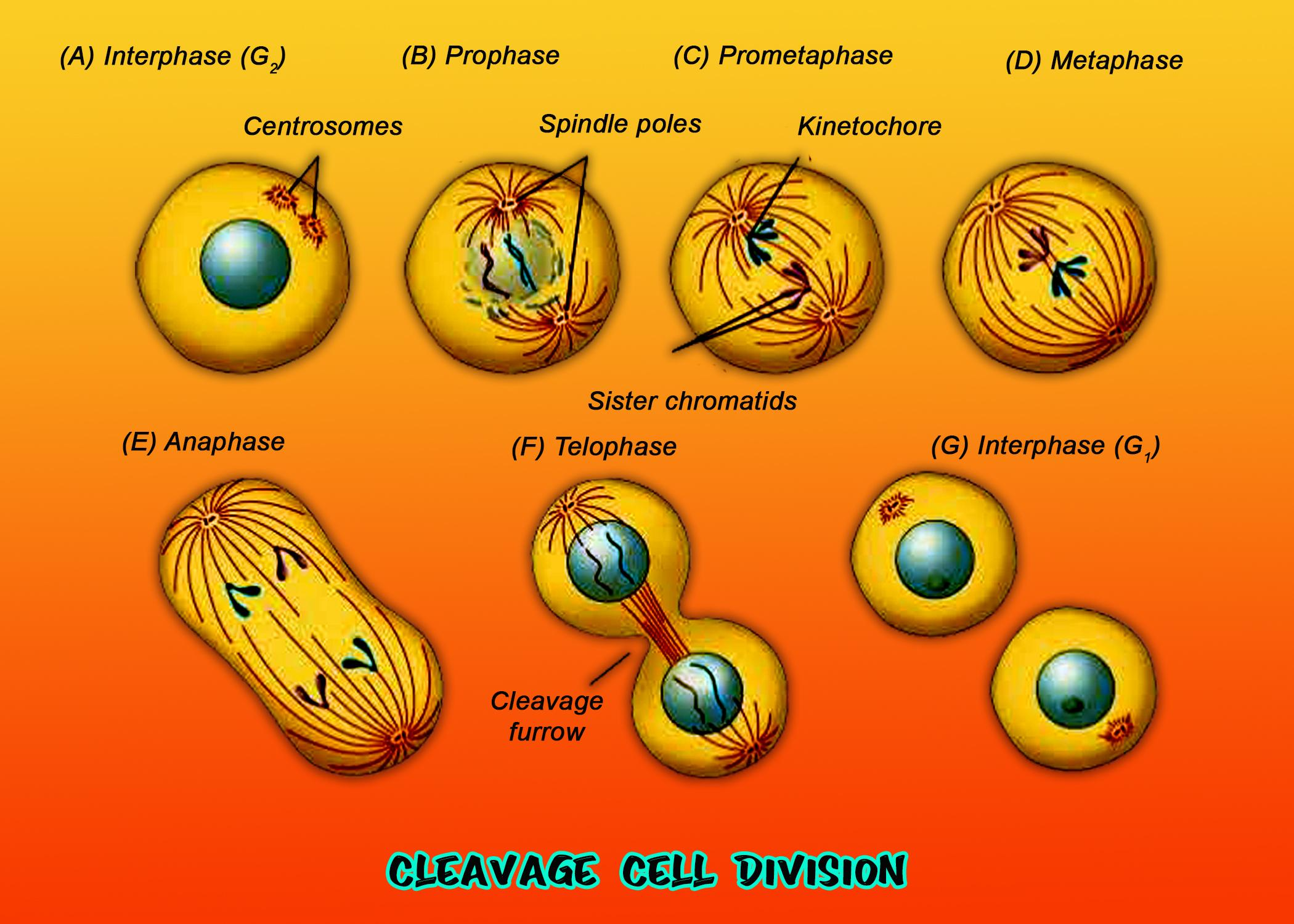
Note: The process of mitosis was first observed by Strasburger in animal cells and further coined by Fleming. The process of meiosis was coined by Farmer and Moore. The interphase stage occurs in both meiosis and mitosis. The process is divided into meiosis 1 and meiosis 2. Meiosis-1 is further divided into four phases which are professor metaphase anaphase and telophase.
Complete answer:
Mitosis occurred during the cleavage division. Cleavage involves cytokinesis and karyokinesis (mitosis) together. Mitotic apparatus consists of a central spindle and the polar esters which are made up of polymers of tubulin protein known as microtubules. They are nucleated by centrosomes. The centrosomes are organized by the sperm as basal bodies. The process of cytokinesis is interfered with by the contractile ring which is made up of polymers of actin protein known as microfilaments. The process of karyokinesis and cytokinesis are independent but are coordinated processes. Cytokinesis requires the mitotic apparatus while mitosis can be performed in the absence of cytokinesis.
Additional Information: Amitosis: It is the cell division that occurs directly. It is also known as karyo stenosis. It does not take place by the process of mitosis and cell proliferation. It involves cell division in eukaryotes. Ciliates which contain polyploid micronucleus divide mitotically. It results in a random distribution of parental alleles. The paired structures are not pulled in the opposite direction by a mitotic spindle to form daughter cells in Amitosis.
Closed mitosis: During closed mitosis the chromosome divides with an intact cell nucleus. Most animals perform shape change which is known as the mitotic cell rounding. They do so to adopt a near-spherical morphology at the initial stage of mitosis. During mitotic cell division, many human cells are produced.
Meiosis: Meiosis best place in sexually reproducing organisms which is a special type of cell division of germ cells. This process results in the production of gametes such as sperm or egg cells. This process takes place in two rounds. It results in four cells which include one copy of each paternal and maternal chromosome which is haploid. The genetic material of the copies of the paternal and maternal chromosome is crossed over which creates a combination of code on each chromosome. These haploid cells fuse to form two copies of each chromosome again which is known as a zygote.
So, the correct answer is 'mitosis'.
Note: The process of mitosis was first observed by Strasburger in animal cells and further coined by Fleming. The process of meiosis was coined by Farmer and Moore. The interphase stage occurs in both meiosis and mitosis. The process is divided into meiosis 1 and meiosis 2. Meiosis-1 is further divided into four phases which are professor metaphase anaphase and telophase.
Recently Updated Pages
Master Class 11 Social Science: Engaging Questions & Answers for Success

Master Class 11 English: Engaging Questions & Answers for Success
Master Class 11 Maths: Engaging Questions & Answers for Success
Master Class 11 Chemistry: Engaging Questions & Answers for Success
Master Class 11 Biology: Engaging Questions & Answers for Success
Master Class 11 Physics: Engaging Questions & Answers for Success
Trending doubts
One Metric ton is equal to kg A 10000 B 1000 C 100 class 11 physics CBSE
Difference Between Prokaryotic Cells and Eukaryotic Cells
There are 720 permutations of the digits 1 2 3 4 5 class 11 maths CBSE
Draw a diagram of a plant cell and label at least eight class 11 biology CBSE
Two of the body parts which do not appear in MRI are class 11 biology CBSE
Which gas is abundant in air class 11 chemistry CBSE