




What is magnetic declination?
Answer
 Verified
662.4k+ views
Hint: Magnetic declination is the angle on the horizontal plane between magnetic north and true north. As the time passes, magnetic declination varies both from place to place. It depends on how far away the magnetic poles are.
Complete step by step answer:
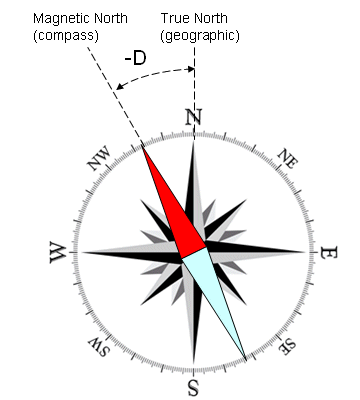
The direction in which the compass needle points is known as Magnetic North. Angle between this magnetic north and the True North direction is called magnetic declination. As the time passes, magnetic declination varies both from place to place. The magnetic declination in a given area will change slowly as time moves, like 20-25 degrees per year only. The rate of change is very small. It depends on how far away the magnetic poles are. There is Complex fluid motion in the outer core of the Earth which causes the magnetic field to change slowly with time. This change is called secular variation. If the compass at the place is pointing clockwise with respect to the True North, then the declination is positive or EAST. If the compass at the place is pointing counter-clockwise with respect to the True North, then the declination is negative or WEST. So this is the magnetic declination and it is also known as magnetic variation.
Note:
The magnetic declination is also known as magnetic variation. So don’t get confused. Magnetic declination is the angle between magnetic north and true north. The magnetic variation is seen as the time moves or the location changes. Now let us look at how to calculate magnetic declination. Convergence angle is the angle between grid north and true north. To obtain the true declination it is needed to add or subtract the convergence angle to the Grid Declination. So to find the true inclination, convergence angle is necessary.
Complete step by step answer:
The direction in which the compass needle points is known as Magnetic North. Angle between this magnetic north and the True North direction is called magnetic declination. As the time passes, magnetic declination varies both from place to place. The magnetic declination in a given area will change slowly as time moves, like 20-25 degrees per year only. The rate of change is very small. It depends on how far away the magnetic poles are. There is Complex fluid motion in the outer core of the Earth which causes the magnetic field to change slowly with time. This change is called secular variation. If the compass at the place is pointing clockwise with respect to the True North, then the declination is positive or EAST. If the compass at the place is pointing counter-clockwise with respect to the True North, then the declination is negative or WEST. So this is the magnetic declination and it is also known as magnetic variation.
Note:
The magnetic declination is also known as magnetic variation. So don’t get confused. Magnetic declination is the angle between magnetic north and true north. The magnetic variation is seen as the time moves or the location changes. Now let us look at how to calculate magnetic declination. Convergence angle is the angle between grid north and true north. To obtain the true declination it is needed to add or subtract the convergence angle to the Grid Declination. So to find the true inclination, convergence angle is necessary.
Recently Updated Pages
Which of the following graphs shows the variation of class 12 physics CBSE

Draw a labelled diagram of the human male reproductive class 12 biology CBSE
Describe the experiment to compare the emf of two cells class 12 physics CBSE
What is standard hydrogen electrode
What is conventional current and electric current class 12 physics CBSE
2Bromopentane is treated with an alcoholic KOH solution class 12 chemistry CBSE
Trending doubts
Draw a labelled sketch of the human eye class 12 physics CBSE
Which are the Top 10 Largest Countries of the World?
Differentiate between homogeneous and heterogeneous class 12 chemistry CBSE
Draw ray diagrams each showing i myopic eye and ii class 12 physics CBSE
Which is the correct genotypic ratio of mendel dihybrid class 12 biology CBSE
What is the Full Form of PVC, PET, HDPE, LDPE, PP and PS ?