




What is Gametogenesis?
Answer
 Verified
674.7k+ views
Hint: The end products of gametogenesis help in the formation of the zygote.
Complete answer:
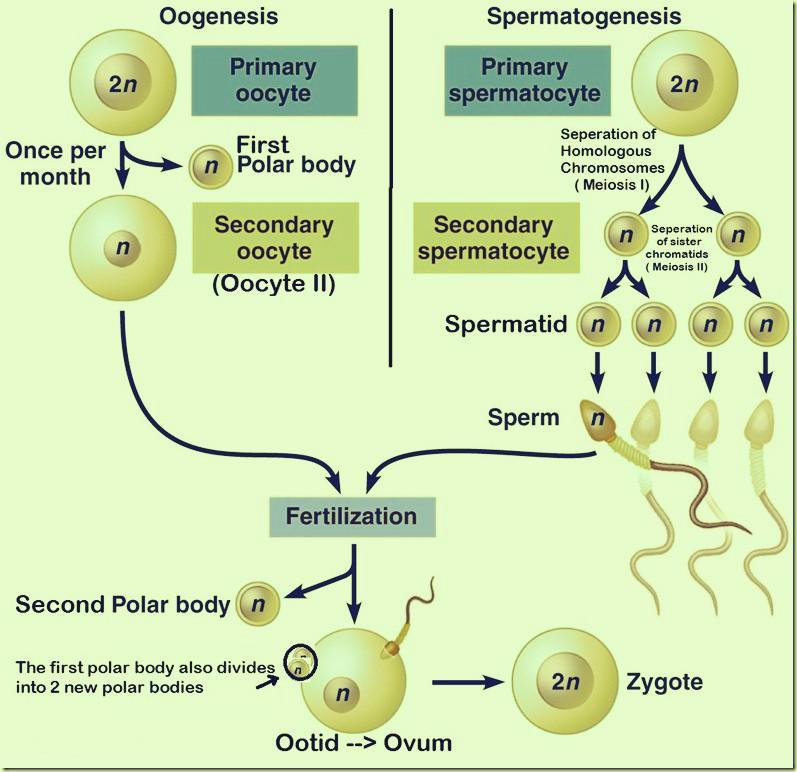
Gametogenesis is the process of production and development of haploid gametes by the primary sex organs, which are testes in males and ovary in females. The production of male gametes known as spermatozoa is known as spermatogenesis and the production of female gametes, known as eggs or ova is known as oogenesis.
The steps involved in spermatogenesis and oogenesis are different in many ways, as described in the next part.
Spermatogenesis:
- Immatures male germ cells in testes are known as spermatogonia. Spermatogenesis starts at the age of puberty when the amount of GnRH (Gonadotropin-Releasing Hormone) increases. This leads to an increase in LH and FSH hormones.
- LH or Luteinizing hormones act on the Leydig cells and increase the synthesis of androgens, these androgens stimulate spermatogenesis.
- FSH or Follicular cells act on Sertoli cells which secrete substances that help in spermatogenesis.
- Spermatogonia divide mitotically and form primary spermatocytes, primary spermatocyte divides meiotically and completes first meiotic division to form secondary spermatocyte.
- The secondary spermatocytes complete the second meiotic division and form four spermatids.
- The Spermatids develop and transform into spermatozoa by the process of spermiogenesis.
Oogenesis:
- Oogenesis initiated during embryonic development.
- Each fetal ovary contains millions of female gamete cells known as oogonia. No more oogonia are formed after birth.
- Oogenesis is the process of mature female gamete formation. During embryonic development, millions of gamete mother cells known as oogonia are formed within each ovary.
- These oogonia start dividing and enter into prophase I of meiosis I, where the division comes to a halt temporarily. These are now known as primary oocytes.
- Each primary oocyte gets surrounded by a layer of cuboidal granulosa cells and it is now known as a primary follicle. These primary follicles develop further after reaching puberty.
- It gets surrounded by more layers of these granulosa cells and a new theca layer and now it is known as a secondary follicle. The Next step is the formation of Tertiary follicle which has a fluid-filled space known as Antrum. At this stage, the primary follicle fully grows and completes the Meiosis I which is an unequal division forming a polar body and Secondary oocyte. This division occurs after puberty is reached till then primary oocyte remains undivided.
- The final stage is known as Graafian Follicle where the secondary oocyte forms a new membrane known as Zona Pellucida. The Graafian follicle has a larger antrum and larger size. The Graafian follicle ruptures to release the Secondary Oocyte or Ovum by the process of Ovulation.
Note: It should be remembered that spermatogenesis is the formation of spermatozoa, spermiogenesis is the development of spermatozoa from immature spermatids and spermiation, is the release of sperm from the testes. Also during oogenesis, there is the formation of three polar bodies and not two because the first polar body divides into two.
Complete answer:
Gametogenesis is the process of production and development of haploid gametes by the primary sex organs, which are testes in males and ovary in females. The production of male gametes known as spermatozoa is known as spermatogenesis and the production of female gametes, known as eggs or ova is known as oogenesis.
The steps involved in spermatogenesis and oogenesis are different in many ways, as described in the next part.
Spermatogenesis:
- Immatures male germ cells in testes are known as spermatogonia. Spermatogenesis starts at the age of puberty when the amount of GnRH (Gonadotropin-Releasing Hormone) increases. This leads to an increase in LH and FSH hormones.
- LH or Luteinizing hormones act on the Leydig cells and increase the synthesis of androgens, these androgens stimulate spermatogenesis.
- FSH or Follicular cells act on Sertoli cells which secrete substances that help in spermatogenesis.
- Spermatogonia divide mitotically and form primary spermatocytes, primary spermatocyte divides meiotically and completes first meiotic division to form secondary spermatocyte.
- The secondary spermatocytes complete the second meiotic division and form four spermatids.
- The Spermatids develop and transform into spermatozoa by the process of spermiogenesis.
Oogenesis:
- Oogenesis initiated during embryonic development.
- Each fetal ovary contains millions of female gamete cells known as oogonia. No more oogonia are formed after birth.
- Oogenesis is the process of mature female gamete formation. During embryonic development, millions of gamete mother cells known as oogonia are formed within each ovary.
- These oogonia start dividing and enter into prophase I of meiosis I, where the division comes to a halt temporarily. These are now known as primary oocytes.
- Each primary oocyte gets surrounded by a layer of cuboidal granulosa cells and it is now known as a primary follicle. These primary follicles develop further after reaching puberty.
- It gets surrounded by more layers of these granulosa cells and a new theca layer and now it is known as a secondary follicle. The Next step is the formation of Tertiary follicle which has a fluid-filled space known as Antrum. At this stage, the primary follicle fully grows and completes the Meiosis I which is an unequal division forming a polar body and Secondary oocyte. This division occurs after puberty is reached till then primary oocyte remains undivided.
- The final stage is known as Graafian Follicle where the secondary oocyte forms a new membrane known as Zona Pellucida. The Graafian follicle has a larger antrum and larger size. The Graafian follicle ruptures to release the Secondary Oocyte or Ovum by the process of Ovulation.
Note: It should be remembered that spermatogenesis is the formation of spermatozoa, spermiogenesis is the development of spermatozoa from immature spermatids and spermiation, is the release of sperm from the testes. Also during oogenesis, there is the formation of three polar bodies and not two because the first polar body divides into two.
Recently Updated Pages
Which of the following graphs shows the variation of class 12 physics CBSE

Draw a labelled diagram of the human male reproductive class 12 biology CBSE
Describe the experiment to compare the emf of two cells class 12 physics CBSE
What is standard hydrogen electrode
What is conventional current and electric current class 12 physics CBSE
2Bromopentane is treated with an alcoholic KOH solution class 12 chemistry CBSE
Trending doubts
Draw a labelled sketch of the human eye class 12 physics CBSE
Which are the Top 10 Largest Countries of the World?
Differentiate between homogeneous and heterogeneous class 12 chemistry CBSE
Draw ray diagrams each showing i myopic eye and ii class 12 physics CBSE
Which is the correct genotypic ratio of mendel dihybrid class 12 biology CBSE
What is the Full Form of PVC, PET, HDPE, LDPE, PP and PS ?