




Velocity $(v)$-Time $(t)$ graph of a body thrown vertically upward is:
A. A straight line
B. A parabola
c. A hyperbola
D. A circle
Answer
 Verified
543k+ views
Hint:In order to answer this question let us have some idea about motion of kinematics. Kinematics is a branch of classical mechanics that deals with the motion of points, structures, and systems of objects without taking into account the causes of motion (i.e., forces. The "geometry of motion" is a term used to describe kinematics.
Complete answer:
When a body is tossed vertically upward, it experiences a relentless acceleration. By using,
$\overrightarrow v = \overrightarrow u + \overrightarrow a t$
Let initial velocity be$u$upward ,$g$ is acting downwards
$\overrightarrow v = u - gt$ upwards
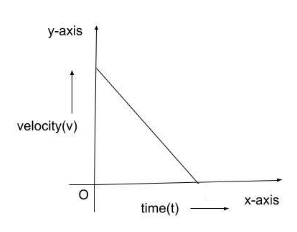
This is a slope- $g$ based equation for a straight line.
So, the correct option is A.
Additional Information:
Slope of velocity $(v)$-time $(t)$ graph the graph is equal to acceleration. This implies that when the slope is steep, the object's velocity will change quickly. When the slope is shallow, the object's velocity does not change as quickly. This also implies that the acceleration would be negative if the slope is negative (directed downwards), and positive if the slope is positive (directed upwards).
Note:The object's acceleration is represented by the slope of a velocity graph. As a result, the value of the slope at a given time reflects the object's acceleration at that time. The slope is defined as the ratio of y-axis change to x-axis .
Complete answer:
When a body is tossed vertically upward, it experiences a relentless acceleration. By using,
$\overrightarrow v = \overrightarrow u + \overrightarrow a t$
Let initial velocity be$u$upward ,$g$ is acting downwards
$\overrightarrow v = u - gt$ upwards
This is a slope- $g$ based equation for a straight line.
So, the correct option is A.
Additional Information:
Slope of velocity $(v)$-time $(t)$ graph the graph is equal to acceleration. This implies that when the slope is steep, the object's velocity will change quickly. When the slope is shallow, the object's velocity does not change as quickly. This also implies that the acceleration would be negative if the slope is negative (directed downwards), and positive if the slope is positive (directed upwards).
Note:The object's acceleration is represented by the slope of a velocity graph. As a result, the value of the slope at a given time reflects the object's acceleration at that time. The slope is defined as the ratio of y-axis change to x-axis .
Recently Updated Pages
Master Class 11 Social Science: Engaging Questions & Answers for Success

Master Class 11 English: Engaging Questions & Answers for Success
Master Class 11 Maths: Engaging Questions & Answers for Success
Master Class 11 Chemistry: Engaging Questions & Answers for Success
Master Class 11 Biology: Engaging Questions & Answers for Success
Master Class 11 Physics: Engaging Questions & Answers for Success
Trending doubts
Differentiate between an exothermic and an endothermic class 11 chemistry CBSE
One Metric ton is equal to kg A 10000 B 1000 C 100 class 11 physics CBSE
Difference Between Prokaryotic Cells and Eukaryotic Cells
There are 720 permutations of the digits 1 2 3 4 5 class 11 maths CBSE
Draw a diagram of a plant cell and label at least eight class 11 biology CBSE
1 Quintal is equal to a 110 kg b 10 kg c 100kg d 1000 class 11 physics CBSE