



Using the given figure, find the length of AB.
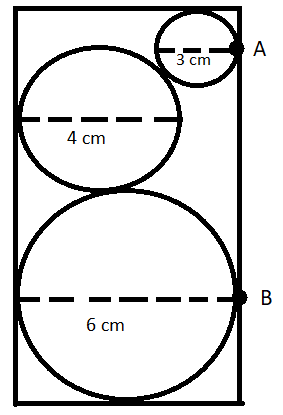
(a) 8 cm
(b) 4.5 cm
(c) 7.35 cm
(d) 7.30 cm
Answer
 Verified
645k+ views
Hint: First, find the radii of the circles. Redraw the diagram to understand things better. Apply Pythagoras theorem on the two right angles formed in the redrawn figure to find the length of PR and OQ which are equal to MB and AM, respectively. Add these to find the final answer.
Complete step-by-step answer:
In this question, we have to find the length of the segment AB using the given figure.
We are given the length of the diameters of the three circles. We will find the radii of these circles.
We know that radius is half of the diameter. Using this we will get the following:
Radius of 3 cm diameter circle = 1.5 cm
Radius of 4 cm diameter circle = 2 cm
Radius of 6 cm diameter circle = 3 cm
We will now redraw the given diagram as:
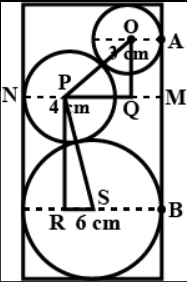
Finding the length of MB:
PS = 2 + 3 = 5 cm.
SR = 3 - 2 = 1 cm .
Also, triangle PRS is a right angled triangle. So we will use the Pythagoras theorem on triangle PRS.
$P{{R}^{2}}+S{{R}^{2}}=P{{S}^{2}}$
$P{{R}^{2}}+{{1}^{2}}={{5}^{2}}$
$P{{R}^{2}}=24$
$PR=\sqrt{24}=2\sqrt{6}$ cm.
Also, PR = MB
So, the length of MB is $2\sqrt{6}$ cm. …(1)
Finding the length of AM :
OP = 1.5 + 2 = 3.5 cm
PQ = MN - PN - MQ = 6 - 2 - 1.5 = 2.5 cm
Triangle OQP is a right angled triangle. So we will use the Pythagoras theorem on triangle OQP.
$O{{Q}^{2}}+P{{Q}^{2}}=O{{P}^{2}}$
$O{{Q}^{2}}+{{2.5}^{2}}={{3.5}^{2}}$
$O{{Q}^{2}}=6$
$OQ=\sqrt{6}$ cm
Also, OQ = AM.
So, the length of AM = $\sqrt{6}$ cm. …(2)
Now, we can see that AB = AM + MB
So, from (1) and (2), we will get the following:
$AB=2\sqrt{6}+\sqrt{6}$
$AB=3\sqrt{6}=7.35$ cm
Hence, option (c) is correct.
Note: In this question, it is very important to redraw the given diagram to understand things better. Also, it is important to know that if we join the centres of two tangential circles, the line joining the centre has the length equal to the sum of the radii of the circles.
Complete step-by-step answer:
In this question, we have to find the length of the segment AB using the given figure.
We are given the length of the diameters of the three circles. We will find the radii of these circles.
We know that radius is half of the diameter. Using this we will get the following:
Radius of 3 cm diameter circle = 1.5 cm
Radius of 4 cm diameter circle = 2 cm
Radius of 6 cm diameter circle = 3 cm
We will now redraw the given diagram as:
Finding the length of MB:
PS = 2 + 3 = 5 cm.
SR = 3 - 2 = 1 cm .
Also, triangle PRS is a right angled triangle. So we will use the Pythagoras theorem on triangle PRS.
$P{{R}^{2}}+S{{R}^{2}}=P{{S}^{2}}$
$P{{R}^{2}}+{{1}^{2}}={{5}^{2}}$
$P{{R}^{2}}=24$
$PR=\sqrt{24}=2\sqrt{6}$ cm.
Also, PR = MB
So, the length of MB is $2\sqrt{6}$ cm. …(1)
Finding the length of AM :
OP = 1.5 + 2 = 3.5 cm
PQ = MN - PN - MQ = 6 - 2 - 1.5 = 2.5 cm
Triangle OQP is a right angled triangle. So we will use the Pythagoras theorem on triangle OQP.
$O{{Q}^{2}}+P{{Q}^{2}}=O{{P}^{2}}$
$O{{Q}^{2}}+{{2.5}^{2}}={{3.5}^{2}}$
$O{{Q}^{2}}=6$
$OQ=\sqrt{6}$ cm
Also, OQ = AM.
So, the length of AM = $\sqrt{6}$ cm. …(2)
Now, we can see that AB = AM + MB
So, from (1) and (2), we will get the following:
$AB=2\sqrt{6}+\sqrt{6}$
$AB=3\sqrt{6}=7.35$ cm
Hence, option (c) is correct.
Note: In this question, it is very important to redraw the given diagram to understand things better. Also, it is important to know that if we join the centres of two tangential circles, the line joining the centre has the length equal to the sum of the radii of the circles.
Recently Updated Pages
Master Class 9 General Knowledge: Engaging Questions & Answers for Success

Master Class 9 Maths: Engaging Questions & Answers for Success
Master Class 9 Science: Engaging Questions & Answers for Success
Master Class 9 English: Engaging Questions & Answers for Success
Master Class 9 Social Science: Engaging Questions & Answers for Success
Class 9 Question and Answer - Your Ultimate Solutions Guide
Trending doubts
What is the situation called when no party gets the class 9 social science CBSE
Find the sum of series 1 + 2 + 3 + 4 + 5 + + 100 class 9 maths CBSE
Difference Between Plant Cell and Animal Cell
Fill the blanks with the suitable prepositions 1 The class 9 english CBSE
What is pollution? How many types of pollution? Define it
What is the Full Form of ICSE / ISC ?