




What is the use of the kelvin double bridge?
Answer
 Verified
525.3k+ views
Hint:Low resistance is defined as resistance that is less than or equal to $1\Omega $. Machine armature windings, cables, and ammeter shunts, for example, have a low resistance value.
The Kelvin double bridge is ideally suited for measuring extremely low resistances.
Complete step-by-step solution:
Kelvin's double bridge was used to measure four-terminal low resistances with precision. The resistance of four-terminal resistors is equal to the stated nominal value across two current leading terminals and two potential terminals. This is because the current must enter and exit the resistor in such a way that the current density distribution between the several equipotential surfaces used to determine the resistance is the same or equal. Any contact resistance at the current lead-in terminals is also reduced by the new points.
Additional information:
Circuit Diagram:
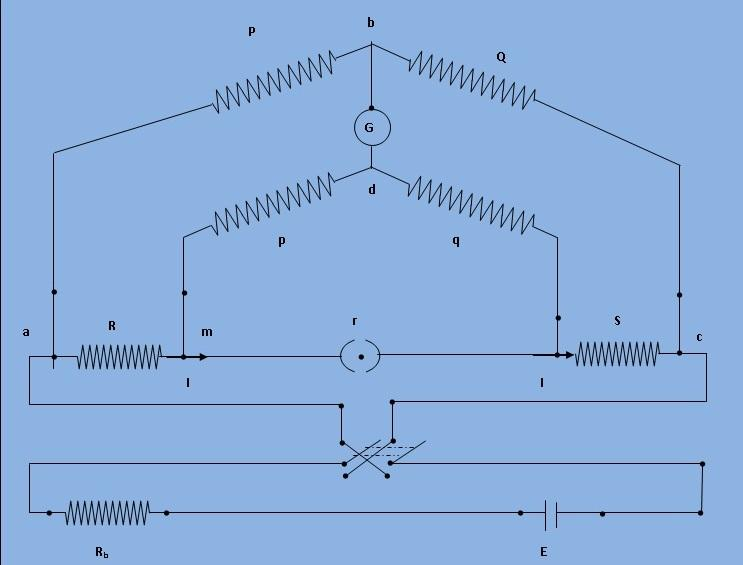
The kelvin double bridge has four terminal resistors for the low resistance arms and the second set of ratio arms (thus the name "double bridge"). The Kelvin bridge is depicted in Figure. P and Q represent the first ratio arms. To avoid the effect of connecting lead resistance r between the unknown resistance R and the standard resistance S, the second set of ratio arms p and q are employed to connect the galvanometer to a point d at the proper voltage between points m and n.
Note:
Advantages of Kelvin double bridge:
It can detect resistance values ranging from \[0.1\mu A\] to \[1.0{\text{ }}A\].
There is a reduction in the amount of energy used.
The construction is straightforward.
The level of sensitivity is really high.
The Kelvin double bridge is ideally suited for measuring extremely low resistances.
Complete step-by-step solution:
Kelvin's double bridge was used to measure four-terminal low resistances with precision. The resistance of four-terminal resistors is equal to the stated nominal value across two current leading terminals and two potential terminals. This is because the current must enter and exit the resistor in such a way that the current density distribution between the several equipotential surfaces used to determine the resistance is the same or equal. Any contact resistance at the current lead-in terminals is also reduced by the new points.
Additional information:
Circuit Diagram:
The kelvin double bridge has four terminal resistors for the low resistance arms and the second set of ratio arms (thus the name "double bridge"). The Kelvin bridge is depicted in Figure. P and Q represent the first ratio arms. To avoid the effect of connecting lead resistance r between the unknown resistance R and the standard resistance S, the second set of ratio arms p and q are employed to connect the galvanometer to a point d at the proper voltage between points m and n.
Note:
Advantages of Kelvin double bridge:
It can detect resistance values ranging from \[0.1\mu A\] to \[1.0{\text{ }}A\].
There is a reduction in the amount of energy used.
The construction is straightforward.
The level of sensitivity is really high.
Recently Updated Pages
Master Class 10 Computer Science: Engaging Questions & Answers for Success

Master Class 10 General Knowledge: Engaging Questions & Answers for Success
Master Class 10 English: Engaging Questions & Answers for Success
Master Class 10 Social Science: Engaging Questions & Answers for Success
Master Class 10 Maths: Engaging Questions & Answers for Success
Master Class 10 Science: Engaging Questions & Answers for Success
Trending doubts
Sulphuric acid is known as the king of acids State class 12 chemistry CBSE
Why should a magnesium ribbon be cleaned before burning class 12 chemistry CBSE
Which is the correct genotypic ratio of mendel dihybrid class 12 biology CBSE
MABP stands for A Man and Biology Protection B Man class 12 biology CBSE
Who discovered the cell and how class 12 biology CBSE
The correct structure of ethylenediaminetetraacetic class 12 chemistry CBSE