




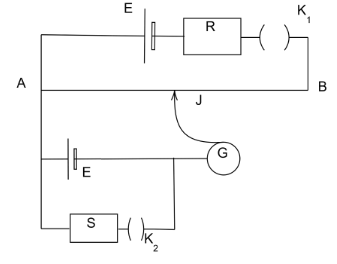
Two students 'X' and 'Y' perform an experiment on potentiometer separately using the circuit given.
Keeping other parameters unchanged, how ill the position of the null point be affected if
(A) 'X' increases the value of resistance R in the set-up by keeping the key $K_1$ closed and the key $K_2$ open?
(B) 'Y ' decreases the value of resistance S in the set-up, while the key $K_2$ remains open and the key $K_1$ closed? Justify your answer in each case.
Answer
 Verified
561.3k+ views
Hint: We are asked to write down the null point that will be affected if the two students perform this experiment in a particular manner. We can start by explaining the potentiometer experiment and defining what a null point is, and what factors affect the null point so that we can answer the question correctly.
Complete step by step solution:
The potentiometer is an electrical device used to measure the electromotive force or the emf by balancing it against a potential difference that is generated by using a known value of current through a known variable resistance. It is also used to compare the emfs of cells.
Principle: The potentiometer works on the principle of the potential dropped across a segment of wire of uniform cross section and carries a current that is constant and is directly proportional to its length.
The null point or the balancing point of a potentiometer is defined as the point in the sliding wire where the galvanometer shows no deflection. A change in the cross-sectional area of the potentiometer wire, the resistance of an arm changes, which means an already balanced potentiometer would now have a different null point.
In conclusion, (A) When the resistance value R increases, the current in the main circuit decreases, causing the potential gradient to decrease. Hence a wire with a greater length will be required for balancing the same potential difference. So, the null point would shift towards right (that is, towards point B).
(B) When the resistance value S decreases, the terminal potential difference across the cell decreases, so a balance is obtained at a small length, that is, the point will be obtained at a smaller length. So, the null point would shift towards left (that is, towards point A).
Note:
The factors that affect the null point are the ones that are affecting the resistance of the circuit and the cross-sectional area of the wire (which also affects the resistance value). Potentiometers are also widely used in our day to day lives in audio controllers. Even though they are mainly used as audio controllers in televisions and radios, they also have a use in the medical industry as well (electrosurgical generator controls).
Complete step by step solution:
The potentiometer is an electrical device used to measure the electromotive force or the emf by balancing it against a potential difference that is generated by using a known value of current through a known variable resistance. It is also used to compare the emfs of cells.
Principle: The potentiometer works on the principle of the potential dropped across a segment of wire of uniform cross section and carries a current that is constant and is directly proportional to its length.
The null point or the balancing point of a potentiometer is defined as the point in the sliding wire where the galvanometer shows no deflection. A change in the cross-sectional area of the potentiometer wire, the resistance of an arm changes, which means an already balanced potentiometer would now have a different null point.
In conclusion, (A) When the resistance value R increases, the current in the main circuit decreases, causing the potential gradient to decrease. Hence a wire with a greater length will be required for balancing the same potential difference. So, the null point would shift towards right (that is, towards point B).
(B) When the resistance value S decreases, the terminal potential difference across the cell decreases, so a balance is obtained at a small length, that is, the point will be obtained at a smaller length. So, the null point would shift towards left (that is, towards point A).
Note:
The factors that affect the null point are the ones that are affecting the resistance of the circuit and the cross-sectional area of the wire (which also affects the resistance value). Potentiometers are also widely used in our day to day lives in audio controllers. Even though they are mainly used as audio controllers in televisions and radios, they also have a use in the medical industry as well (electrosurgical generator controls).
Recently Updated Pages
Which of the following graphs shows the variation of class 12 physics CBSE

Draw a labelled diagram of the human male reproductive class 12 biology CBSE
Describe the experiment to compare the emf of two cells class 12 physics CBSE
What is standard hydrogen electrode
What is conventional current and electric current class 12 physics CBSE
2Bromopentane is treated with an alcoholic KOH solution class 12 chemistry CBSE
Trending doubts
Draw a labelled sketch of the human eye class 12 physics CBSE
Which are the Top 10 Largest Countries of the World?
Differentiate between homogeneous and heterogeneous class 12 chemistry CBSE
Draw ray diagrams each showing i myopic eye and ii class 12 physics CBSE
Which is the correct genotypic ratio of mendel dihybrid class 12 biology CBSE
What is the Full Form of PVC, PET, HDPE, LDPE, PP and PS ?