




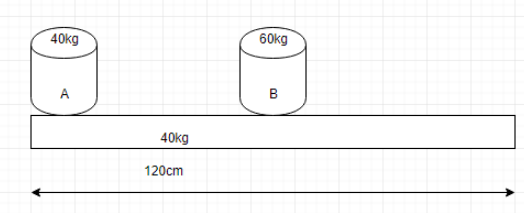
Two men 'A' and 'B' are standing on a plank. 'B' is at the middle of the plank and 'A' is at the left end of the plank. The lower surface of the plank is smooth. The system is initially at rest and masses are as shown in the figure. 'A' and 'B' start moving such that the position of 'B' remains fixed with respect to ground. A and B meet at some position. Then the point where A meets B is located at?
(A) the middle of the plank
(B) 30 cm from the left end of the plank
(C) the right end of the plank
(D) none of the above
Answer
 Verified
584.7k+ views
Hint:B is at the extreme left end and the total length is 120 cm. Given that B is in the middle so the distance between A and B is $\dfrac{120}{2}=60cm$. The plank’s lower surface is smooth, so there is no friction present between the plank and the ground. After the system is in equilibrium A and B start moving each other. So A moves towards the right end and B moves towards the left end.
Complete step by step answer:
It is given that the position of B will remain fixed with respect to the ground.Thus, A will move 60 cm towards B. Assuming plank moves $x$ distance along leftward
$\Rightarrow 60{{m}_{A}}={{m}_{p}}\times x$
$\Rightarrow 40\times 60=40x$
$\therefore x=60cm$
Thus, A and B will meet at the right end of the plank.
So, the correct option is C.
Note:While doing such problems we have to keep in mind the frame of reference. If the observer which is recording the movement is also in motion, then the frame of reference is also moving. Also, when both the objects are in motion, then we have to use the concept of relative velocity. When both the bodies are moving in the same direction then the velocity gets subtracted and when they move in opposite directions then velocity gets added up.
Complete step by step answer:
It is given that the position of B will remain fixed with respect to the ground.Thus, A will move 60 cm towards B. Assuming plank moves $x$ distance along leftward
$\Rightarrow 60{{m}_{A}}={{m}_{p}}\times x$
$\Rightarrow 40\times 60=40x$
$\therefore x=60cm$
Thus, A and B will meet at the right end of the plank.
So, the correct option is C.
Note:While doing such problems we have to keep in mind the frame of reference. If the observer which is recording the movement is also in motion, then the frame of reference is also moving. Also, when both the objects are in motion, then we have to use the concept of relative velocity. When both the bodies are moving in the same direction then the velocity gets subtracted and when they move in opposite directions then velocity gets added up.
Recently Updated Pages
Master Class 12 Economics: Engaging Questions & Answers for Success

Master Class 12 English: Engaging Questions & Answers for Success
Master Class 12 Social Science: Engaging Questions & Answers for Success
Master Class 12 Maths: Engaging Questions & Answers for Success
Master Class 12 Physics: Engaging Questions & Answers for Success
Master Class 9 General Knowledge: Engaging Questions & Answers for Success
Trending doubts
One Metric ton is equal to kg A 10000 B 1000 C 100 class 11 physics CBSE
Difference Between Prokaryotic Cells and Eukaryotic Cells
Two of the body parts which do not appear in MRI are class 11 biology CBSE
Find the value of the expression given below sin 30circ class 11 maths CBSE
1 ton equals to A 100 kg B 1000 kg C 10 kg D 10000 class 11 physics CBSE
Draw a diagram of nephron and explain its structur class 11 biology CBSE