




To locate the Pole Star using Ursa Major, to which direction should the imaginary line be drawn?
A. North
B. West
C. East
D. South
Answer
 Verified
576.6k+ views
Hint: Ursa Major is a constellation which consists of a large number of stars in the northern sky. It is primarily known for having seven of its main stars. These stars form a structure-like ladle. Between the seven stars, the two stars, Dubhe and Merak, may be the Pole Star used for navigating.
Complete solution:
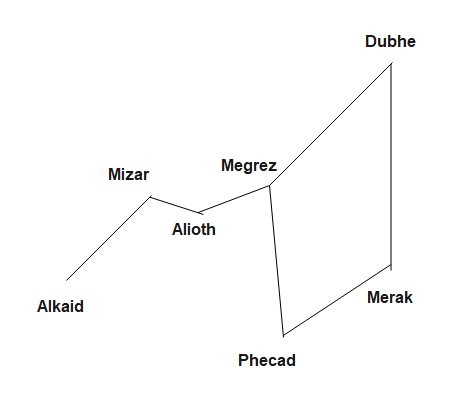
Locate and observe the constellation of Ursa Major first. The following seven stars can be found there: Dubhe, Merak, Phecda, Megrez, Alioth, Mizar and Alkaid. As shown in the figure, all these stars appear to form a spoon/ladle like shape.
The first three are on the imaginary ladle handle, and the remaining four are on the imaginary ladle bowl.
On the right side of the quadrilateral, consider the last two stars, Dubhe and Merak. Just imagine a line that passes through these two stars. Extend this line, from Merak to Dubhe, in an upward direction. A star is going to coincide with that extended line of imagination, a faint star. Your Pole Star will be this star.
With the help of Ursa Major, the Pole Star can therefore be located by extending the line that joins the two stars, Dubhe and Merak.
Using Ursa Major, the pole star can be located by extending an imaginary line from the last two stars towards the north.
In the north direction an imaginary line is drawn. Hence, option A is correct.
Note:
Keep the main seven Ursa major stars mentioned above and in the diagram in mind. Remember to look for the quadrilateral that has the stars Megrez, Phecda, Merak and Dubhe, and not the stars on the handle, while looking for the last two stars. Before extending it the imaginary line should only have two stars, Dubhe and Merak.
Complete solution:
Locate and observe the constellation of Ursa Major first. The following seven stars can be found there: Dubhe, Merak, Phecda, Megrez, Alioth, Mizar and Alkaid. As shown in the figure, all these stars appear to form a spoon/ladle like shape.
The first three are on the imaginary ladle handle, and the remaining four are on the imaginary ladle bowl.
On the right side of the quadrilateral, consider the last two stars, Dubhe and Merak. Just imagine a line that passes through these two stars. Extend this line, from Merak to Dubhe, in an upward direction. A star is going to coincide with that extended line of imagination, a faint star. Your Pole Star will be this star.
With the help of Ursa Major, the Pole Star can therefore be located by extending the line that joins the two stars, Dubhe and Merak.
Using Ursa Major, the pole star can be located by extending an imaginary line from the last two stars towards the north.
In the north direction an imaginary line is drawn. Hence, option A is correct.
Note:
Keep the main seven Ursa major stars mentioned above and in the diagram in mind. Remember to look for the quadrilateral that has the stars Megrez, Phecda, Merak and Dubhe, and not the stars on the handle, while looking for the last two stars. Before extending it the imaginary line should only have two stars, Dubhe and Merak.
Recently Updated Pages
The magnetic field in a plane electromagnetic wave class 11 physics CBSE

In a plane electromagnetic wave the electric field class 12 physics CBSE
A plane electromagnetic wave travels in vacuum along class 12 physics CBSE
Basicity of sulphurous acid and sulphuric acid are
Master Class 11 Business Studies: Engaging Questions & Answers for Success
Master Class 11 Computer Science: Engaging Questions & Answers for Success
Trending doubts
One Metric ton is equal to kg A 10000 B 1000 C 100 class 11 physics CBSE
What are the examples of C3 and C4 plants class 11 biology CBSE
State and prove Bernoullis theorem class 11 physics CBSE
Draw a diagram of a plant cell and label at least eight class 11 biology CBSE
10 examples of friction in our daily life
A body is said to be in dynamic equilibrium if A When class 11 physics CBSE