




TMV is a
(a) Helical virus
(b) Polyhedral virus
(c) Spherical virus
(d) Binal virus
Answer
 Verified
574.5k+ views
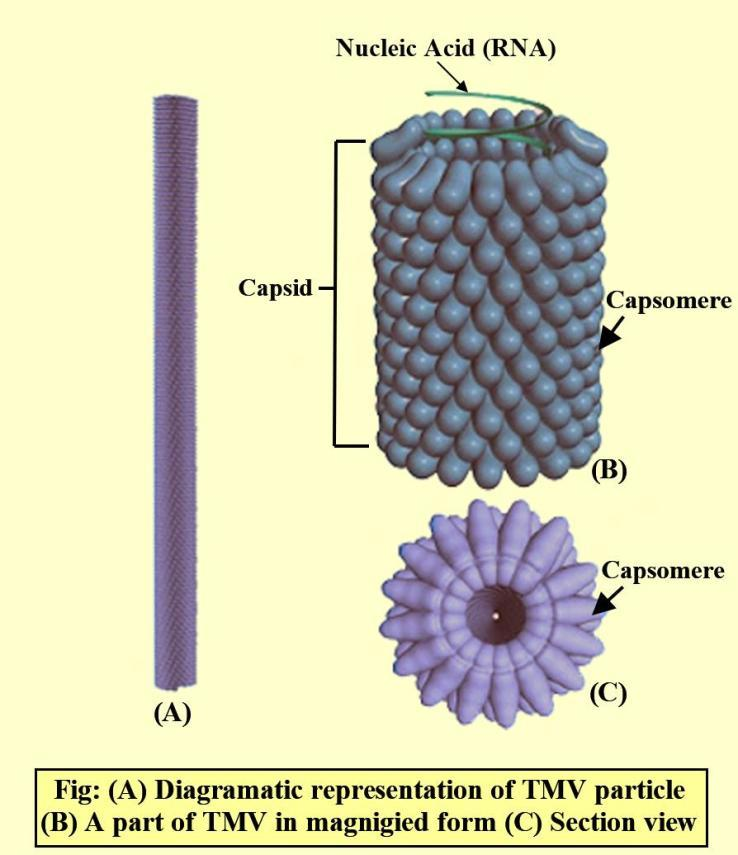
Hint: TMV is known as tobacco mosaic virus which is the first discovered virus based on its structure. It is made up of single-strand RNA and is surrounded by capsid which is made up of protein and it is rod-shaped with a helical arrangement.
Complete Answer:
The tobacco mosaic virus or TMV was first crystallised by Wendell Meredith Stanley in 1935. Tobacco mosaic viruses occur in rod-like elongated form and it is a helical virus. It consists of a single-stranded RNA nucleoid and the nucleoid is covered by a protein coat capsid which is made up of a capsomeres subunit due to this it comes under the class Ribohelica. Its common hosts are tobacco, tomato and other solanaceous plants.
Additional Information:
Due to the tobacco mosaic virus, the symptoms that arise are mosaic, moulting, necrosis, stunning, leaf curling, and yellowing of plant leaves. It also causes poor yielding, delay ripening of fruit and uneven fruit colour, especially in tomatoes.
It gets transmitted from an infected plant to a healthy plant or from one plant part to another plant by direct contact or indirectly by contaminated tools and infected plant seeds. Internally the transmission takes place through xylem and phloem and from cell to cell by replication and it infected the whole plant from root to tip.
So, the correct answer is 'Helical virus'.
Note:
The unique property of the tobacco mosaic virus is that it does not die with the host plant therefore when a new plant is planted in the soil containing debris of the infected plant the new plant also gets infected. It also survives at extremely high temperatures, therefore, it is hard to control this virus once it starts infecting the plant.
Complete Answer:
The tobacco mosaic virus or TMV was first crystallised by Wendell Meredith Stanley in 1935. Tobacco mosaic viruses occur in rod-like elongated form and it is a helical virus. It consists of a single-stranded RNA nucleoid and the nucleoid is covered by a protein coat capsid which is made up of a capsomeres subunit due to this it comes under the class Ribohelica. Its common hosts are tobacco, tomato and other solanaceous plants.
Additional Information:
Due to the tobacco mosaic virus, the symptoms that arise are mosaic, moulting, necrosis, stunning, leaf curling, and yellowing of plant leaves. It also causes poor yielding, delay ripening of fruit and uneven fruit colour, especially in tomatoes.
It gets transmitted from an infected plant to a healthy plant or from one plant part to another plant by direct contact or indirectly by contaminated tools and infected plant seeds. Internally the transmission takes place through xylem and phloem and from cell to cell by replication and it infected the whole plant from root to tip.
So, the correct answer is 'Helical virus'.
Note:
The unique property of the tobacco mosaic virus is that it does not die with the host plant therefore when a new plant is planted in the soil containing debris of the infected plant the new plant also gets infected. It also survives at extremely high temperatures, therefore, it is hard to control this virus once it starts infecting the plant.
Recently Updated Pages
Write structures of the following compounds i 2 Chloro3methylpentane class 11 chemistry CBSE

What is BLO What is the full form of BLO class 8 social science CBSE
Explain the Treaty of Vienna of 1815 class 10 social science CBSE
A Paragraph on Pollution in about 100-150 Words
XIX+XXX A 49 B 51 C 55 D 44 class 5 maths CBSE
If x a + bt + ct2 where x is in meters and t is in class 11 physics CBSE
Trending doubts
One Metric ton is equal to kg A 10000 B 1000 C 100 class 11 physics CBSE
Draw a diagram of nephron and explain its structur class 11 biology CBSE
10 examples of friction in our daily life
Proton was discovered by A Thomson B Rutherford C Chadwick class 11 chemistry CBSE
Bond order ofO2 O2+ O2 and O22 is in order A O2 langle class 11 chemistry CBSE
Draw a labelled diagram of the neuron and describe class 11 biology CBSE