




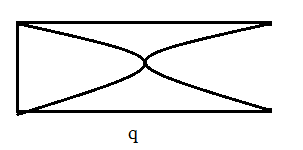
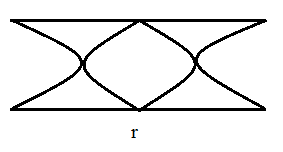
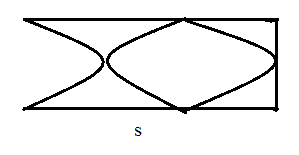
The vibrations of four air columns are represented in the figure. The ratio of frequencies np : nq : nr : ns is
A. 12 : 6 : 3 : 5
B. 1 : 2 : 4 : 3
C. 4 : 2 : 3 : 1
D. 6 : 2 : 3 : 4
Answer
 Verified
644.1k+ views
Hint: In the case of the closed end air column, the wavelength to be considered will be 4 times the length of the column, whereas, in the case of the open end air column, the wavelength to be considered will be 2 times the length of the column, while calculating the frequencies.
Formula used:
\[n=\dfrac{v}{4l}\]
\[n=\dfrac{v}{2l}\]
Complete step by step answer:
The air column p represents the fundamental closed end.
Thus the frequency of the air column p is given as,
\[{{n}_{p}}=\dfrac{v}{4l}\]
The air column q represents the fundamental open end.
Thus the frequency of the air column q is given as,
\[{{n}_{q}}=\dfrac{v}{2l}\]
The air column r represents the second overtone open end.
Thus the frequency of the air column r is given as,
\[\begin{align}
& {{n}_{r}}=\dfrac{2v}{2l} \\
& {{n}_{r}}=\dfrac{v}{l} \\
\end{align}\]
The air column s represents the second overtone closed end.
Thus the frequency of the air column s is given as,
\[{{n}_{s}}=\dfrac{3v}{4l}\]
The ratio of the frequencies of the air columns p, q, r and s is given as follows:
\[{{n}_{p}}:{{n}_{q}}:{{n}_{r}}:{{n}_{s}}=\dfrac{1}{4}:\dfrac{1}{2}:1:\dfrac{3}{4}\]
Multiply by 4 to take the LCM.
Therefore, the ratio of the frequencies is,
\[{{n}_{p}}:{{n}_{q}}:{{n}_{r}}:{{n}_{s}}=1:2:4:3\]
As, the ratio of frequencies np : nq : nr : ns of four air columns is 1 : 2 : 4 : 3, thus option (B) 1 : 2 : 4 : 3 is correct.
Note:
The things to be on your finger-tips for further information on solving these types of problems are: The frequencies should be calculated considering open end and the closed end concepts.
Formula used:
\[n=\dfrac{v}{4l}\]
\[n=\dfrac{v}{2l}\]
Complete step by step answer:
The air column p represents the fundamental closed end.
Thus the frequency of the air column p is given as,
\[{{n}_{p}}=\dfrac{v}{4l}\]
The air column q represents the fundamental open end.
Thus the frequency of the air column q is given as,
\[{{n}_{q}}=\dfrac{v}{2l}\]
The air column r represents the second overtone open end.
Thus the frequency of the air column r is given as,
\[\begin{align}
& {{n}_{r}}=\dfrac{2v}{2l} \\
& {{n}_{r}}=\dfrac{v}{l} \\
\end{align}\]
The air column s represents the second overtone closed end.
Thus the frequency of the air column s is given as,
\[{{n}_{s}}=\dfrac{3v}{4l}\]
The ratio of the frequencies of the air columns p, q, r and s is given as follows:
\[{{n}_{p}}:{{n}_{q}}:{{n}_{r}}:{{n}_{s}}=\dfrac{1}{4}:\dfrac{1}{2}:1:\dfrac{3}{4}\]
Multiply by 4 to take the LCM.
Therefore, the ratio of the frequencies is,
\[{{n}_{p}}:{{n}_{q}}:{{n}_{r}}:{{n}_{s}}=1:2:4:3\]
As, the ratio of frequencies np : nq : nr : ns of four air columns is 1 : 2 : 4 : 3, thus option (B) 1 : 2 : 4 : 3 is correct.
Note:
The things to be on your finger-tips for further information on solving these types of problems are: The frequencies should be calculated considering open end and the closed end concepts.
Recently Updated Pages
Which will be the least stable resonating structure class 11 chemistry CBSE

How many 5 digit telephone numbers can be construc-class-11-maths-CBSE
How do you find the angle of the resultant vector class 11 physics CBSE
Draw labelled diagram of the following i Gram seed class 11 biology CBSE
1 Quintal is equal to a 110 kg b 10 kg c 100kg d 1000 class 11 physics CBSE
What is the need and importance of classification class 11 biology CBSE
Trending doubts
Find the value of the expression given below sin 30circ class 11 maths CBSE
The teeth used for biting and cutting food are called class 11 biology CBSE
Bond order ofO2 O2+ O2 and O22 is in order A O2 langle class 11 chemistry CBSE
Frogs heart when taken out of the body continues to class 11 biology CBSE
Can anyone list 10 advantages and disadvantages of friction
Draw a diagram of a plant cell and label at least eight class 11 biology CBSE