




The vectors \[\overrightarrow {AB} = 3\widehat i + 4\widehat k\]and \[\overrightarrow {AC} = 5\widehat i - 2\widehat j + 4\widehat k\] are the sides of a triangle ABC, then the length of the median through A is:
(A). $\sqrt {72} $
(B). $\sqrt {33} $
(C). $\sqrt {45} $
(D). $\sqrt {18} $
Answer
 Verified
630.3k+ views
Hint: Before attempting this question one should have prior knowledge about the vectors sides of triangle and also remember that medium through A is given by $\overrightarrow {AD} = \dfrac{1}{2}\left( {\overrightarrow {AB} + \overrightarrow {AC} } \right)$ here $\overrightarrow {AD} $ is the position vector of D and $\overrightarrow {AB} $ is the position vector of B and $\overrightarrow {AC} $ is the position vector of C, using this information can help you to approach the solution of the question.
Complete step-by-step answer:
According to the given information it is given that triangle ABC where \[\overrightarrow {AB} = 3\widehat i + 4\widehat k\]and \[\overrightarrow {AC} = 5\widehat i - 2\widehat j + 4\widehat k\] are the sides
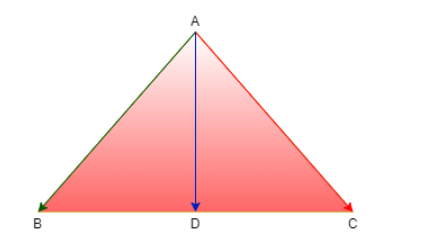
Let D be the midpoint of BC such as AD is the median through A
So, the resulting triangle is
As we know that length of any line is given by magnitude of the vector which represents line
So, to find the length of the median through A is given by magnitude of that median and to find the magnitude of the median we have to find the position vector of D
We know that when D is the midpoint of BC
Then position vector of D = $\dfrac{1}{2}$(position vector of B + position vector of C) i.e. $\overrightarrow {AD} = \dfrac{1}{2}\left( {\overrightarrow {AB} + \overrightarrow {AC} } \right)$
Therefore, $\overrightarrow {AD} = \dfrac{1}{2}\left( {3\widehat i + 4\widehat k + 5\widehat i - 2\widehat j + 4\widehat k} \right)$
$ \Rightarrow $\[\overrightarrow {AD} = \dfrac{1}{2}\left( {8\widehat i - 2\widehat j + 8\widehat k} \right)\]
$ \Rightarrow $\[\overrightarrow {AD} = 4\widehat i - \widehat j + 4\widehat k\]
So, we know that to find the length of median through A, we have to find the magnitude of AD
And the magnitude of any position vector $\overrightarrow {AB} $ (x, y, z) is given by $\left| {\overrightarrow {AB} } \right| = \sqrt {{x^2} + {y^2} + {z^2}} $
$AD = \sqrt {{{\left( 4 \right)}^2} + {{\left( { - 1} \right)}^2} + {{\left( 4 \right)}^2}} $
$ \Rightarrow $$AD = \sqrt {16 + 1 + 16} $
$ \Rightarrow $$AD = \sqrt {33} $unit
Therefore, length of median through A is equal to $\sqrt {33} $
Hence, option B is the correct option.
Note: In the above solution, we came across the term “position vector” which can be explained as line having two ends which consists of 2 points where one end point is fixed and other point is dynamic or the moving point which describes the position to the relative point so as the point moves the length of position vectors changes or the direction of the position vector or both the direction and length of the position vector will change.
Complete step-by-step answer:
According to the given information it is given that triangle ABC where \[\overrightarrow {AB} = 3\widehat i + 4\widehat k\]and \[\overrightarrow {AC} = 5\widehat i - 2\widehat j + 4\widehat k\] are the sides
Let D be the midpoint of BC such as AD is the median through A
So, the resulting triangle is
As we know that length of any line is given by magnitude of the vector which represents line
So, to find the length of the median through A is given by magnitude of that median and to find the magnitude of the median we have to find the position vector of D
We know that when D is the midpoint of BC
Then position vector of D = $\dfrac{1}{2}$(position vector of B + position vector of C) i.e. $\overrightarrow {AD} = \dfrac{1}{2}\left( {\overrightarrow {AB} + \overrightarrow {AC} } \right)$
Therefore, $\overrightarrow {AD} = \dfrac{1}{2}\left( {3\widehat i + 4\widehat k + 5\widehat i - 2\widehat j + 4\widehat k} \right)$
$ \Rightarrow $\[\overrightarrow {AD} = \dfrac{1}{2}\left( {8\widehat i - 2\widehat j + 8\widehat k} \right)\]
$ \Rightarrow $\[\overrightarrow {AD} = 4\widehat i - \widehat j + 4\widehat k\]
So, we know that to find the length of median through A, we have to find the magnitude of AD
And the magnitude of any position vector $\overrightarrow {AB} $ (x, y, z) is given by $\left| {\overrightarrow {AB} } \right| = \sqrt {{x^2} + {y^2} + {z^2}} $
$AD = \sqrt {{{\left( 4 \right)}^2} + {{\left( { - 1} \right)}^2} + {{\left( 4 \right)}^2}} $
$ \Rightarrow $$AD = \sqrt {16 + 1 + 16} $
$ \Rightarrow $$AD = \sqrt {33} $unit
Therefore, length of median through A is equal to $\sqrt {33} $
Hence, option B is the correct option.
Note: In the above solution, we came across the term “position vector” which can be explained as line having two ends which consists of 2 points where one end point is fixed and other point is dynamic or the moving point which describes the position to the relative point so as the point moves the length of position vectors changes or the direction of the position vector or both the direction and length of the position vector will change.
Recently Updated Pages
Master Class 12 Business Studies: Engaging Questions & Answers for Success

Master Class 12 Chemistry: Engaging Questions & Answers for Success
Master Class 12 Biology: Engaging Questions & Answers for Success
Class 12 Question and Answer - Your Ultimate Solutions Guide
Master Class 11 English: Engaging Questions & Answers for Success
Master Class 11 Social Science: Engaging Questions & Answers for Success
Trending doubts
Which are the Top 10 Largest Countries of the World?
Draw a labelled sketch of the human eye class 12 physics CBSE
Differentiate between homogeneous and heterogeneous class 12 chemistry CBSE
Differentiate between Pyramid of energy and pyramid class 12 biology CBSE
Why is the cell called the structural and functional class 12 biology CBSE
Draw the diagram of the pyramid of energy Explain In class 12 biology CBSE