




The tops of two poles of heights 20m and 14m are connected by a wire if the wire makes an angle of \[{{30}^{0}}\]with the horizontal then the length of wire is.
(a) 40m
(b) 12m
(c) 28m
(d) 68m
Answer
 Verified
645.9k+ views
Hint: We solve this problem first by drawing the respected figure with the information given as follows
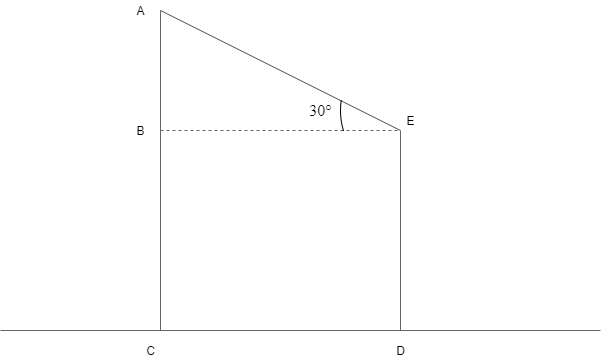
Here, we find the length of wire AE by sing the formula of sine of angle given as
\[\sin \theta =\dfrac{\text{opposite side to }\theta }{\text{hypotenuse}}\]from the triangle \[\Delta ABE\].
Complete step-by-step answer:
We are given that the heights of two towers are 20m and 14m.
From the figure we can write that
\[\begin{align}
& \Rightarrow AC=20m \\
& \Rightarrow ED=14m \\
\end{align}\]
Here, we know that the angle \[\angle ABE={{90}^{0}}\]so, we can write
\[\Rightarrow BC=ED=14m\]
Now we can divide the length AC as follows
\[\Rightarrow AC=AB+BC\]
By substituting the required values in above equation we get
\[\begin{align}
& \Rightarrow 20m=AB+14m \\
& \Rightarrow AB=6m \\
\end{align}\]
Now, let us consider the triangle \[\Delta ABE\]
We know that sine of angle given as
\[\sin \theta =\dfrac{\text{opposite side to }\theta }{\text{hypotenuse}}\]
By using this formula to \[\angle AEB\]in the triangle \[\Delta ABE\]we get
\[\Rightarrow \sin \left( \angle AEB \right)=\dfrac{AB}{AE}\]
We are given that the wire AE makes an angle of \[{{30}^{0}}\]with horizontal. So, we can write \[\angle AEB={{30}^{0}}\]
Now, by substituting the required values in above equation we get
\[\begin{align}
& \Rightarrow \sin \left( {{30}^{0}} \right)=\dfrac{6}{AE} \\
& \Rightarrow AE=\dfrac{6}{\sin \left( {{30}^{0}} \right)} \\
\end{align}\]
We know that from the standard table of trigonometric functions \[\sin \left( {{30}^{0}} \right)=\dfrac{1}{2}\].
By substituting this value in above equation we get
\[\begin{align}
& \Rightarrow AE=\dfrac{6}{\left( \dfrac{1}{2} \right)} \\
& \Rightarrow AE=6\times 2=12 \\
\end{align}\]
Therefore the length of wire is given as 12m.
So, the correct answer is “Option B”.
Note: Students may make mistakes in applying the formula of sine of an angle. The sine of an angle is given as
\[\sin \theta =\dfrac{\text{opposite side to }\theta }{\text{hypotenuse}}\]
This formula is applicable only in case of right angles triangle because we have hypotenuse in right angled triangle only. But some students may apply this formula to all types of triangles which is a big mistake. Here, since the triangle \[\Delta ABE\]is right angles, we used this formula. So, the definitions of basic terms need to be taken care of.
Here, we find the length of wire AE by sing the formula of sine of angle given as
\[\sin \theta =\dfrac{\text{opposite side to }\theta }{\text{hypotenuse}}\]from the triangle \[\Delta ABE\].
Complete step-by-step answer:
We are given that the heights of two towers are 20m and 14m.
From the figure we can write that
\[\begin{align}
& \Rightarrow AC=20m \\
& \Rightarrow ED=14m \\
\end{align}\]
Here, we know that the angle \[\angle ABE={{90}^{0}}\]so, we can write
\[\Rightarrow BC=ED=14m\]
Now we can divide the length AC as follows
\[\Rightarrow AC=AB+BC\]
By substituting the required values in above equation we get
\[\begin{align}
& \Rightarrow 20m=AB+14m \\
& \Rightarrow AB=6m \\
\end{align}\]
Now, let us consider the triangle \[\Delta ABE\]
We know that sine of angle given as
\[\sin \theta =\dfrac{\text{opposite side to }\theta }{\text{hypotenuse}}\]
By using this formula to \[\angle AEB\]in the triangle \[\Delta ABE\]we get
\[\Rightarrow \sin \left( \angle AEB \right)=\dfrac{AB}{AE}\]
We are given that the wire AE makes an angle of \[{{30}^{0}}\]with horizontal. So, we can write \[\angle AEB={{30}^{0}}\]
Now, by substituting the required values in above equation we get
\[\begin{align}
& \Rightarrow \sin \left( {{30}^{0}} \right)=\dfrac{6}{AE} \\
& \Rightarrow AE=\dfrac{6}{\sin \left( {{30}^{0}} \right)} \\
\end{align}\]
We know that from the standard table of trigonometric functions \[\sin \left( {{30}^{0}} \right)=\dfrac{1}{2}\].
By substituting this value in above equation we get
\[\begin{align}
& \Rightarrow AE=\dfrac{6}{\left( \dfrac{1}{2} \right)} \\
& \Rightarrow AE=6\times 2=12 \\
\end{align}\]
Therefore the length of wire is given as 12m.
So, the correct answer is “Option B”.
Note: Students may make mistakes in applying the formula of sine of an angle. The sine of an angle is given as
\[\sin \theta =\dfrac{\text{opposite side to }\theta }{\text{hypotenuse}}\]
This formula is applicable only in case of right angles triangle because we have hypotenuse in right angled triangle only. But some students may apply this formula to all types of triangles which is a big mistake. Here, since the triangle \[\Delta ABE\]is right angles, we used this formula. So, the definitions of basic terms need to be taken care of.
Recently Updated Pages
Write structures of the following compounds i 2 Chloro3methylpentane class 11 chemistry CBSE

What is BLO What is the full form of BLO class 8 social science CBSE
Explain the Treaty of Vienna of 1815 class 10 social science CBSE
A Paragraph on Pollution in about 100-150 Words
XIX+XXX A 49 B 51 C 55 D 44 class 5 maths CBSE
If x a + bt + ct2 where x is in meters and t is in class 11 physics CBSE
Trending doubts
One Metric ton is equal to kg A 10000 B 1000 C 100 class 11 physics CBSE
Find the value of the expression given below sin 30circ class 11 maths CBSE
What do you mean by retardation What is its SI uni class 11 physics CBSE
Draw a diagram of nephron and explain its structur class 11 biology CBSE
10 examples of friction in our daily life
Difference between physical and chemical change class 11 chemistry CBSE