




The term trigonometry was first invented by the German mathematician:
A. William Rowan Hamilton
B. Euclid
C. Newton
D. Bartholomaeus pitiscus.
Answer
 Verified
629.7k+ views
Hint: In this question, we will see the basics of trigonometry like what is trigonometry, its history and its some of the basic functions. In the history of trigonometry, we will come to know about the mathematician who coined the word “trigonometry”.
Complete step by step answer:
Let us first see what trigonometry is.
Trigonometry is made up of two greek words “trigonon” which means “triangle” and “metron” which means “measure”. It is the branch of mathematics which deals with the relationship between side lengths and angles of the triangle.
In trigonometry we basically learn about the trigonometric ratios.
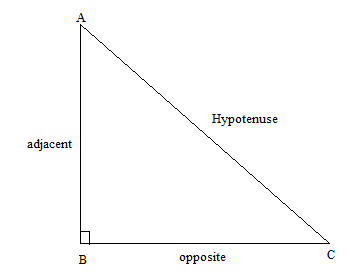
Sine function(sin)- it is given as the ratio of side opposite the angle and hypotenuse.
sinA = $\dfrac{{BC}}{{AC}}$
Cosine function (cos), defined as the ratio of the adjacent leg (the side of the triangle joining the angle to the right angle) to the hypotenuse.
cosA = $\dfrac{{AB}}{{AC}}$
Tangent function (tan), defined as the ratio of the opposite leg to the adjacent leg.
tanA = $\dfrac{{BC}}{{AB}}$
The term trigonometry was first coined by the German trigonometry, astronomer and theologian Bartholomaeus Pitiscus.
Pitiscus edited the “Thesaurus mathematicus”(1613) in which he improved the trigonometric tables of “George Joachim Rheticus”.
So,Option D is the correct answer.
Note:
The hypotenuse is the side opposite to the 90 degree angle in a right triangle and is the largest side of the triangle. The reciprocal of sine, cosine and tangent are cosecant(csc), secant(sec) and cotangent(cot) respectively.
$\csc A = \dfrac{1}{{\sin A}} = \dfrac{{AC}}{{BC}}$
$\sec A = \dfrac{1}{{\cos A}} = \dfrac{{AC}}{{AB}}$
$\cot A = \dfrac{1}{{\tan A}} = \dfrac{{AB}}{{BC}}$
Complete step by step answer:
Let us first see what trigonometry is.
Trigonometry is made up of two greek words “trigonon” which means “triangle” and “metron” which means “measure”. It is the branch of mathematics which deals with the relationship between side lengths and angles of the triangle.
In trigonometry we basically learn about the trigonometric ratios.
Sine function(sin)- it is given as the ratio of side opposite the angle and hypotenuse.
sinA = $\dfrac{{BC}}{{AC}}$
Cosine function (cos), defined as the ratio of the adjacent leg (the side of the triangle joining the angle to the right angle) to the hypotenuse.
cosA = $\dfrac{{AB}}{{AC}}$
Tangent function (tan), defined as the ratio of the opposite leg to the adjacent leg.
tanA = $\dfrac{{BC}}{{AB}}$
The term trigonometry was first coined by the German trigonometry, astronomer and theologian Bartholomaeus Pitiscus.
Pitiscus edited the “Thesaurus mathematicus”(1613) in which he improved the trigonometric tables of “George Joachim Rheticus”.
So,Option D is the correct answer.
Note:
The hypotenuse is the side opposite to the 90 degree angle in a right triangle and is the largest side of the triangle. The reciprocal of sine, cosine and tangent are cosecant(csc), secant(sec) and cotangent(cot) respectively.
$\csc A = \dfrac{1}{{\sin A}} = \dfrac{{AC}}{{BC}}$
$\sec A = \dfrac{1}{{\cos A}} = \dfrac{{AC}}{{AB}}$
$\cot A = \dfrac{1}{{\tan A}} = \dfrac{{AB}}{{BC}}$
Recently Updated Pages
Master Class 11 English: Engaging Questions & Answers for Success

Master Class 11 Social Science: Engaging Questions & Answers for Success
Master Class 11 Maths: Engaging Questions & Answers for Success
Master Class 11 Biology: Engaging Questions & Answers for Success
Master Class 11 Physics: Engaging Questions & Answers for Success
Master Class 11 Chemistry: Engaging Questions & Answers for Success
Trending doubts
One Metric ton is equal to kg A 10000 B 1000 C 100 class 11 physics CBSE
Difference Between Prokaryotic Cells and Eukaryotic Cells
1 ton equals to A 100 kg B 1000 kg C 10 kg D 10000 class 11 physics CBSE
Find the value of the expression given below sin 30circ class 11 maths CBSE
Two of the body parts which do not appear in MRI are class 11 biology CBSE
What are hard magnetic materials class 11 physics CBSE