




The Relationship between Glucose and sucrose is
A. Glucose is sucrose, with an extra –OH group at the 3’ position.
B. Sucrose is compared to two Glucose molecule joined by a glycosidic bond
C. A Glucose molecule joined to a fructose molecules makes a molecule of sucrose
D. Glucose is compared to two' sucrose molecules joined by a glycosidic bond
E. Glucose is compared to fructose and a sucrose molecule joined by a glycosidic bond
Answer
 Verified
591.3k+ views
Hint: The molecules joined together by glycosidic linkage and one molecule of the Glucose and 1 molecule of the fructose present in the case of Sugar that is sucrose. On the acidic medium 1 molecule of glucose and 1 molecule of fructose released during the glycosidic link break.
Complete answer:
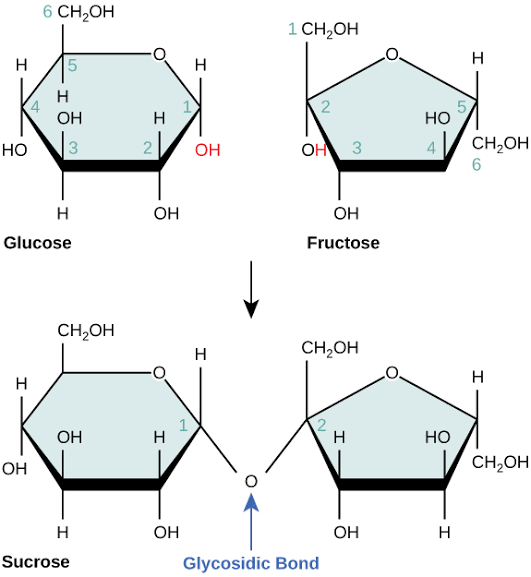
Carbohydrates are the most useful organic constituents present in the plants and a major source of chemical energy for living organisms such as starch and sugar. It also provides the support of the plant tissues in the form of cellulose. Glucose is also called dextrose and hexose and is the principal building blocks of all other carbohydrates. And laevulose is the name of the fructose and also the isomers of Glucose, its help to be metabolized into the Glucose by the liver.
The classification of the sugar molecules is two types in which simple carbohydrates have monosaccharides and disaccharide. And in the complex carbohydrates have fibres, glycogen, starches, polysaccharide and oligosaccharides are present in it. Made of carbon-hydrogen and oxygen in the form of ratio 1:2:1 and provides a primary fuel source for body cells.
Therefore the correct option is (E).
Note:
Aqueous acid helps to hydrolyze the sucrose molecule by the enzyme action occurring in the yeast and produces equal amounts of glucose and fructose. The table sugar is generated during the process of hydrolysis and also known by the name disaccharide. And in the sucrose molecule, the end product is storage carbohydrates and photosynthesis.
Complete answer:
Carbohydrates are the most useful organic constituents present in the plants and a major source of chemical energy for living organisms such as starch and sugar. It also provides the support of the plant tissues in the form of cellulose. Glucose is also called dextrose and hexose and is the principal building blocks of all other carbohydrates. And laevulose is the name of the fructose and also the isomers of Glucose, its help to be metabolized into the Glucose by the liver.
The classification of the sugar molecules is two types in which simple carbohydrates have monosaccharides and disaccharide. And in the complex carbohydrates have fibres, glycogen, starches, polysaccharide and oligosaccharides are present in it. Made of carbon-hydrogen and oxygen in the form of ratio 1:2:1 and provides a primary fuel source for body cells.
Therefore the correct option is (E).
Note:
Aqueous acid helps to hydrolyze the sucrose molecule by the enzyme action occurring in the yeast and produces equal amounts of glucose and fructose. The table sugar is generated during the process of hydrolysis and also known by the name disaccharide. And in the sucrose molecule, the end product is storage carbohydrates and photosynthesis.
Recently Updated Pages
Master Class 11 English: Engaging Questions & Answers for Success

Master Class 11 Social Science: Engaging Questions & Answers for Success
Master Class 11 Maths: Engaging Questions & Answers for Success
Master Class 11 Biology: Engaging Questions & Answers for Success
Master Class 11 Physics: Engaging Questions & Answers for Success
Master Class 11 Chemistry: Engaging Questions & Answers for Success
Trending doubts
One Metric ton is equal to kg A 10000 B 1000 C 100 class 11 physics CBSE
Difference Between Prokaryotic Cells and Eukaryotic Cells
1 ton equals to A 100 kg B 1000 kg C 10 kg D 10000 class 11 physics CBSE
Find the value of the expression given below sin 30circ class 11 maths CBSE
Two of the body parts which do not appear in MRI are class 11 biology CBSE
What are hard magnetic materials class 11 physics CBSE